Last updated: May 25, 2026

Furnace Repair · San Marcos, CA

Furnace repair in San Marcos, CA

San Marcos nights run colder than the coast, and that first cold week of winter is when furnaces quit. We run a full furnace diagnostic for a flat $89, fix most failures the same day, and quote every repair before we open a panel.

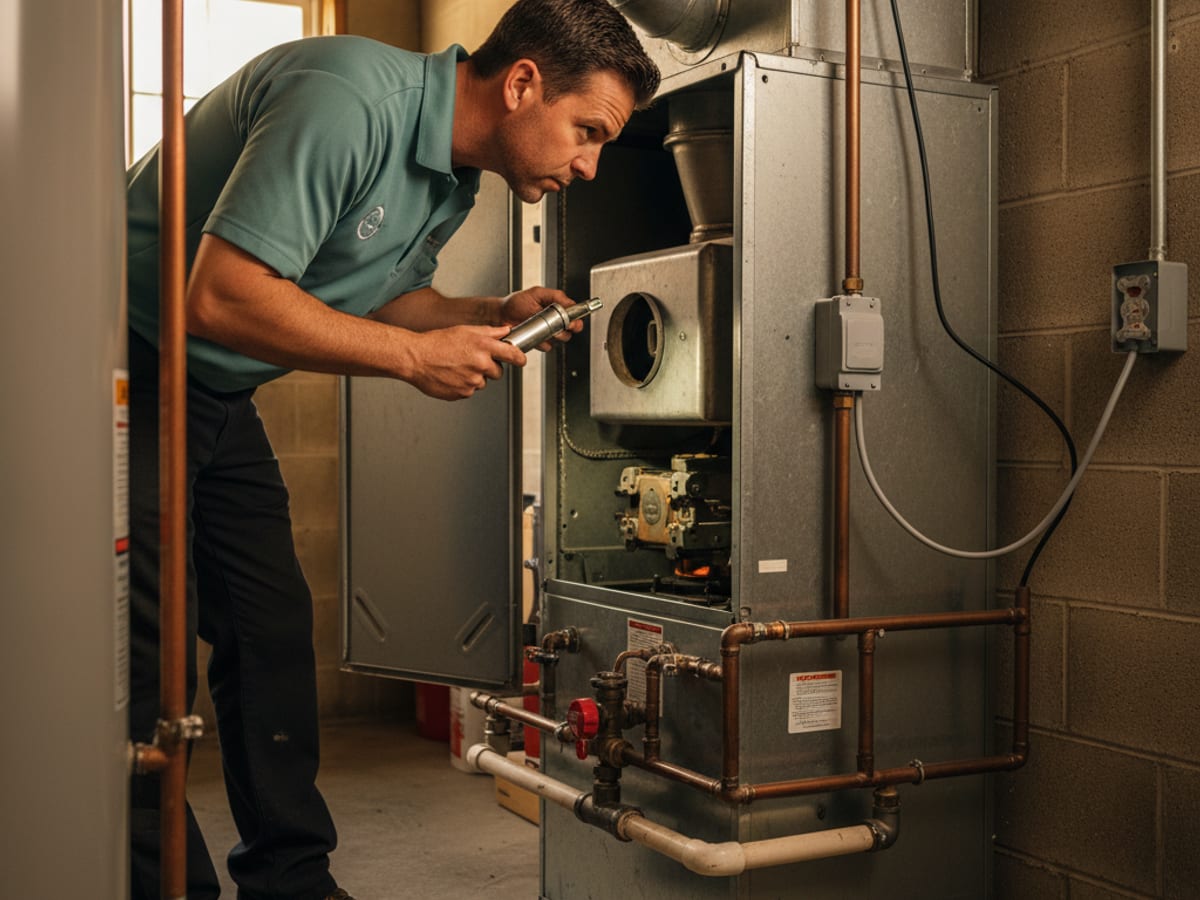
Climate Pros SD technician performing furnace repair in San Marcos, CA

Furnace repair in San Marcos costs $89 for the diagnostic, and most common repairs land between $150 and $700. The diagnostic fee is credited back to you when you move forward with the work. We carry the parts that fail most often on the truck, so the majority of San Marcos no-heat calls are fixed in one visit.

San Marcos sits inland in North County, away from the marine layer that keeps the coast mild. Winter nights here drop into the 30s and low 40s, colder than Carlsbad or Encinitas a few miles west. Homes here actually need their furnaces, sometimes for several hours each morning through December and January. That heavier use surfaces failures faster than a coastal home would see them.

We service every part of the city. That includes the newer hillside homes in San Elijo Hills, the established neighborhoods around Lake San Marcos, the larger lots in Twin Oaks Valley, and the tract homes in Santa Fe Hills, Discovery Hills, and Coronado Hills. Same flat pricing everywhere in San Marcos, with no mileage upcharge for the hillside addresses.

What we fix on a San Marcos furnace repair call

Most no-heat calls in San Marcos come down to a short list of failures. Our technicians arrive with these parts stocked, tested, and ready to install.

  • Failed hot surface igniters, the most common no-heat failure of the winter
  • Dirty or cracked flame sensors that shut the burner down within seconds
  • Gas valves that will not open or hold a steady flame
  • Blower motors and bearings worn from longer inland run times
  • Tripped or failed high-limit switches caused by airflow restriction
  • Cracked heat exchangers, inspected with a camera and combustion analyzer
  • Control board and thermostat faults that leave the system unresponsive
  • Pilot and ignition problems on older standing-pilot furnaces
  • No-heat and short-cycling diagnosis, traced to the actual root cause
  • Draft inducer motors and pressure switch faults
Furnace Repair detail work by a Climate Pros SD technician in San Marcos, CA

Furnace repair cost in San Marcos

Every repair is quoted at a flat rate before we start, so you approve the number first. These are the typical ranges San Marcos homeowners see in 2026. The exact figure depends on the part, the brand, and how the furnace is built.

Repair Typical range Notes
Diagnostic fee $89 flat Credited toward the repair when you proceed
Hot surface igniter replacement $150 - $350 The most common single-visit no-heat fix
Flame sensor service or replacement $100 - $250 Often a clean rather than a full swap
Thermostat replacement $150 - $400 Higher for smart thermostats with a C-wire run
Draft inducer motor $350 - $650 Common on furnaces past the 12-year mark
Gas valve replacement $300 - $700 Brand-dependent, some valves are slow to source
Blower motor replacement $400 - $900 ECM motors cost more than older PSC motors
Control board $300 - $700 Brand-dependent, some boards are hard to find
Pressure switch or limit switch $150 - $350 Often points to a deeper airflow problem
Heat exchanger replacement $1,000 - $2,500 At this cost, weigh repair against replacement

Pricing is the same across San Marcos and all of San Diego County. There is no travel surcharge for San Elijo Hills, Lake San Marcos, or Twin Oaks Valley. If a repair runs high enough that replacement makes more sense, we tell you that directly.

Should you repair or replace your furnace?

Repair makes sense when the furnace is under about 12 years old and the fix costs less than half the price of a new system. Replace when the unit is older, when the heat exchanger is cracked, or when repairs are stacking up. A few simple rules help you decide.

The 50% rule

If a repair costs more than 50% of the price of a new furnace, replacement is the better money. A $1,800 heat exchanger on a 16-year-old unit is a clear replace. A $250 igniter on an 8-year-old furnace is a clear repair.

The $5,000 rule

Multiply the age of the furnace by the repair cost. If the result is over $5,000, replace it. A 17-year-old furnace with a $400 repair scores 6,800, so replacement wins. The same $400 repair on a 6-year-old furnace scores 2,400, so you repair it.

A cracked heat exchanger ends the conversation

A cracked heat exchanger is a carbon monoxide risk, and we red-tag the furnace when we find one. On an older unit the exchanger alone often costs as much as a new furnace, so replacement is almost always the call. On a newer furnace still under warranty, the part may be covered, though labor is not.

The heat pump option

San Marcos winters are cool but not severe, so a modern heat pump handles the heating load here without trouble. One unit heats and cools, costs less to run, and qualifies for SDG&E and TECH Clean California rebates. We give you the furnace repair number, the furnace replacement number, and the heat pump number, then let you decide.

Local angle

Furnace repair built for San Marcos homes

Why San Marcos is harder on furnaces than the coast

San Marcos sits in the inland North County valley, shielded from the ocean breeze that keeps coastal cities mild. Winter nights here regularly drop into the 30s, and clear inland skies pull morning lows down further than people expect. A furnace in San Marcos runs more hours per winter than the same furnace in Carlsbad or Oceanside.

More run time means failures show up sooner. The igniter cycles more, the blower logs more hours, and the flame sensor sees more burn time. San Marcos homeowners are also more likely to notice a failing furnace early, because they actually rely on the heat in the morning. That is good. An early call usually means a smaller repair.

The housing stock we work on

San Marcos is a mix of eras, and the era tells us a lot before we arrive. The hillside homes in San Elijo Hills were built mostly between 2000 and 2015. Their original furnaces are now 10 to 25 years old and reaching first repair, so we see a lot of igniter, inducer, and control board failures there.

Around Lake San Marcos, the housing is older, much of it from the 1960s and 1970s. Many of those homes are on a second or third furnace, sometimes with undersized return air or aging ductwork that we check as part of the diagnostic. Twin Oaks Valley has larger lots and a wider spread of home ages, while the 1990s tract neighborhoods like Santa Fe Hills and Discovery Hills tend to have two-story floor plans where the upstairs and downstairs heat unevenly. That is usually an airflow or zoning issue rather than a dead furnace.

Permits and rebates in San Marcos

A straight furnace repair does not need a permit. Replacing the furnace does. San Marcos requires a mechanical permit through the city Building Division for a furnace changeout, and we pull that permit as part of the job so the work is inspected and on record.

If you do end up replacing, SDG&E and the TECH Clean California program offer rebates, and they are strongest for heat pump systems rather than gas furnaces. We walk you through what your home and system actually qualify for. We do not inflate a rebate number to push a sale.

How fast we reach you

We offer same-day furnace repair across San Marcos on most weekdays, and no-heat calls get priority. During a cold week the morning slots fill first, so a call before 10 a.m. gives you the best shot at same-day service. After-hours emergency calls are answered by an on-call technician, not a call center.

Elevation, fog drainage, and the coldest mornings

San Marcos has an unusual cold pattern that surprises people who moved here from the coast. The valley floor around Lake San Marcos and Richland Road sits in a basin, and on clear winter nights cold air drains off the surrounding hills and pools at the bottom. Those mornings can read 10 degrees colder at the valley floor than at the same hour in San Elijo Hills a few miles uphill. We see furnace failures cluster around those cold-drainage mornings every January.

The implication for repair is direct. A furnace in a valley-floor neighborhood is logging more sub-50-degree morning starts than the same furnace on the hillside, and that cold start is when the igniter and flame sensor work hardest. If you live near the lake or downtown and your furnace has needed two repairs in two winters, the cause is usually the run hours and the cold-start cycles, not a defective unit.

CSUSM-area rentals and the cold-snap rush

The rental stock around Cal State San Marcos is the part of the city that most often hits no-heat status in a winter cold snap. The furnaces in those homes are typically 15 to 25 years old, often the original equipment that came with the build, and they get the lightest maintenance of any segment in town. When inland temps drop into the 30s, that combination produces a wave of igniter and flame sensor failures.

We work directly with the tenant on the diagnostic and route the written quote and findings to the landlord or property manager. The diagnostic fee is the same flat $89 whether the home is owner-occupied or a rental, and our quote does not get inflated for property-manager work. The goal is to keep the timeline tight so the home is not sitting at 50 degrees while approvals bounce around.

When a furnace repair is also a CO safety issue

Most furnace repairs are mechanical, not safety, problems. But two specific findings change the conversation. A cracked heat exchanger leaks combustion gases, including carbon monoxide, into the air your blower distributes through the home. A failed or misadjusted gas valve can also produce incomplete combustion that elevates CO. In either case we red-tag the furnace, shut off the gas supply to it, and walk you through the options before anything else.

If you do not yet have a working CO detector on every level of the home, install one before the next heating season. The detectors are inexpensive, they last about seven years, and they are the only reliable way to catch a slow CO leak before it makes someone sick. We will tell you on the diagnostic if your existing detectors are past their useful life.

San Marcos furnace repair questions

How much does furnace repair cost in San Marcos?

Furnace repair in San Marcos starts with an $89 flat diagnostic, and most common repairs run $150 to $700. An igniter or flame sensor sits at the low end. Bigger jobs like a blower motor, gas valve, or heat exchanger run higher, and at that point we help you weigh repair against replacement. Every repair is quoted before we start.

How fast can you get to San Marcos for furnace repair?

Same-day service on most weekdays, and no-heat calls get priority. Morning slots book fastest during a cold week, so call before 10 a.m. for the best same-day availability. After-hours emergency calls are answered by an on-call technician, not a dispatcher.

Why does my furnace fail every winter in San Marcos?

San Marcos nights run colder than the coast, so furnaces here work real hours through December and January. That run time wears the igniter, blower, and flame sensor faster than a coastal home would see. A fall tune-up before the cold sets in catches most failures before they leave you without heat.

Is a furnace not turning on an emergency?

A cold house on a San Marcos winter morning is uncomfortable but usually not life-threatening, so it is not always a true emergency. A gas smell or a carbon monoxide alarm is. If your CO detector sounds, leave the home, call 911, then call us. For a cold home with no safety issue, same-day or next-morning service is the normal path.

Should I repair or replace my furnace?

Repair is the better money when the furnace is under about 12 years old and the fix costs less than half the price of a new system. Replacement wins when the unit is older, the heat exchanger is cracked, or repairs keep stacking up. We give you both numbers and an honest read so you can decide.

What is the $5,000 rule for furnaces?

Multiply the age of your furnace by the repair cost. If the result is over $5,000, replace the system. A 17-year-old furnace with a $400 repair scores 6,800, which points to replacement. A 6-year-old furnace with the same repair scores 2,400, which points to repair.

Why does my furnace start and then shut off after a minute?

That short-cycling pattern in San Marcos is usually a dirty flame sensor, a clogged filter choking airflow, or a tripped high-limit switch. The furnace lights, fails a safety check, and shuts down to protect itself. Our diagnostic finds the actual cause rather than just resetting the system.

My furnace is blowing cold air. What is wrong?

If the blower runs but the air stays cold, the burners are not staying lit. In San Marcos that usually means a failed igniter, a dirty flame sensor, or a gas valve that will not open. Most are same-day repairs with parts we carry on the truck.

Why is my upstairs cold while the downstairs is warm?

In the two-story tract homes around Santa Fe Hills and Discovery Hills this is common, and it is usually not a broken furnace. Heat rises, returns are often undersized, and a single-zone system struggles to balance both floors. The fix is an airflow or zoning correction, which we assess as part of the diagnostic.

Do you need a permit for furnace work in San Marcos?

A repair does not need a permit. Replacing the furnace does. San Marcos requires a mechanical permit through the city Building Division for a changeout, and we pull that permit as part of the job so the work is inspected and on record.

Do you charge extra to come to San Elijo Hills or Lake San Marcos?

No. Pricing is flat across all of San Marcos and San Diego County. There is no mileage or travel surcharge for the hillside neighborhoods, the lake area, or Twin Oaks Valley. The $89 diagnostic and every repair quote are the same wherever you are in the city.

What furnace brands do you repair?

We repair all major brands, including Carrier, Trane, Lennox, Goodman, Rheem, American Standard, York, Bryant, Payne, and Amana. Our diagnostic process and stocked parts cover modern high-efficiency furnaces and the older standing-pilot units still running in many established San Marcos homes.

Why is my San Marcos morning colder than the forecast says?

You probably live in a cold-drainage spot. Clear winter nights pull cold air off the surrounding hills and pool it on the valley floor around Lake San Marcos, downtown, and Richland Road. Those neighborhoods can read 10 degrees colder at sunrise than San Elijo Hills uphill. Furnaces in those areas get more cold-start cycles per winter, which is why we see repairs cluster there in January.

How can I tell if my heat exchanger is cracked?

You usually cannot see it without removing the burner assembly, but the symptoms are a flame that shifts or flickers when the blower kicks on, a metallic or chemical odor when the furnace runs, soot around the burner area, and a CO detector that sounds during heating cycles. We inspect the heat exchanger with a borescope camera and verify combustion safety with a calibrated analyzer as part of any suspected-crack diagnostic.

I rent near CSUSM and the heat is broken. Who pays for repair?

In a rental, the landlord is responsible for keeping the heating system in working order under California Civil Code. We run the $89 diagnostic with you on site, send the written findings and quote directly to the property owner or manager, and schedule the repair once they approve. The diagnostic fee is the same whether you call or the landlord does.

My furnace runs but the house is not warming up. What is wrong?

If the burners are firing and the blower is running but the house stays cold, the most common causes in San Marcos are an undersized return air system, a major duct leak in the attic, or a blower wheel coated in dust and unable to move enough air. We measure static pressure and temperature rise on the diagnostic to find the real problem, rather than just changing parts.

How old does a carbon monoxide detector have to be before I replace it?

Most CO detectors are rated for seven years of life from the manufacture date, not from when you installed them. Look at the back of the unit for a date. If it is older than seven years, the sensor is past reliable, even if it still chirps when tested. Replace every CO detector in the home before each heating season starts.

Can I keep a 25-year-old furnace running indefinitely with repairs?

You can keep many of them running, but the math usually says you should not. A furnace at 25 years has an aging heat exchanger, a blower motor that has logged tens of thousands of hours, and an efficiency rating roughly 25 percent lower than current equipment. The combination of repair frequency, gas cost, and CO risk usually tips toward replacement. We will run both numbers honestly and let you decide.

Service area

Where we serve San Marcos

We cover San Marcos and the surrounding North County Inland communities, with same-day service on most furnace repair calls.

Serving San Marcos

Need furnace repair in San Marcos?

Call for a free quote. Same-day service on most repairs, next-day on most installs.

Call now · (442) 777-6440 Same-day · a real tech answers Quote