Lemon Grove sits just far enough inland that summer temperatures climb into the 90s and push to 100 in peak heat. Most of the housing was built decades ago. Many of those HVAC systems are 15 years old or more and in the zone where a tune-up either confirms they have years left or tells you what the summer holds.
Climate Pros SD matches Lemon Grove homeowners with a licensed HVAC company. That company quotes in writing whether they offer a single visit or a maintenance plan, what they inspect, and any fees before work starts. Typical industry tune-ups look at capacitors, coils, and refrigerant charge. Ask the matched company which of those they include. Appointment length is set by that company.
Lemon Grove is a compact, densely built East County community with a housing stock concentrated. HVAC systems in this age range are often original retrofits or early replacements that are now approaching or well into its service life, which is the point where annual maintenance either extends useful life or surfaces the combination of findings that make replacement the smarter call. Temperatures here reach 86 to 89 degrees in summer, enough to stress older equipment significantly.
We match homeowners with pros across all of Lemon Grove. If the inspection turns up something beyond routine maintenance, it gets quoted separately before any additional work.
What to ask a matched company to inspect in Lemon Grove
Ask the matched company what they inspect. Typical industry tune-ups look at capacitors, coils, and refrigerant charge. Get that list in writing.
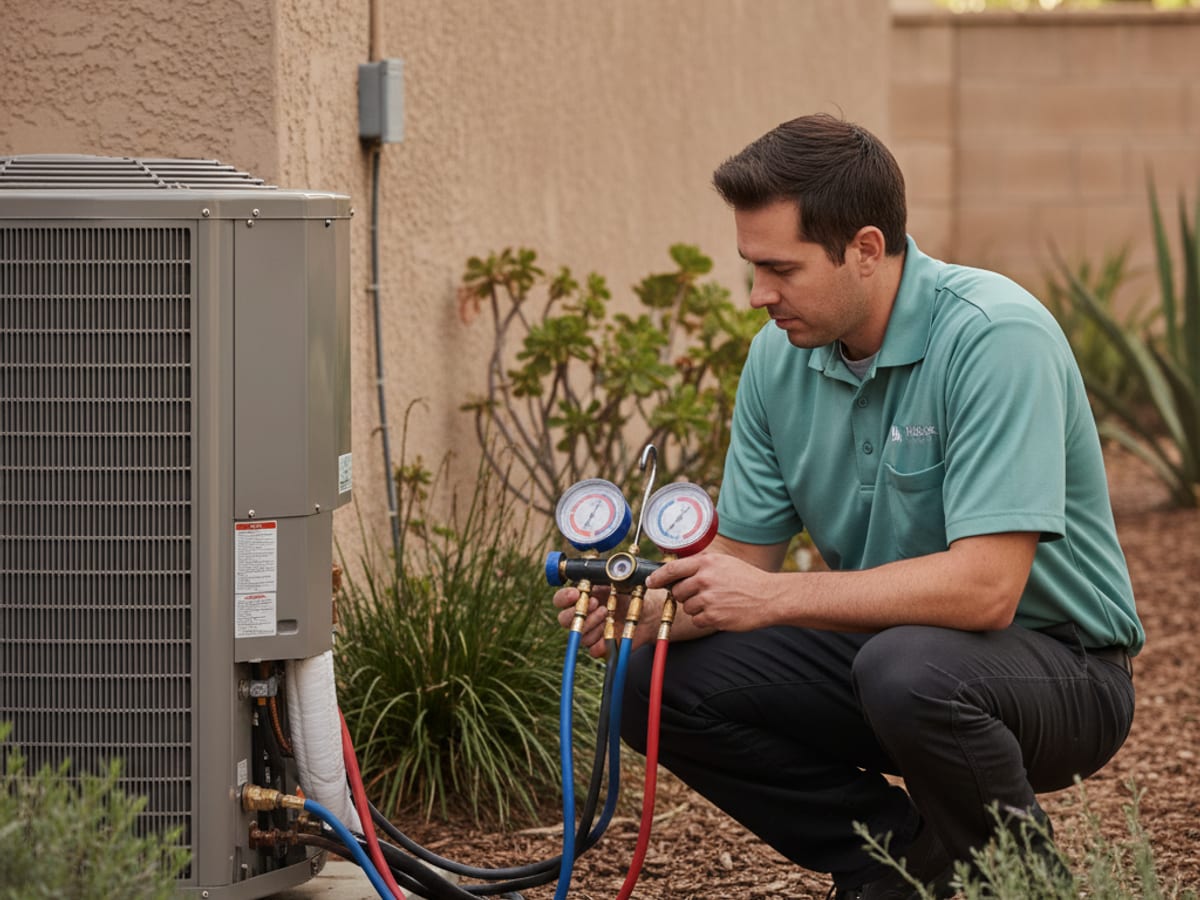
Refrigerant level check with gauges: slow leaks found here, not mid-summer
Capacitor microfarad test: degraded capacitors are the most common failure on older equipment
Compressor and fan motor amp draw: high amps on aging motors signal approaching failure
Condenser coil cleaning: removes accumulated East County dust and debris
Evaporator coil inspection for buildup or early freeze indicators
Electrical connection inspection for heat damage and corrosion on older wiring
Static pressure check to catch duct leaks in original or retrofit ductwork
Condensate drain flush and float switch test
Contactor inspection: original contactors on 15-plus-year systems often show pitting
Thermostat calibration and cycle timing check
Temperature split measured across the air handler
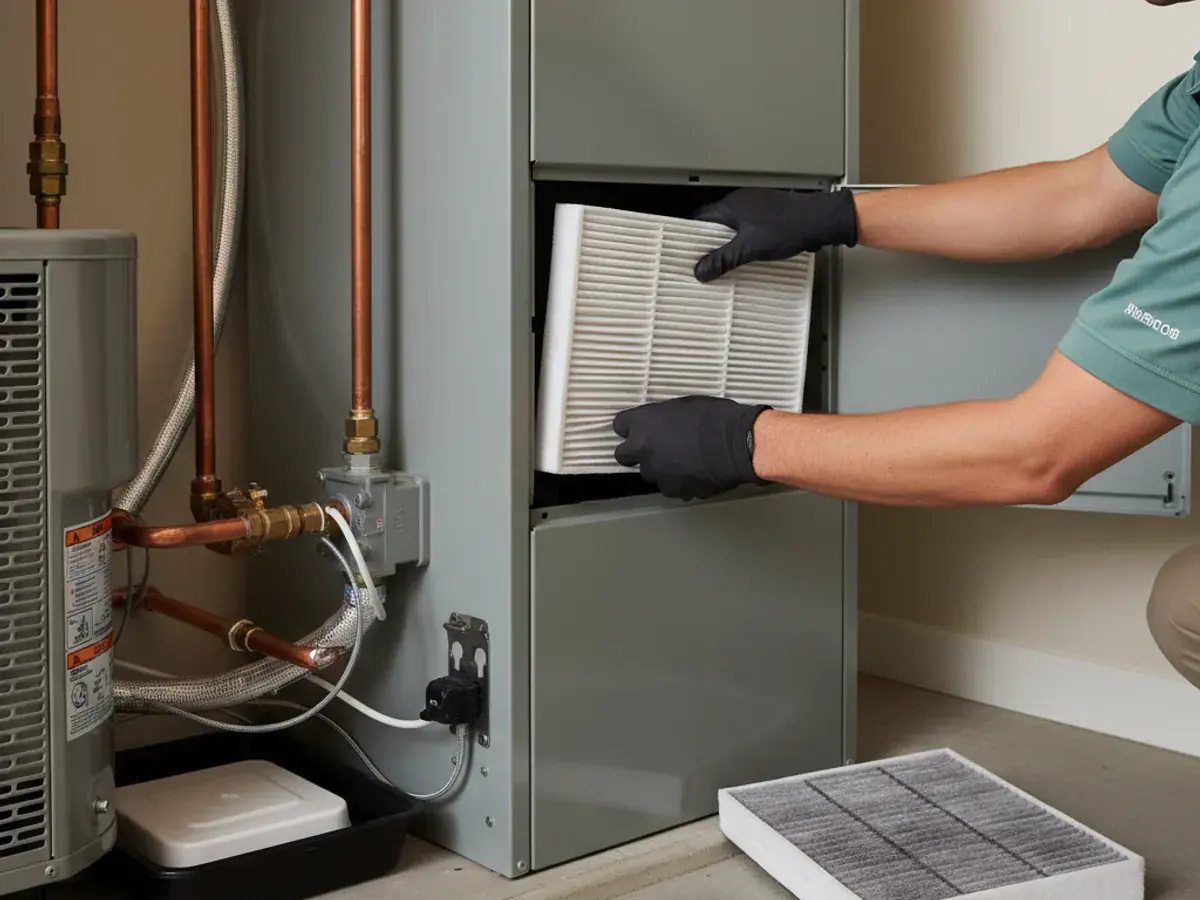
Filter condition check and replacement if needed (filter priced separately)
Blower wheel inspection for dirt buildup that reduces airflow
Heat exchanger visual inspection on furnace units
Full written summary with any findings and recommended action items
HVAC maintenance cost in Lemon Grove
The company you are matched with quotes the visit in writing before starting. Ask whether they offer a single appointment or a plan, what they inspect, and which fees are extra.
Repair
Typical range
Notes
Single tune-up visit
Quoted by the matched company
Ask what they inspect and whether coil cleaning is included
Annual maintenance plan, if the company offers one
Quoted by the matched company
Ask how many visits they include and what each visit covers
Filter replacement
Priced by filter type and MERV rating
Depends on filter type and MERV rating
Refrigerant top-off (R-410A)
Priced by how much charge is needed
If low charge is found during inspection; quoted separately before adding
Refrigerant top-off (R-22)
Priced by supply availability and charge needed
R-22 supply is limited; persistent leaks on older systems point toward replacement
Capacitor replacement
Priced by part and labor
If the microfarad test fails during the tune-up
Contactor replacement
Priced by part and labor
Pitted or burned contactors on older systems found during inspection
Condensate drain line clear (severe blockage)
Priced by severity of the blockage
If the drain is fully blocked and requires more than a basic flush
Pricing is set by the company you are matched with, not by neighborhood. If the inspection turns up something that warrants a repair, that gets quoted separately and you decide whether to proceed.
What maintenance prevents in Lemon Grove
A yearly tune-up in Lemon Grove is both a maintenance visit and a diagnostic checkpoint. On older equipment, the findings from one tune-up to the next tell you whether the system is holding steady or entering a decline that points toward replacement. The goal is always to give you that information before the failure, not after.
Capacitor and contactor failure on aging equipment
The most common failure on HVAC systems in the 12 to 20 year age range is electrical component degradation: capacitors drift below rated microfarads, contactors develop pitting on the contact surfaces, and the combination produces hard starts, slow starts, or no-starts on hot days. Both components cost relatively little to replace during a maintenance visit and significantly more when the failure produces an emergency service call.
Lemon Grove systems in this age range often have original capacitors and contactors. Ask whether both get tested on the visit. A capacitor at 65 percent of rated microfarads is not a question of if it will fail: only when. Replacing it during the tune-up as a scheduled part-and-labor cost is the obvious call.
Refrigerant charge on older systems
Pre-2010 systems running R-22 refrigerant are common in Lemon Grove. R-22 is no longer manufactured in the US and supply is limited and expensive. A system that needs refrigerant top-offs more than once every two to three years has a slow leak. That leak does not get better on its own, and on an R-22 system the economics of repeated top-offs eventually point toward replacement.
Ask whether they check refrigerant levels and document the charge. If a system needed a top-off on the previous visit and needs another one now, that gets flagged directly. That is a leak conversation, not just a maintenance finding.
Ductwork and airflow in older homes
Many Lemon Grove homes had ductwork added or retrofitted when central AC was installed. Original duct runs in these homes often took the path of least resistance rather than the path of optimal airflow: runs that are too long, too many bends, or too small for the equipment that was eventually installed. Over decades, duct connections loosen, insulation degrades, and flex duct in attic spaces sags and kinks.
Static pressure measurement during the tune-up is the way duct problems get found without a full duct inspection. If the static pressure is high for the system size, something in the duct system is creating restriction. Findings get documented and whether further investigation is warranted gets discussed.
The 15-year decision zone
A system that hits 15 years in a San Diego East County climate has run significant hours. Some of those systems are well-maintained and have years of life remaining. Others are on their last summer. The inspection tells the difference. A compressor within amp spec, clean electrical connections, a refrigerant charge that has held steady, and a capacitor still testing within rated range: that system probably has a few more good years. Multiple simultaneous findings on those same points mean you are likely looking at the last season or two.
There's no push toward replacement decisions. The inspection findings get delivered along with an honest assessment of what they mean. Some Lemon Grove homeowners want to run their 18-year-old system until it fails. Others want to replace before the failure forces the issue. Both are valid. The tune-up gives you the information to choose.
Local angle
HVAC maintenance built for Lemon Grove homes
Lemon Grove's climate and HVAC load
Lemon Grove sits about 10 miles from the coast and roughly 500 feet above sea level. The marine layer reaches here on some days but not reliably in summer, and when the inland heat builds, Lemon Grove temperatures track closer to El Cajon than to Chula Vista. Summer afternoons run much hotter than the coast. The cooling season runs from late April through October.
That heat load is meaningful for older equipment. A system that runs fine in mild weather may struggle when temperatures push above 95 and stay there. The pre-summer tune-up is specifically designed to find the components that will fail under load: capacitors, refrigerant charge levels, and dirty coils that reduce heat rejection efficiency.
older housing stock
Lemon Grove developed decades ago. The housing stock from this era shares common characteristics: slab foundations or raised foundation with crawl spaces, original stucco construction, and HVAC systems that were installed or upgraded between the 1980s and 2000s. Systems installed are now 25 to 40 years old. Systems installed are in the 20 to 25 year range.
Both age ranges benefit from the same maintenance approach: thorough electrical inspection for heat damage and corrosion, careful capacitor and contactor testing, and honest documentation of what the compressor is telling us. A compressor that is running at or above its rated amp draw is not a unit that will fail tomorrow: it is a unit that is telling you something, and the maintenance visit is when that gets listened to.
Value-driven market and repair vs. replace decisions
Lemon Grove is a value-oriented community. Homeowners here are generally careful with money and expect a straight answer about whether a repair is worth making. That expectation gets matched. If the inspection shows a failing capacitor and the rest of the system looks sound, the answer is straightforward: replace the capacitor, schedule the fall visit, and run the system.
If the inspection shows a failing capacitor, a compressor pulling high amps, low refrigerant charge with no previous repair history, and an R-22 system, the answer is also straightforward: this is the repair-versus-replace conversation, and sinking significant repair money into a system that is 18 years old and on R-22 is probably not the right call. The findings and what they mean get laid out clearly.
Duct conditions in older Lemon Grove homes
Ductwork in older homes was often designed for the original window units or early central systems and then modified as equipment was upgraded over the decades. The result is sometimes a patchwork of different duct materials: original sheet metal sections connected to flex duct added during a later renovation, with connections made by whoever did the upgrade work at the time.
Duct condition observations get noted in the inspection report when obvious issues show up during the standard static pressure check and air handler inspection. Full duct inspection is a separate service, but the tune-up surfaces the cases where it is warranted.
Pre-summer timing for Lemon Grove
March or April is the right window for the pre-summer tune-up. By May the schedule starts filling with calls from homeowners who noticed their system running long or not cooling properly when the temperature hit 85. By June, slots are hard to find on short notice. Getting ahead of the heat in March or April means you have time to make a repair decision without the deadline pressure of an already-hot house.
What else is hvac maintenance in Lemon Grove called?
Homeowners search for this a few different ways. In Lemon Grove it also goes by HVAC tune-up in Lemon Grove , seasonal HVAC tune-up in Lemon Grove , preventive HVAC maintenance in Lemon Grove , HVAC inspection in Lemon Grove , furnace maintenance in Lemon Grove , and AC maintenance in Lemon Grove . They all reach the same licensed local pros, and the operator who answers will
sort out which one your job actually is.
Lemon Grove maintenance questions
How much does HVAC maintenance cost in Lemon Grove?
The company you are matched with quotes the visit in writing. Ask whether they offer a single appointment or a plan, what they inspect, and which fees are extra. Climate Pros SD does not sell a branded maintenance plan or inspection protocol. Filter replacement is priced separately by filter type. Capacitor and contactor replacement, if needed, are quoted separately once found during the inspection.
How often should I service my HVAC in Lemon Grove?
Once a year at minimum, twice for older systems. Lemon Grove summers hit 86 to 89 degrees, which is enough heat to stress aging equipment. Systems that are 15 years or older benefit from the twice-yearly plan: a pre-summer visit to catch electrical component failures before the heat, and a fall visit to check the heating side before winter nights arrive.
What should I ask the matched company to inspect?
Refrigerant level check with gauges, capacitor microfarad test, compressor and motor amp draw, condenser coil cleaning, evaporator coil inspection, electrical connection check for heat damage, static pressure measurement, condensate drain flush and float switch test, contactor inspection, thermostat calibration and cycle timing, temperature split measurement, filter condition check, and blower wheel inspection. Every visit ends with a written summary of everything found.
My HVAC system is 15 years old. Is maintenance still worth it?
Yes, and it is the most important time to do it. At 15 years, the inspection either tells you the system has several more years of life or surfaces the combination of findings that means replacement is coming. Either way, knowing that before a summer failure is worth the cost of the inspection. A modest scheduled inspection beats an expensive emergency replacement in August.
What is the replacement decision point for an older Lemon Grove system?
There is no hard rule by age. The inspection findings drive the decision. A system with a sound compressor, clean connections, and a stable refrigerant charge may have years of life regardless of age. A system with a compressor pulling high amps, multiple failing electrical components, and an R-22 refrigerant charge that keeps needing top-offs is a replacement conversation. The honest read from what the inspection shows drives the recommendation.
What is R-22 and why does it matter for my older system?
R-22 is the refrigerant used in most systems built before 2010. It has been phased out of production in the US under EPA regulations. Supply is limited and expensive. If your R-22 system has a slow leak that requires repeated top-offs, the cost of maintaining it adds up quickly and the underlying leak does not fix itself. That is the conversation that often leads to a replacement decision.
What is a contactor and when does it need replacement?
A contactor is an electrical switch that connects power to the compressor and condenser fan motor when the thermostat calls for cooling. Over years of operation, the contact surfaces develop pitting from the electrical arc each time the unit cycles on and off. Pitted contactors cause hard starts, premature compressor wear, and eventually a unit that won't run. Ask whether they inspect contactors. Replacement is quoted separately if needed.
When should I schedule HVAC maintenance in Lemon Grove?
March or April for the pre-summer visit. Contractor calendars tighten as temperatures start climbing. October is a common window if you book a second visit.
Do you work on older HVAC systems?
Yes. Older systems are a meaningful part of the Lemon Grove work the companies in the network handle. Common capacitors and contactors for older equipment are typically stocked, so electrical repairs can often happen during the same visit if a failing component is found during the tune-up.
How long does a tune-up take in Lemon Grove?
Most appointments run 60 to 90 minutes. Older systems that need more thorough electrical inspection or have multiple findings to document run closer to 90 minutes.
Can maintenance extend the life of my 15-year-old system?
Yes. Annual coil cleaning, capacitor checks, and refrigerant monitoring reduce wear on the compressor, which is the most expensive part of the system. A well-maintained system often runs well past 20 years. A neglected system in Lemon Grove's summer heat rarely makes it past 12 to 15 years. The math favors maintenance.