On a Fallbrook property, the shape of the lot drives an air conditioning install more than the equipment brand does. Line-set length, where the condenser can sit, what the panel carries, and how the ducts run through a hot attic decide most of what the job costs and how well it performs.
That’s a different conversation than the one a homeowner in a tract subdivision has. Out past Reche Road, the condenser may need to sit much farther from the air handler, and the full line-set run matters.
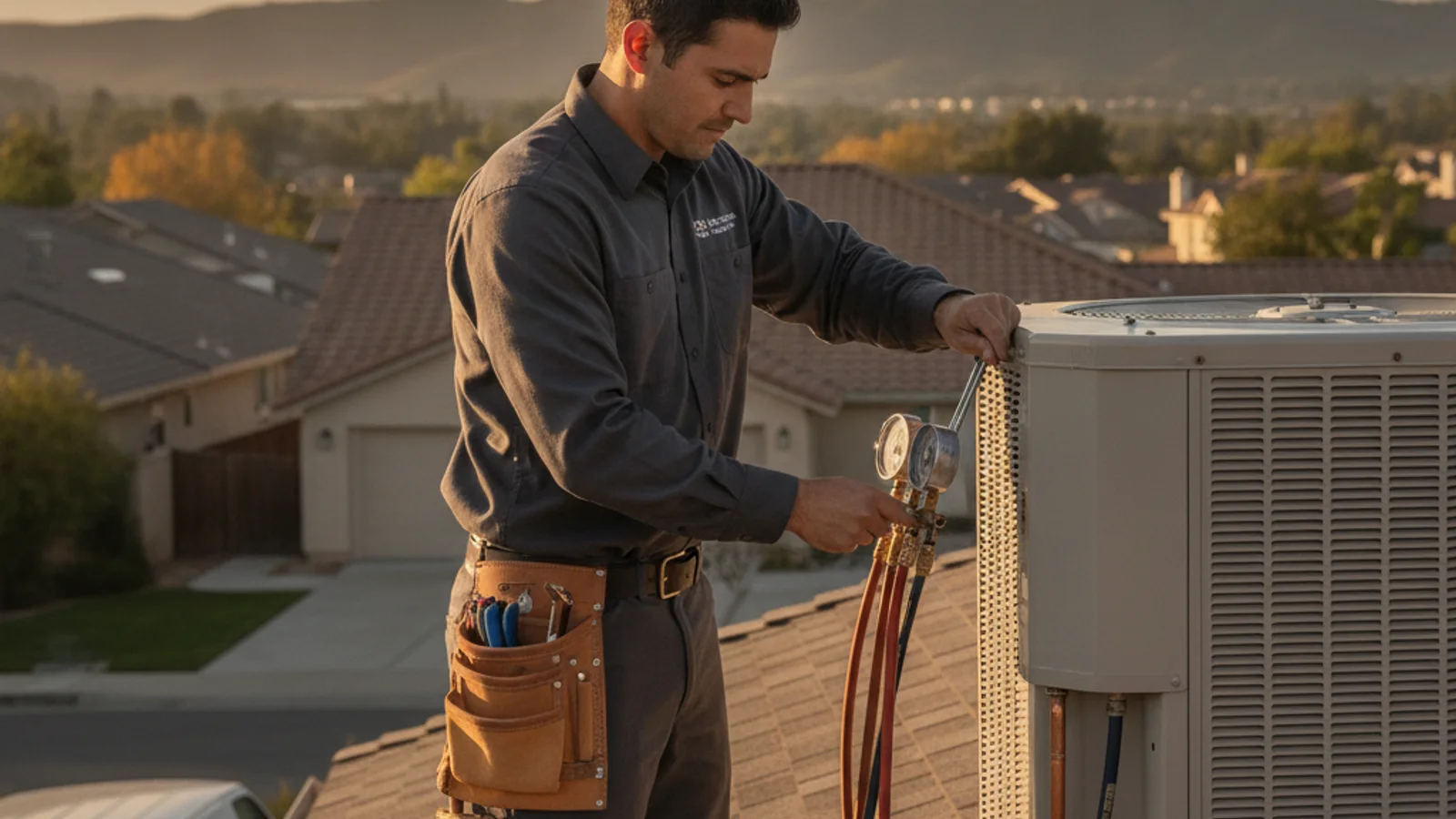
What to measure before you compare Fallbrook quotes
Ask every bidder for a measured line-set length, a load calculation that uses inland North County design temperatures, and a pad location that keeps grove debris off the coil. Fallbrook afternoons run hotter than Carlsbad’s. A system sized off a coastal assumption runs out of capacity on the days you bought it for.
Checklist
- Write the condenser-to-air-handler path in feet, including vertical rise.
- Note well pumps, irrigation boosters, shops, or a second dwelling on the same panel.
- Confirm natural gas versus propane at the meter or tank.
- Photograph attic duct insulation and any crushed or disconnected runs.
- Ask whether Title 24 field verification is in the quote.
Related: Fallbrook HVAC page and AC installation.
Line-set length is the first thing to measure
The line set is the pair of insulated copper lines carrying refrigerant between the outdoor condenser and the indoor coil. On a compact lot nobody thinks about it. On a Fallbrook property where the only shaded, level, serviceable spot for the condenser is around the corner and down a slope, the run gets long enough to change how the system is engineered.
Long runs need line diameters sized to the actual measured distance, not the default in the box. They may need extra refrigerant charge, and on a vertical rise they need oil return handled correctly. Get any of that wrong and the system still turns on, which is the problem. It can keep running while the installation problem stays hidden.
Insulation on the line set is the second half of this. Exposed insulation sitting in full inland sun degrades, and once it’s crumbling you’re cooling the outdoors. Ask what insulation is specified and whether the exposed sections get UV-rated protection.
So before you compare quotes, ask each contractor a plain question: did you measure the line-set run, and what diameter did you spec for it? A contractor who quoted from the driveway did not measure it.
Older ranch homes and the attic duct problem
A lot of Fallbrook’s housing is single-story ranch construction, and in that layout the ducts almost always run through a vented attic. In summer that attic gets far hotter than the rooms below it. Cold air travels through it on the way to your bedrooms and picks up heat the whole trip.
Leaky or poorly insulated attic ducts are why a correctly sized new system can still leave the far end of a spread-out floor plan warm. The fix belongs in the install, not in a service call next August. That means sealing accessible joints, confirming the duct insulation value, and checking that returns are large enough to feed the new blower.
Spread-out ranch floor plans also strain a single thermostat. One sensor near the hallway can’t represent a west-facing bedroom at the end of the house at four in the afternoon. Zoning or a ductless unit for the problem room is often cheaper than oversizing the whole system to force the far end cold, and oversizing brings its own trouble: short cycling, poor humidity control, and more wear on the compressor.
If the duct system is the real limitation, an honest contractor will tell you so and quote the duct work separately so you can see what you’re paying for. Our HVAC maintenance overview covers what regular service can and can’t do for an aging duct run.
Power, propane, and what else the property runs
Rural Fallbrook properties often carry electrical loads a suburban lot doesn’t: a well pump, a booster pump for grove irrigation, a shop, sometimes a second dwelling. All of that sits on the same service. Adding a condenser circuit to that mix needs a real load calculation, not a glance at the panel door.
Older ranch homes may also be on a panel that predates most of those additions. That doesn’t mean an automatic service upgrade, but it does mean the electrical scope belongs in the quote before you sign, rather than surfacing on install morning.
Gas is worth checking too. Not every Fallbrook property is on natural gas; some out toward De Luz and the outer valleys run propane instead. That doesn’t affect a cooling-only install directly, but it changes the arithmetic if you’re weighing a heat pump that would cover heating as well. Confirm what’s actually feeding your equipment rather than assuming.
Power reliability is its own planning question in the backcountry. Whether your address falls in a high fire-risk area subject to planned outages is something to look up on SDG&E’s own maps for your parcel, not something to take from a general article. If it does, that shapes whether a battery or generator interlock belongs in the same project.
Clearance, defensible space, and where the pad goes
A condenser needs unobstructed airflow. Manufacturers publish minimum clearances around and above the unit, and those numbers are in the install manual for your specific model. On a grove property the pressure runs the other way: people tuck the unit behind shrubs or under a low overhang to hide it, and then wonder why it struggles in August.
Vegetation management around the pad matters for two separate reasons here. Airflow is one. Wildfire exposure is the other, and Fallbrook homeowners are already used to clearing brush back from structures. Treat the condenser as part of that zone. Keep leaf litter, grove trimmings, and dry growth away from it, and site the pad where seasonal debris doesn’t drift into the coil.
Coil fouling is the quiet cost of a grove lot. Dust off a dirt drive, pollen in spring, and organic debris from trees all pack into condenser fins and force the system to work harder for the same cooling. That’s an argument for accessible placement, because a unit that’s hard to reach is a unit that doesn’t get cleaned.
Noise placement is worth a minute too. Bedroom windows, an outdoor dining area, and a neighbor’s property line all deserve a look before the pad is poured. Moving a pad costs almost nothing on paper day and real money afterward.
Sizing, ratings, and permits
Sizing should come from a load calculation on your actual house: square footage, orientation, insulation, window area, and the design temperature for inland North County rather than a coastal average. Fallbrook afternoons are not Carlsbad afternoons, and a system sized off a coastal assumption will run out of capacity on the days you bought it for. Our Escondido AC installation guide walks through why inland sizing runs differently.
For efficiency comparison, ENERGY STAR publishes certification levels you can hold quotes against, and the US Department of Energy’s heating and cooling pages explain what the SEER2 and EER2 ratings on a spec sheet actually measure. New equipment also uses lower-GWP refrigerant under EPA rules that took effect January 1, 2025, so a new system’s refrigerant won’t match an older R-410A unit.
Fallbrook is unincorporated, so there’s no city building department to call. Confirm the permit path and current requirements with the County of San Diego before work begins, and expect the licensed contractor to pull the permit as part of the job. California’s Title 24 energy code also requires field verification by a certified rater when a system is replaced, and that line should appear on your quote rather than arriving as a surprise.
Check the contractor’s license number yourself on the CSLB license lookup. HVAC falls under the C-20 classification. Every HVAC pro in the network is licensed and insured, and the lookup takes a minute.
For more on service coverage out here, see the Fallbrook HVAC page, the AC installation service page, or our broader Fallbrook HVAC services guide.
When to call us
A new system on a rural lot is a design job before it’s an installation job, and the design happens during a walk of the property. If you’re collecting quotes and want one that starts with a measured line-set run and a load calculation, that’s the visit to book. Call us at (442) 777-6440 and we will match you with a licensed local pro.