Living in Encinitas means enjoying some of the best coastline in the world, but that beautiful, salty air is quietly waging war on your home’s air conditioner. The constant marine layer carries abrasive salt particles that settle on your outdoor condenser unit, leading to premature rust, corrosion, and system failure. This isn’t just a minor issue; it’s the number one driver of AC repair calls in Encinitas.
Climate Pros SD matches you with licensed HVAC companies. We do not publish an Encinitas parts menu.
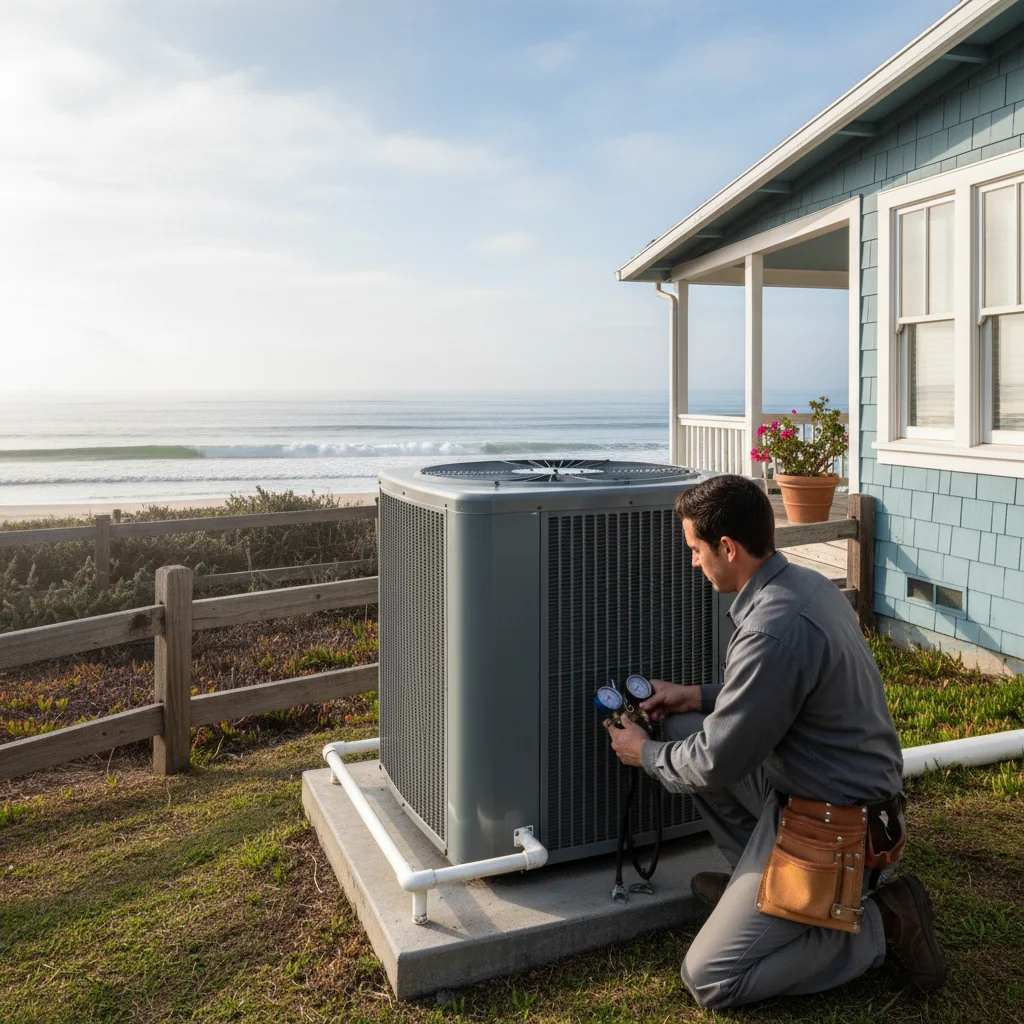
Why Encinitas homes face accelerated condenser wear
Your AC’s outdoor unit, the condenser, works by pulling heat from your home and releasing it outside. To do this efficiently, it uses a large coil made of thin aluminum fins bonded to copper tubing. This design maximizes surface area for heat exchange, but it also creates a perfect trap for airborne salt.
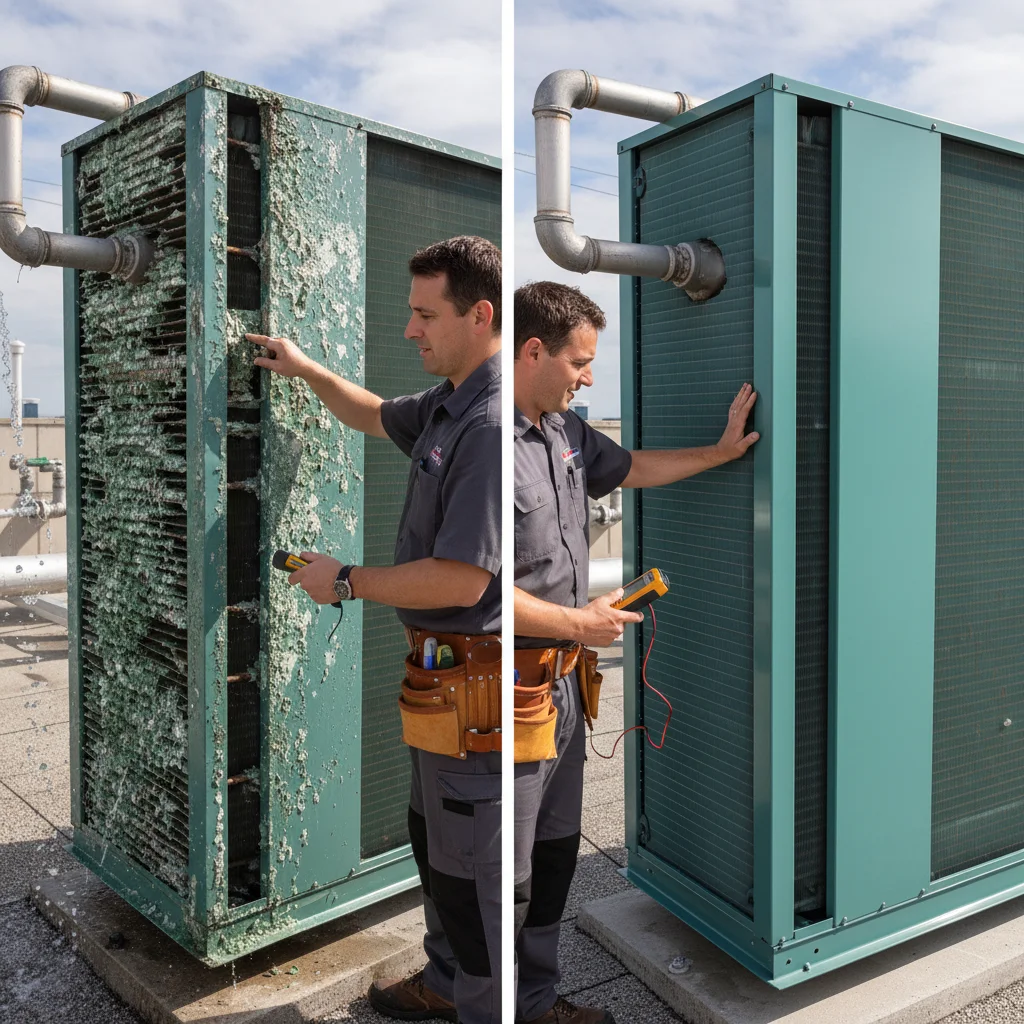
When the salty, moist air from the Pacific rolls in, it coats these delicate fins. The salt then reacts with the moisture and the dissimilar metals (aluminum and copper), creating a galvanic reaction. This electrochemical process eats away at the metal, causing what’s known as formicary corrosion on the copper and turning the aluminum fins into a white, chalky powder.
The result? The fins crumble, the copper tubing develops microscopic pinhole leaks, and your expensive refrigerant escapes. Your system loses its ability to cool, and the compressor has to work much harder, leading to more significant and costly damage. We see units in west-of-5 neighborhoods fail in as little as five to seven years, while the same model might last 15 years just a few miles inland.
Common failures we see in 92024
When an Encinitas homeowner calls for service, the issue is almost always tied to this coastal effect. While every home is different, a few specific problems show up on service orders again and again. These are the most frequent types of AC repair in the 92024 zip code.
Refrigerant leaks from corroded coils
This is a common and serious failure. The pinhole leaks caused by corrosion are often too small to see with the naked eye. The first sign for a homeowner is usually an AC that’s blowing cool, but not cold, air. Eventually, it stops cooling altogether. Finding and fixing these leaks can be time-consuming, and if the coil is too damaged, it requires a full replacement.
Seized fan motors
The condenser fan motor sits on top of the outdoor unit, completely exposed to the elements. Salt-laced moisture gets into the motor’s bearings, causing them to rust and eventually seize up. You might hear a loud humming or grinding noise before it fails completely. Without a working fan, the unit can’t release heat and will quickly overheat and shut down.
Electrical component failure
Your condenser has a number of critical electrical parts, including the capacitor, contactor, and various wiring terminals. Salt is conductive and corrosive. When it builds up on these components, it can cause short circuits, rust through connections, and lead to system failure. These are often quick fixes, but they are a clear warning sign that more significant corrosion is happening elsewhere.
Leucadia, Cardiff, and Olivenhain, micro-climates that change the answer
Encinitas isn’t a single climate zone; it’s a city of distinct neighborhoods with their own micro-climates. Where you live dramatically changes the challenges your HVAC system faces. This is a critical detail that many less experienced technicians miss. An hvac encinitas strategy that works in Olivenhain will lead to early failure in Cardiff.
Leucadia and Cardiff-by-the-Sea
Homes in Leucadia and Cardiff are on the front lines. They get the full, direct impact of the salt spray and marine layer. Here, corrosion is not a possibility, it’s a certainty. Outdoor units here look decades old after just three or four years. The salt accumulation is so aggressive that standard maintenance schedules are often not enough. For these homes, biannual cleanings and proactive component checks are essential to extend the life of the system. The pattern is very similar to what shows up in AC repair in Carlsbad, where proximity to the lagoons and ocean dictates the service plan.
Olivenhain
Drive east on Encinitas Boulevard, cross under the 5, and head into Olivenhain, and the environment changes completely. Tucked into the rolling hills, Olivenhain is more protected from the direct marine influence. It’s hotter, drier, and dustier. The climate here is much more like Escondido or Rancho Santa Fe. AC units in Olivenhain still face challenges, but they are different. The primary enemies are high summer heat, which means longer run times and more strain on the compressor, and dust, which can clog the condenser coils and reduce efficiency. Corrosion is still a factor, but it’s a much slower process than on the coast.
What belongs on a North Coast repair quote
Providing an exact quote without seeing the unit is impossible. Climate Pros SD does not publish capacitor, fan-motor, leak, or coil-replacement bands. Corroded, difficult-to-disassemble units take more labor.
| Line to insist on | Why it matters |
|---|---|
| Diagnostic fee, in dollars | Confirm before the visit |
| Capacitor | Common electrical failure |
| Fan motor type | OEM versus universal, variable speed |
| Leak search vs coil replacement | Indoor evaporator leaks are a larger ticket |
| Coastal coating | If you replace a coil, ask for it |
| Warranty | Part versus labor |
Always get a firm, written quote before authorizing any Encinitas air conditioning repair.
Coastal-grade install upgrades worth the extra cost
If you’re facing a major repair or your coastal AC is nearing the end of its life, it’s time to think about a smarter replacement. Simply installing a standard off-the-shelf unit is setting yourself up for another premature failure in a few years. Investing in coastal-grade features during a new AC installation is one of the wisest decisions an Encinitas homeowner can make.
Here are the upgrades we recommend:
- Corrosion-Resistant Coils: Some manufacturers, like Trane and Carrier, offer models with specially coated coils designed to resist galvanic corrosion. These “coastal” or “seacoast” models use proprietary coatings or all-aluminum construction to dramatically slow the corrosive process.
- Composite Base Pans and Weather-Resistant Screws: The base of the unit often sits in moisture and is the first place rust takes hold. A composite, non-metallic base pan eliminates this problem. Likewise, using stainless steel or coated screws prevents them from rusting into place, making future service much easier.
- Protective Coatings and Wax: After installation, the entire outdoor coil can be treated with a specialized sacrificial coating. We also apply a rust-inhibiting wax to all electrical connections and copper pipe joints to seal out moisture.
- Strategic Placement: Sometimes, simply moving the unit to a more sheltered side of the house, away from the prevailing ocean breeze, can add years to its life.
These upgrades add to the upfront cost, but they easily pay for themselves by preventing thousands of dollars in premature repairs and extending the system’s lifespan by five years or more.
When to call us
If your air conditioner is struggling to keep up, making strange noises, or simply not turning on, it’s time to call a professional. Working with high-voltage electrical components and high-pressure refrigerant lines is not a DIY job. A licensed and insured technician can safely diagnose the problem and prevent further damage to your system.
For Encinitas-specific pricing, coastal equipment specs, and what to expect on a repair visit, see our full AC repair in Encinitas service page. Call us at (442) 777-6440.