A Carrier system that stops cooling presents two very different choices. Repair may fit when the contractor documents one correctable problem. Replacement belongs in the discussion when the diagnosis, equipment condition, and complete bids support it. Climate Pros SD is a referral service, isn’t Carrier, and doesn’t claim manufacturer authorization.
Repair a Carrier when one part failed. Replace when the coil or compressor is done
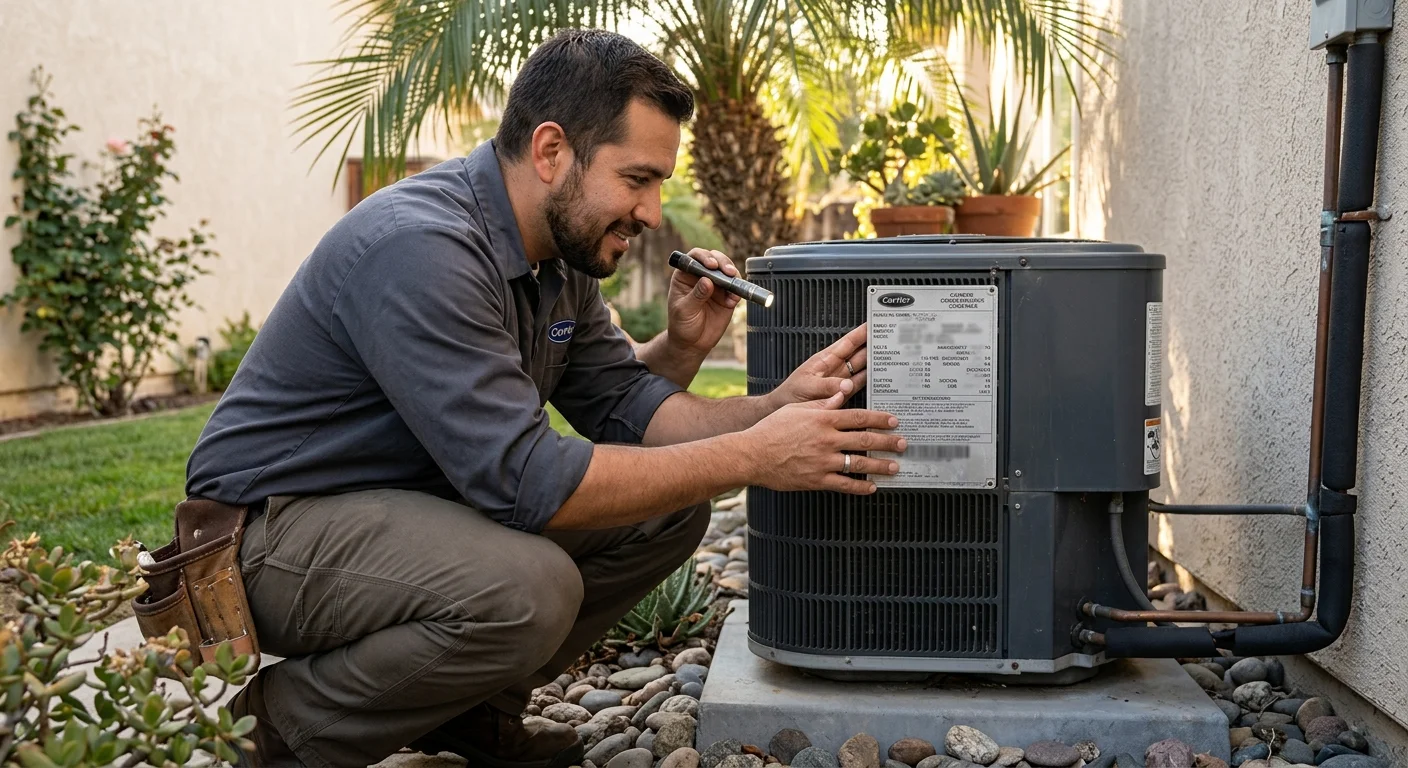
Use the data plate model to pull the right parts list. Repair is the default for a documented capacitor, contactor, or fan. Replacement needs age, parts availability, and a complete bid, not a brand slogan. Climate Pros SD is not Carrier. The matched licensed contractor tests the system you have.
Checklist
- Photograph the data plate.
- Ask whether the failed part is still available for that vintage.
- Get repair and replacement scopes in writing if both are reasonable.
- Confirm refrigerant type. New equipment will not match older R-410A service practices.
- See AC replacement in San Marcos.
Related: AC repair and best AC brands.
What should you identify on the data plate?
Start by photographing the complete data plate on your Carrier AC unit. Keep every printed field visible and readable. Don’t crop the photo around one number.
Record any fields labeled:
- Model or product number
- Serial number
- Refrigerant
- Electrical rating
- Manufacturing date, if one is printed
- Certification or listing information
Don’t guess what a character means. Similar letters and numbers are easy to confuse on a weathered label. Read the information back to the contractor and send the photo with it.
Photograph the indoor equipment plate too. Ask the pro to identify every component included in the diagnosis. A written quote should distinguish the outdoor unit, indoor coil, furnace or air handler, and thermostat. That prevents a vague recommendation from being treated as a complete system assessment.
Climate Pros SD can’t verify a Carrier model, manufacturing date, factory specification, or warranty status. Use Carrier’s official residential website or its support channel for model-specific information. Provide the exact model and serial numbers shown on the plate.
Our HVAC brand repair guide explains how to organize this information before speaking with a contractor. Bring previous service records if you have them. Those documents can show what was actually repaired without relying on memory.
Which symptoms support a repair discussion?
A symptom alone doesn’t decide whether Carrier AC repair makes sense. It gives the contractor a starting point. The stronger repair discussion begins with a written diagnosis naming one fault and the testing behind it.
Describe exactly what happened. Useful observations include:
- The thermostat calls for cooling, but the system doesn’t start
- Air moves through the vents but doesn’t feel cool
- The outdoor unit starts and stops repeatedly
- A new sound appears during operation
- Water appears near the indoor equipment
- A breaker trips when the system attempts to run
- One room remains uncomfortable while others cool
Note when the problem began and whether it repeats. Tell the contractor about any outage, thermostat change, filter change, or prior repair. Don’t open electrical panels or refrigerant components to investigate.
Ask the pro to separate the failed part from the system’s overall condition. The written diagnosis should explain what was tested, what failed, and whether another defect was found. It should also state what isn’t included in the proposed repair.
A repair discussion is reasonable when the contractor can document a defined correction and explain the remaining concerns. It isn’t a promise that repair will be the final choice. If the diagnosis stays vague, get another written assessment through an independent AC repair professional.
Ask about part identification and availability using the exact model number. Climate Pros SD doesn’t publish Carrier failure rates or model-specific repair advice because those details haven’t been verified in the approved research.
When does replacement enter the discussion?
Replacement enters the discussion when the written evidence goes beyond one isolated repair. That might include separate defects, unavailable compatible parts, or a proposal that leaves major concerns unresolved. Ask each contractor to show those findings rather than relying on the unit’s appearance or brand name.
No verified Carrier lifespan or failure-rate figure is available in the approved research. Climate Pros SD therefore won’t tell you that a Carrier AC unit must be replaced at a particular age. Confirm the manufacturing date with Carrier, then compare that information with the contractor’s diagnosis.
Two trade heuristics can help organize the conversation. The “50% rule” compares a repair with half of a proposed replacement amount. The “5,000 rule” multiplies system age by repair cost. Neither rule determines the correct answer or guarantees an outcome. Use them only after receiving real written bids.
Refrigerant information also needs context. U.S. production and import of R-22 ended on January 1, 2020. Existing R-22 systems may still be serviced with recycled or previously produced refrigerant.
Older R-410A equipment also remains serviceable with R-410A. EPA rules now limit the global warming potential of refrigerants used in newly manufactured or imported residential equipment. Review the current transition details through the EPA’s HFC restrictions page. Don’t accept a claim that either refrigerant automatically makes replacement mandatory.
If replacement remains a serious option, compare the AC installation scope rather than a single model name. Our San Diego AC brand comparison can help frame broader questions without declaring one brand right for every home.
How do coastal and inland conditions change the quote?
A Carrier AC unit in San Diego County shouldn’t be quoted from the ZIP code alone. Coastal, inland, mountain, and desert areas face different normal temperatures. The contractor should evaluate the actual address, equipment location, home, and comfort problem.
NOAA’s 1991-2020 normals show an August normal high of 77.3°F at San Diego International Airport. The August normal is 88.6°F at El Cajon and 89.0°F at Escondido. Borrego Desert Park reaches an August normal high of 106.8°F. Heat waves can run well above those normals, but the approved research doesn’t support publishing a numeric peak.
For a coastal property, ask the contractor to document any visible corrosion or equipment damage. For an inland home, ask how the proposed repair or replacement addresses the home’s cooling pattern during hotter weather. Neither location proves that one option is correct.
The quote should also identify conditions specific to the property. Ask about the indoor equipment, ducts, electrical connection, thermostat, access, and condenser location. If a contractor recommends replacement, ask how the proposed equipment was selected for that house.
Permitting depends on jurisdiction. Within the City of San Diego, the city states that heating, ventilation, air-conditioning, or refrigeration systems can’t be installed, altered, replaced, or repaired without a mechanical permit. Simple and plan-based permit paths differ by project and property.
That verified statement applies only within City of San Diego jurisdiction. A countywide permit rule couldn’t be confirmed from the approved research. For another city or an unincorporated address, ask the local building authority and matched contractor what applies.
What should each written bid document?
Request comparable written scopes before choosing repair or replacement. Climate Pros SD doesn’t set contractor prices. You contract with and pay the independent licensed contractor directly.
A repair bid should identify:
- The equipment covered by the diagnosis
- The reported symptom and diagnosed fault
- The testing used to support that conclusion
- The exact repair being proposed
- Parts or components included
- Work specifically excluded
- The contractor’s total proposed price
- Any permit or verification that applies
- The expected work duration
- The contractor’s own payment and warranty documents
A replacement bid needs more detail. It should identify the proposed outdoor and indoor equipment, model numbers, refrigerant, controls, and published efficiency ratings. Ask the contractor to cite Carrier documentation for every model-specific statement.
The replacement scope should also address electrical work, ducts, equipment removal, access, and permit responsibility. California Title 24 field verification requirements may apply when HVAC equipment is altered or replaced. Ask the contractor whether they apply to this project and how a California Energy Commission-certified rater will be handled.
Compare exclusions closely. One proposal may cover only the outdoor condenser, while another may describe additional components. Don’t compare the final totals until the scopes describe the same work.
Ask who verified any manufacturer warranty status. Climate Pros SD doesn’t publish Carrier warranty terms because they can depend on the exact equipment and documentation. Carrier should confirm model-specific coverage.
Finally, verify the contractor through the California Contractors State License Board. Search the business or license information shown on the proposal. Every HVAC pro in the Climate Pros SD network is licensed and insured, but you should still review the contractor named in your bid.
When to call us
Bring in a licensed HVAC pro when the diagnosis involves electrical components, refrigerant, or a complete system change. Climate Pros SD can connect you with an independent local contractor who can inspect the equipment and provide a written scope. Call us at (442) 777-6440 and we will match you with a licensed local pro.