Replace the system when the failure is in the compressor or the coil, when the equipment is old enough that parts are getting scarce, or when it simply can’t hold setpoint through a peak-summer San Marcos afternoon. Everything else is usually a repair.
That sounds tidy on paper. In practice the decision gets made in July, in a hot house, with a technician standing in the side yard and a number on a clipboard. This guide is about the part nobody explains in that moment: what a changeout in San Marcos actually involves, and what the 2026 refrigerant rules changed about it.
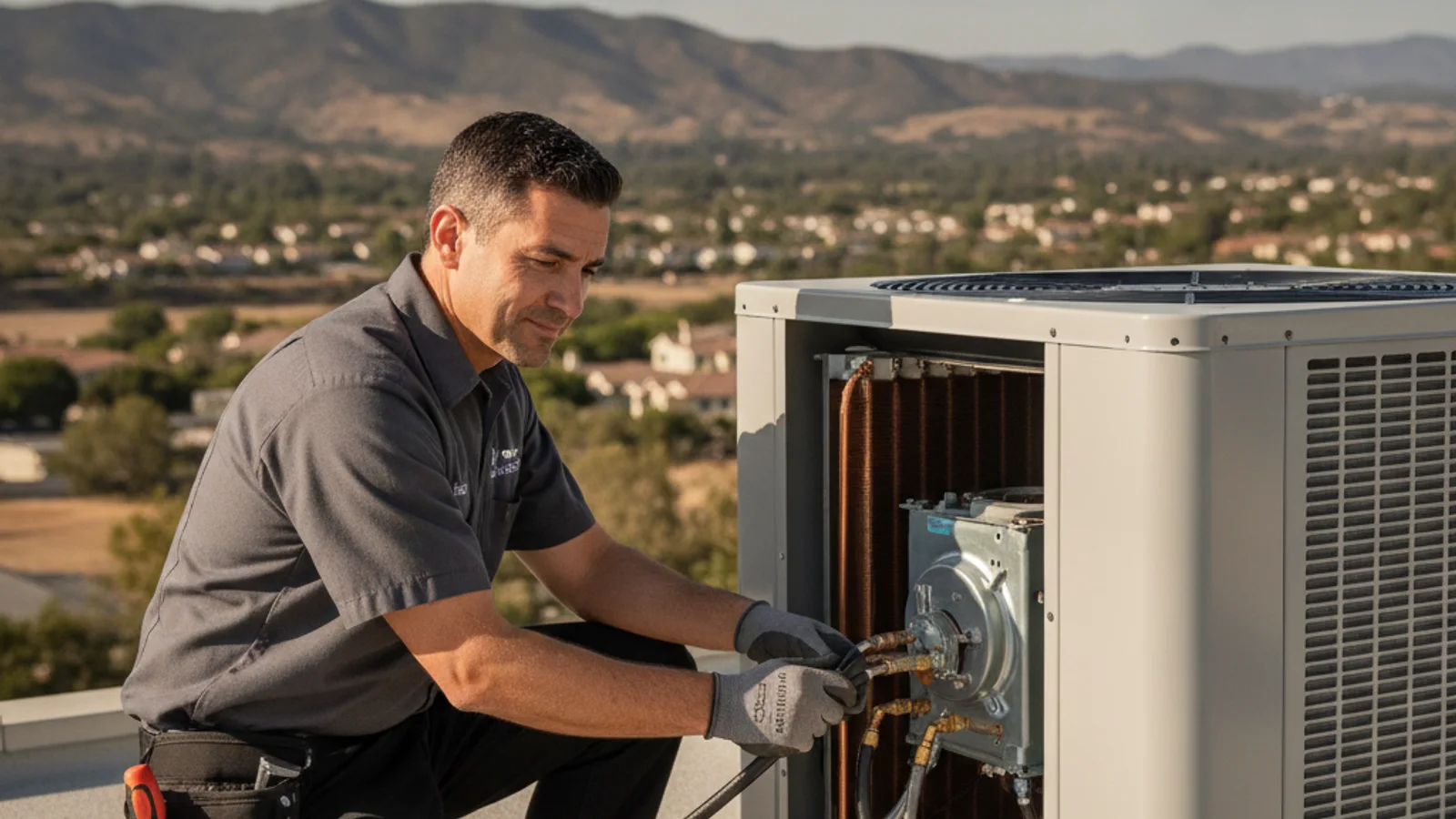
Replace a San Marcos AC when the compressor or coil is gone
Repair still makes sense for a capacitor, contactor, or fan motor. Replacement belongs in the conversation when the compressor or coil has failed, parts are scarce, or the house cannot hold setpoint on a peak-summer hillside afternoon. San Marcos hillside pads settle and collect eucalyptus litter. A tilted condenser and a packed coil both look like an undersized system.
Checklist
- Write equipment age from the data plate week/year code.
- Note whether the pad is level.
- Photograph coil fins packed with hillside debris.
- Ask for Manual J, not a same-tonnage swap, if rooms still overheat.
- See can I replace AC the same size.
Related: San Marcos HVAC and AC installation.
The failures that end a San Marcos system
San Marcos runs its air conditioners harder than the coast does. Systems here work long cycles from June into October, and long cycles are what expose weak parts. Three failures generally close the book on an older unit.
A failed compressor is the first. It’s the single most expensive component in the system, and on a unit past its warranty period the cost of the part plus the labor to recover refrigerant, swap it, and recharge usually lands close enough to a new system that replacement wins. The second is a leaking evaporator or condenser coil. A coil leak is not a top-off problem. Refrigerant doesn’t get consumed, so a system that needs charge every season has a leak somewhere, and coil leaks on aging equipment tend to come back.
The third is quieter and gets ignored the longest: the system runs constantly and still leaves the house four or five degrees above the thermostat setting on the hottest afternoons. That’s usually a capacity or airflow problem, not a broken part. It shows up in the Discovery Hills and Twin Oaks Valley tract homes where the original equipment was specified decades ago for a house that has since added windows, a bonus room, or a west-facing slider.
For the general framework on repairing versus replacing, we cover that separately in our AC replacement vs repair decision guide. Before you assume the worst, it’s also worth reading what actually breaks locally in our San Marcos AC repair breakdown, because a contactor or a capacitor is a small fix, not a reason to buy a system.
What the refrigerant transition changed
This is the part that confuses people most in 2026, and there’s a lot of bad information circulating.
Here’s what’s actually documented. Under the American Innovation and Manufacturing Act, the EPA’s Technology Transitions Program set a global warming potential limit of 700 for residential and light commercial air conditioning and heat pump equipment beginning January 1, 2025. R-410A sits well above that limit, so new residential equipment manufactured after that date uses lower-GWP refrigerant instead.
What that does not mean is that your existing system is illegal, unserviceable, or about to be shut off. The EPA’s restriction applies to new equipment. R-410A remains available for servicing systems already in the field, and a system whose components were all manufactured before the compliance date can still be installed. Anyone telling you that R-410A is banned, or quoting you a future price for it, is speculating.
The practical effect on a San Marcos changeout is narrower than the marketing suggests. You cannot mix refrigerants across a system. If the outdoor unit gets replaced with new low-GWP equipment, the indoor coil and the metering device have to match it, which is why a partial changeout on an older system rarely makes sense. Ask the contractor you’re matched with to put the refrigerant type, the model numbers of both halves, and the AHRI matched-system reference on the proposal in writing. If you want the longer version of how the refrigerants compare, see our R-22 vs R-410A vs R-454B guide.
Hillside lots change where the condenser goes
San Marcos is not flat, and that matters more than most replacement guides admit. A lot of housing here sits on graded hillside pads with retaining walls, narrow side yards, and slopes that fall away behind the house.
A condenser rejects heat upward and pulls air in through the sides. Set it in a narrow slot between a retaining wall and the house and it re-ingests its own hot discharge air, which raises head pressure, cuts capacity, and shortens compressor life on exactly the peak-summer days you bought it for. The fix is clearance and orientation, not a bigger unit. Manufacturers publish minimum clearances for their own equipment in the installation manual, so ask to see that page and ask how the planned location meets it.
Slope brings a second issue. A pad on filled ground can settle, and a condenser that tilts stresses the line set and lets the compressor sit off level. On steep lots the company you are matched with often set the unit on a raised or bracketed pad instead of pouring on grade. Wind is the third: hillside positions in San Marcos catch dry season debris and eucalyptus litter, and a coil packed with it behaves exactly like an undersized system.
If your home is in an HOA with architectural review, exterior equipment changes and screening usually need approval. Confirm the requirement with your association before the equipment is ordered, because relocating a condenser after the fact is not a small change.
Permits, testing, and verifying the contractor
Permitting is jurisdictional, and San Marcos is its own incorporated city, so don’t assume the City of San Diego’s rules apply to your address. The City of San Diego publishes a clear requirement that no part of a heating, ventilating, air conditioning, or refrigeration system may be installed, altered, replaced, or repaired without a mechanical permit. We could not verify the City of San Marcos requirements or fees from a primary source for this article, so confirm those directly with the San Marcos Building Division before work starts, and ask to see the permit number rather than taking it on trust.
California’s Title 24 energy code requires field verification and diagnostic testing when HVAC systems are altered or replaced, performed by a certified rater. As of January 1, 2026 the California Energy Commission relocated the field verification and diagnostic testing scope from the HERS Program into its Energy Code Compliance Program, so the specific current thresholds should come from the California Energy Commission or your rater, not from a contractor’s memory or from an article like this one.
Every HVAC pro in the network is licensed and insured, and you can confirm any California license yourself on the CSLB license check. Look at the classification as well as the status. Warm-air heating, ventilating, and air conditioning work falls under the C-20 classification, and CSLB’s own scope description for C-20 covers the ducts, registers, flues, and thermostatic controls along with the equipment itself.
Fix the airflow side or the new system inherits the problem
A changeout swaps the equipment. It does not fix the duct system, and in San Marcos the duct system is frequently the reason the old unit struggled.
Lake San Marcos housing dates largely to the 1960s and 1970s, and flex duct of that vintage sags, separates at the collars, and loses insulation value in a superheated attic. Newer San Elijo Hills construction has better envelopes but often has long duct runs to second-floor bedrooms that were tight on airflow the day they were built. A high efficiency condenser cannot push air through a duct that was never sized to carry it.
Ask for static pressure readings on the existing system before the proposal is written. High total external static is the number that tells you the ducts, the filter slot, or the return are the constraint. If the return is a single undersized grille, that’s a cheaper fix than the equipment and it changes how the new system performs on day one.
The same applies to the electrical. Confirm the breaker size, the disconnect, and the whip match the new unit’s nameplate rather than the old one’s. For the equipment side of the decision, our AC installation service page and the San Marcos HVAC hub cover what local contractors handle in the city.
When to call us
A changeout is permitted, tested work that touches refrigerant, electrical, and airflow, and getting the sizing and the placement right matters more than the badge on the equipment. If your system failed, or it’s running all afternoon and still losing to the heat, get a load calculation and a static pressure reading before you shop for a model number. Call us at (442) 777-6440 and we will match you with a licensed local pro.