Yes, you can replace your AC with the same size unit, but only if the original system was correctly sized and nothing material about your home has changed since it was installed. The problem is that in San Diego, especially inland and valley areas, a large share of systems installed during the 1990s and 2000s build boom were oversized from day one. If that’s your house, a same-tonnage swap locks in the original mistake. This post walks through when matching tonnage is the right call, when it isn’t, and what a contractor should verify before you sign anything.
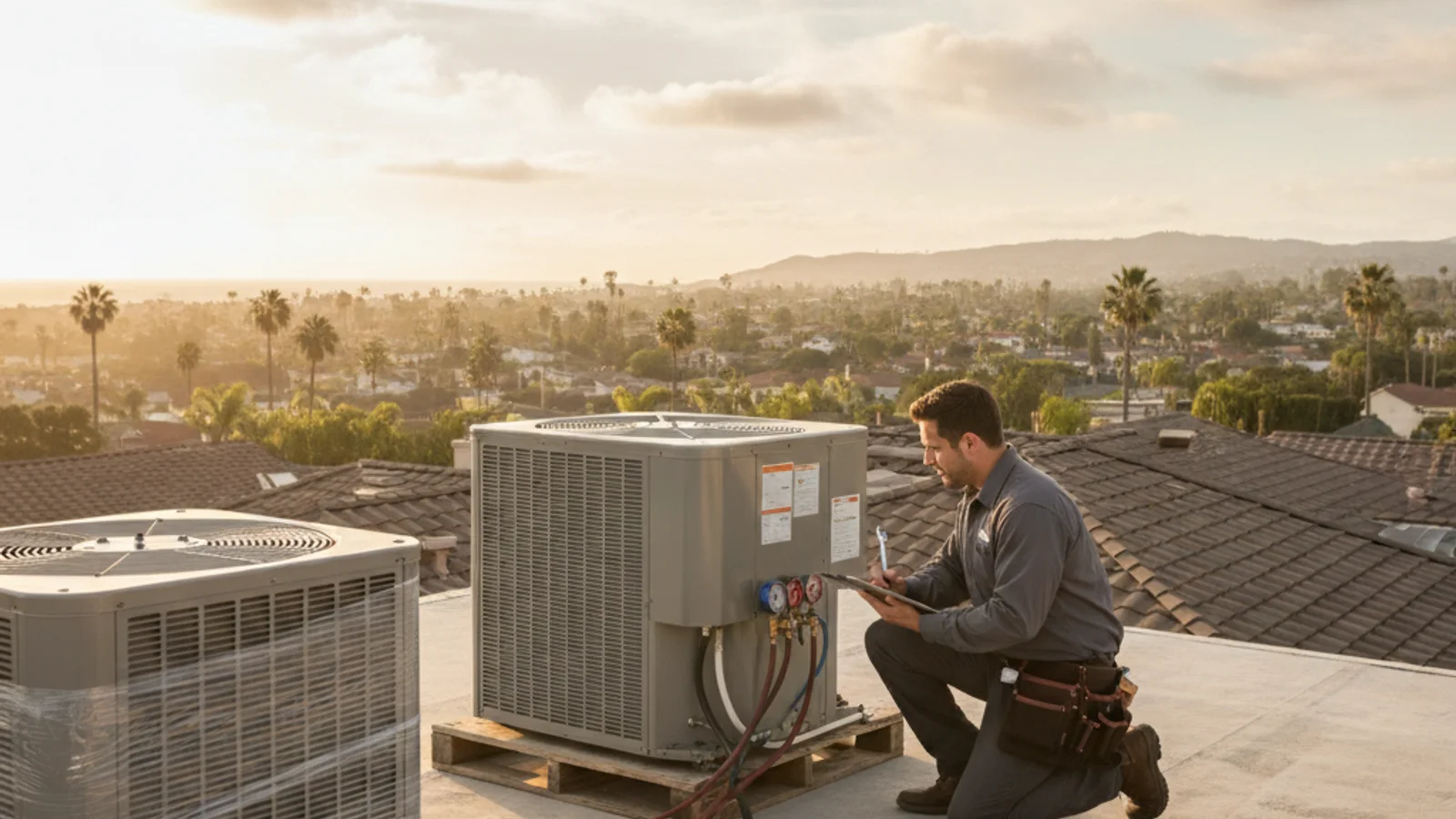
Same-size AC replacement is safe only if the original size was right
Keep the same tonnage when a Manual J on this house, this insulation, and this climate matches the old unit. Do not copy the data plate if the house was remodeled, ducts leak, or the old unit never held setpoint inland. Many San Diego replacements copy the existing tonnage. That repeats an original guess, especially in valleys that were sized like coastal tract homes.
Checklist
- List additions, new windows, or converted attics since the last install.
- Write which rooms still overheat.
- Ask for Manual J inputs in the quote.
- Do not subtract closed 25C or reserved TECH money from the bid.
- See is 3 ton right.
Related: AC sizing and AC installation.
When same-tonnage replacement is the right call
Matching tonnage makes sense when the original system cooled your home reliably, maintained comfortable humidity, and ran in cycles long enough that you never heard it constantly clicking on and off. Those are signs the unit was sized close to correctly. If you haven’t made significant changes to the home (no additions, no window replacements, no attic insulation upgrades), the existing load calculation still roughly applies.
A like-for-like replacement is also the simpler path. The refrigerant line set, air handler, and ductwork are already sized for that tonnage. Upsizing or downsizing mid-replacement means potentially rerunning lines or resizing ducts, which adds cost and time. When the original unit was right, same tonnage is the efficient choice.
One caveat worth understanding: replacing with the same tonnage is not the same as replacing with the same equipment. A modern 3-ton unit at SEER2 18 will outperform the 3-ton unit it replaces on efficiency, comfort, and noise. Tonnage is cooling capacity; SEER2 is efficiency. They’re independent variables.
When you should NOT keep the same size
Short-cycling is the clearest sign an existing system is oversized. If your AC reaches setpoint in 8 to 10 minutes, shuts off, then kicks back on a few minutes later, it’s working against itself. Each start-up cycle draws the highest electrical current, wears the compressor faster, and never gives the evaporator coil enough run time to pull humidity out of the air. The result is a cool room that still feels clammy, especially in the mornings near the coast.
Undersized systems have the opposite problem: the unit runs continuously and still doesn’t keep up on hot afternoons. If your current AC falls behind on days above 90°F in Escondido or El Cajon, that’s a capacity issue. A same-size replacement will have the same limit.
Other triggers that call for a fresh load calculation before replacement:
- You added square footage or converted a garage
- You replaced single-pane windows with dual-pane (reduces load)
- You added or significantly upgraded attic insulation (reduces load)
- The home has had major solar gain changes (a new pergola, new skylights, or less shade than before)
- You’re switching from a gas furnace to a heat pump system, which uses a different efficiency calculation
Any of these can shift the actual load enough that the old tonnage is no longer right.
Why San Diego homes are often the wrong size to begin with
San Diego saw a significant residential building surge from roughly 1992 to 2007, especially in inland communities like Escondido, Poway, El Cajon, Santee, and Chula Vista. HVAC contractors during that period commonly sized by square footage alone, using the “1 ton per 500 sq ft” rule of thumb. It’s fast, easy, and systematically oversizes homes in mild climates.
San Diego’s Title 24 climate zones are worth knowing here. Coastal zones (6 and 7, covering La Jolla, Carlsbad, Encinitas, Mission Valley) run 5 to 10 degrees cooler than inland zones on summer afternoons. A 2,000 sq ft home in Carlsbad often genuinely needs 2.5 tons. That same square footage in El Cajon, with its afternoon heat and older single-pane windows, might need 3 to 3.5 tons. The rule of thumb ignores this entirely.
Coastal homes, by contrast, are sometimes undersized because contractors assumed the mild climate meant any system would do. Homes in beach-adjacent neighborhoods from Ocean Beach to Oceanside often have AC that struggles during the few days a year when offshore flow pushes inland heat to the coast.
If your system was installed before 2008 and you’ve never had a load calculation done, there’s a real chance the tonnage is off.
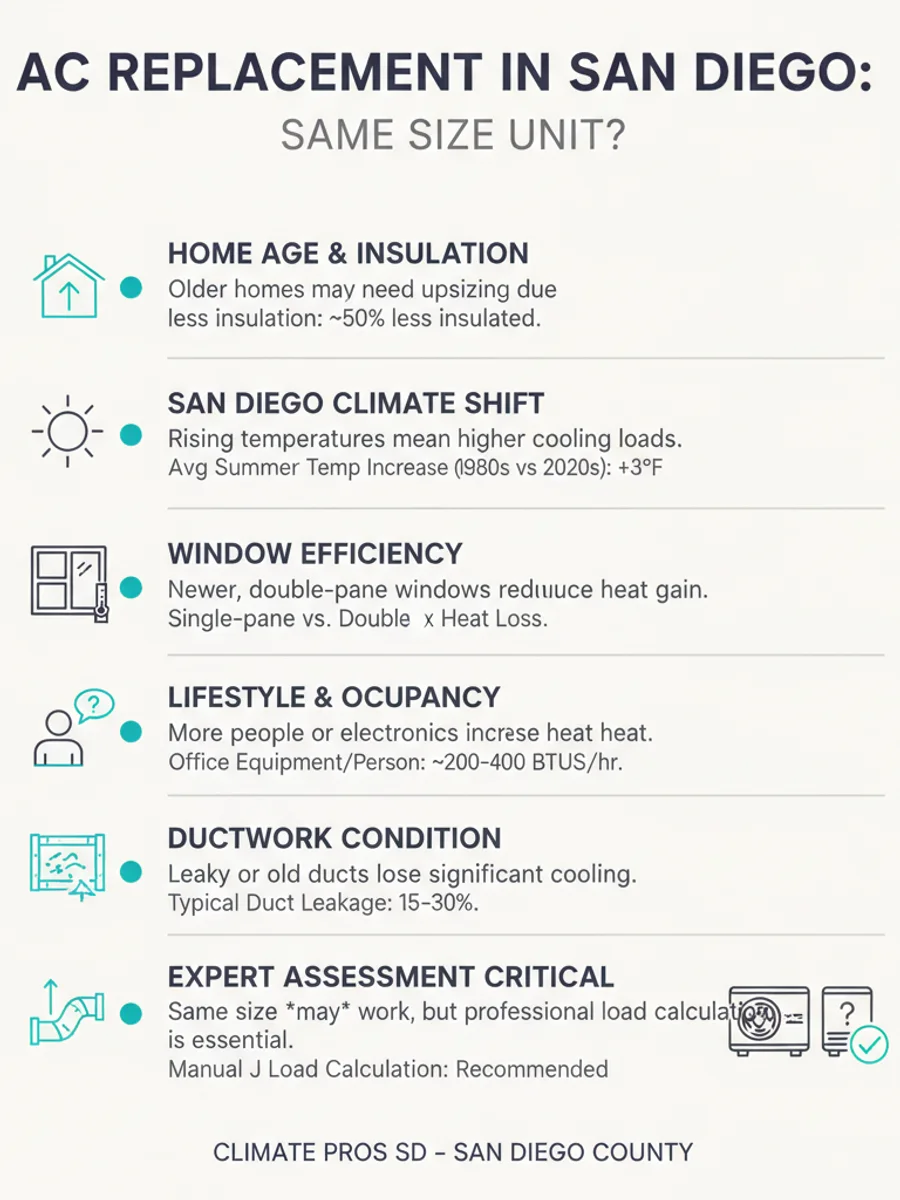
Does SEER2 change the tonnage I need?
No. SEER2 measures how efficiently a unit converts electricity into cooling, not how much cooling it delivers. A 3-ton system at SEER2 14.3 and a 3-ton system at SEER2 20 both cool at the same rate. The higher-efficiency unit just does it while drawing less power from SDG&E.
The practical implication: don’t let a contractor convince you to upsize because you’re upgrading to a higher-efficiency unit. The sizing logic is the same. What changes is the electricity cost to run it, not the capacity it delivers. Higher SEER2 units tend to run in lower-stage modes more often (two-stage and variable-speed compressors), which actually improves humidity removal and comfort at the same tonnage.
For more on what SEER2 means for your utility bill, see our SEER2 explainer for San Diego homeowners.
Does replacing my AC trigger a permit or load calc in San Diego?
A permit is required for an AC replacement in San Diego County, including unincorporated areas. The City of San Diego and most incorporated cities (Chula Vista, El Cajon, Escondido, Santee) require a mechanical permit for any HVAC changeout. Pulling a permit isn’t optional, and it isn’t just paperwork: it triggers an inspection that catches ductwork issues, refrigerant line problems, and improper electrical connections before they become expensive failures.
Title 24, California’s energy code, requires that any permitted HVAC installation meet minimum efficiency standards and, in many cases, include a Manual J load calculation as part of the permit documentation. Some jurisdictions enforce this more strictly than others, but a contractor who tells you no permit is needed for a full system replacement is either wrong or cutting corners, and either way that’s a contractor to avoid.
For a full breakdown of what San Diego permits require, see our post on whether you need a permit for HVAC in San Diego.
How a contractor confirms the right size before replacement
The only correct method is a Manual J load calculation. Square footage alone is not sufficient. A real Manual J accounts for your home’s insulation R-values, window U-value and orientation, ceiling height, air infiltration rate, internal heat loads, and your specific Title 24 climate zone. It takes roughly an hour for an experienced HVAC technician to complete on-site.
The output is a BTU per hour number for cooling load and, if relevant, heating load. That number divides by 12,000 to give you the correct tonnage. A 2-ton unit handles 24,000 BTU/hour. A 3-ton unit handles 36,000.
Ask any contractor for their Manual J before you agree to a system. If they size your home by walking through it for five minutes and quoting the same tonnage as your current unit, they’re skipping the calculation. That’s not a red flag, it’s a reason to get a second quote. Our guide to what size AC you actually need covers the full Manual J process in detail.
Once you know the right size, the AC replacement vs. repair decision post can help you figure out whether a full replacement makes financial sense versus a targeted repair.
Frequently asked questions
Can I put a bigger AC unit in my house?
You can install a larger unit, but it will likely make your home less comfortable, not more. An oversized AC short-cycles, meaning it hits the thermostat setpoint quickly, shuts off, and restarts within minutes. Short cycles don’t run long enough for the coil to remove humidity from the air, leaving the space cool but damp. An oversized unit also costs more upfront and wears out faster because compressor startups are the hardest operating moment for the equipment. Bigger is not better for AC.
Is it cheaper to replace with the same size?
Often yes, because the refrigerant line set and air handler are already matched to that tonnage. Changing tonnage mid-replacement can require resizing or replacing those components, which adds labor and materials cost. If the existing size is correct, same-tonnage replacement is the most cost-efficient path. See our HVAC replacement cost breakdown for San Diego for what full system replacement runs in 2026.
What happens if my new AC is oversized?
Short-cycling is the main problem. The compressor starts and stops too frequently, which drives up electricity costs and accelerates compressor wear. The evaporator coil never runs long enough to condense humidity, so the air feels cool but clammy, particularly noticeable in coastal homes where marine layer can already push indoor humidity up. Hot and cold spots develop because short cycles don’t circulate air evenly through the ducts. Right-sizing is what prevents all of this.
Do I need a Manual J for a like-for-like replacement?
Technically, California’s Title 24 and most San Diego County permit jurisdictions require a Manual J for any permitted HVAC installation, including replacements. In practice, enforcement varies by jurisdiction and inspector. But the more important reason to get one is practical: if the original system was incorrectly sized, a like-for-like replacement is an expensive way to repeat the same problem. A Manual J takes about an hour and removes the guesswork. Any contractor who won’t do one isn’t working to your standard.
When to call us
Climate Pros SD connects you with AC installation and AC replacement pros across San Diego County who run a real Manual J load calculation before quoting a replacement. The HVAC pros in our network work in every part of the county, from coastal Carlsbad to inland El Cajon, and know the Title 24 zone differences that affect your actual tonnage. If you’re also considering a heat pump system instead of a straight AC replacement, they can run the heat pump load calc too.
Call (442) 777-6440 to get connected with a vetted San Diego HVAC contractor for a free replacement quote.