An indoor air concern can start with dust, an odor, or one uncomfortable room. Before buying equipment, define the problem and document when it happens.
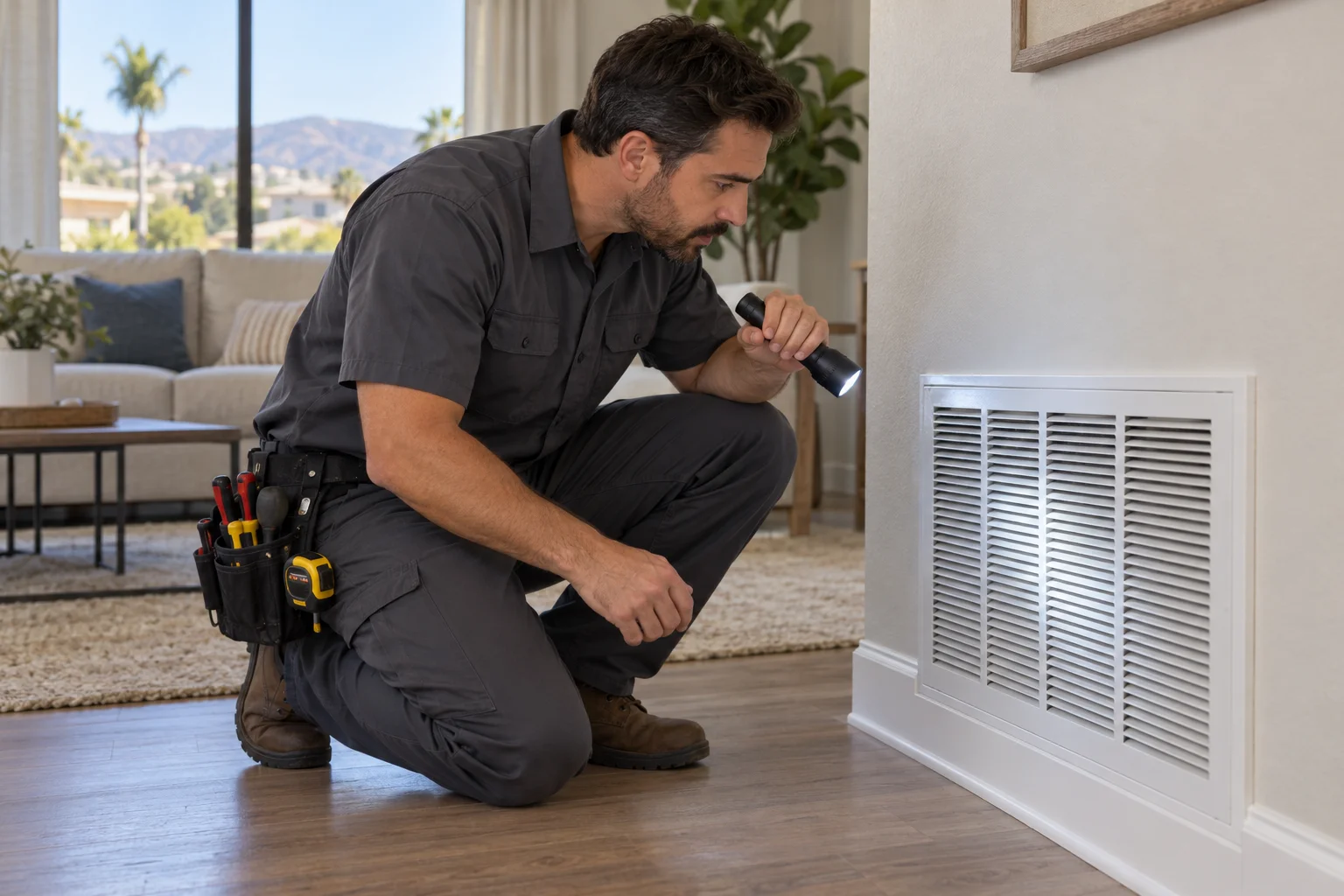
Which indoor-air problem are you trying to solve?
Start with the condition you can observe. Avoid diagnosing the cause before anyone inspects the home. Dust near a register, for example, doesn’t prove that the ducts need cleaning. An odor when the system starts also doesn’t identify one specific source.
Write down whether you’re dealing with:
- Visible dust or particles near certain registers
- An odor in one room or throughout the home
- Staining, damp materials, or signs of a past water event
- Airflow that feels different between rooms
- A concern that appears only while the HVAC system runs
- Outdoor smoke entering the home
- A product decision involving filtration, ventilation, or UV equipment
Location matters in Chula Vista. Note whether the home is in western Chula Vista or the eastern Otay area. NOAA climate normals use separate stations for those parts of the city. The Chula Vista station has July and August normal highs of 74.6°F and 76.9°F. Brown Field, used for eastern Chula Vista and Otay, has corresponding normals of 78.3°F and 80.6°F. Those figures don’t diagnose indoor air. They show why a generic San Diego assumption can miss local operating conditions.
Separate comfort complaints from air-quality concerns. A warm bedroom, weak airflow, and visible residue may require different checks. Our indoor air quality service connects Chula Vista homeowners with independent licensed HVAC pros who can assess the system. The homeowner contracts with and pays the matched professional directly.
If anyone reports symptoms, treat that as a medical question. An HVAC assessment can examine equipment and airflow, but it can’t diagnose a health condition.
What should you document before requesting an assessment?
A short observation log gives the assessor a useful starting point. Record what you noticed, where it happened, and whether the HVAC system was running. Use neutral descriptions such as “musty odor at the hallway return” instead of “mold in the ducts.”
Photograph visible conditions without opening equipment. Include the full room, the nearby register or return, and a close view of any residue or staining. Save dates for leaks, plumbing work, painting, flooring, cabinetry, or other recent changes. Keep product labels for cleaners, coatings, and materials if they seem relevant.
Add these details to your notes:
- Which rooms are affected
- Whether doors or windows were open
- Whether heating, cooling, or the fan was operating
- Whether the issue began after a water event or home project
- Whether residue returns after ordinary cleaning
- Whether the concern changes during outdoor smoke
- The filter’s printed model and size
- Any previous inspection, cleaning, or repair documents
Don’t clean away important evidence before taking photographs. Don’t disturb suspected contamination to collect your own sample. If laboratory testing may be needed, ask an independent environmental testing provider what documentation and sampling method they require.
Outdoor smoke calls for a different record. Note when you saw or smelled smoke, which openings were closed, and how the HVAC system was set. Our guide to indoor air quality during San Diego wildfire smoke provides a separate framework for that event.
Bring your log to the assessment. It helps the pro compare your observations with accessible HVAC components, airflow conditions, filter fit, and equipment operation.
How do filtration and ventilation address different issues?
Filtration and ventilation aren’t interchangeable purchases. They address different parts of an indoor-air plan, and neither identifies the original source by itself.
Filtration places a filter in an air path. The exact result depends on the product, its fit, the equipment, and how air moves through the home. Don’t assume a filter upgrade is compatible because its label promises stronger particle control. A licensed HVAC pro should check the system and explain how the proposed filter relates to airflow and equipment operation.
Ventilation manages the exchange between indoor and outdoor air. Whether that exchange helps depends on the concern and outdoor conditions. A ventilation proposal should identify where outdoor air enters, how the system controls it, and when it operates. Ask how the plan changes during outdoor smoke or another event that makes outdoor air undesirable.
Source inspection comes before either product when you can see damp material, recurring residue, or a localized problem. A device placed elsewhere in the system doesn’t explain the source. Ask the assessor to distinguish observations from conclusions.
Duct cleaning is also a separate scope. The EPA doesn’t recommend routine duct cleaning on a fixed schedule. It lists substantial visible mold, vermin, excessive dust or debris, and particles released from supply registers among the conditions to consider. The EPA also says duct cleaning hasn’t been shown to prevent health problems.
Read our Chula Vista duct-cleaning scope comparison before comparing proposals. You can also review the duct-cleaning referral service when inspection findings support that scope. Cleaning addresses contamination when justified. It doesn’t replace source correction, ventilation planning, or an equipment assessment.
Which product claims need outside verification?
Treat broad product promises as questions, not conclusions. Ask the seller to identify the exact model, the condition it addresses, and the evidence supporting each claim. A label such as “whole-home purification” doesn’t explain placement, compatibility, maintenance, or expected performance in your house.
Request written answers to these points:
- What specific condition is the product intended to address?
- Does the claim apply to particles, surfaces, gases, or odors?
- What installation conditions does the claim assume?
- Is the equipment compatible with the existing HVAC system?
- Which replacement parts or maintenance steps are required?
- Who measured the claimed result, and under what test method?
- Does the proposal include testing before and after installation?
- Which claims come from the manufacturer rather than the contractor?
UV products need especially careful review. The EPA says properly designed ultraviolet germicidal irradiation equipment may destroy certain biological pollutants on moist HVAC surfaces. It also says typical home UVGI cleaners have limited effectiveness. Some organisms need much higher UV exposure than a typical home unit provides.
UVGI shouldn’t replace filtration. EPA guidance says it should be applied with a filtration system when it’s used. The agency also warns that dead mold spores can still cause allergic reactions. A UV claim therefore doesn’t support a promised allergy, asthma, or health outcome. See the EPA’s UV lamp guidance before accepting a performance claim.
Prices, warranties, and maintenance obligations also belong in writing. Climate Pros SD doesn’t set prices or give warranties. Ask the matched pro who provides each warranty, what it covers, and which document controls it.
When should an HVAC pro assess the home?
Request an HVAC assessment when the concern appears connected to system operation. Examples include an odor that starts with the blower, residue released near supply registers, an ill-fitting filter, uneven airflow, or visible conditions around accessible HVAC components.
An HVAC pro can inspect the heating and cooling equipment within the agreed scope. Ask the pro to separate what they observed from what still needs testing. If the concern involves building materials, extensive moisture, or a substance requiring laboratory analysis, an independent environmental specialist may also be appropriate.
EPA guidance supports an evidence-based approach to ducts. Cleaning may be considered when listed conditions are present, but unexplained symptoms shouldn’t be attributed to ducts without evidence. The agency also says little evidence shows that duct cleaning alone improves system efficiency. Read the EPA’s residential duct-cleaning guidance before approving that work.
Ask each professional to define their role. An assessor, laboratory, remediator, and HVAC contractor may answer different questions. If one company proposes testing and corrective work, ask how it keeps those decisions separate. Request the observations, test method, results, proposed scope, and exclusions in writing.
Confirm the contractor’s license independently through the CSLB license check. Climate Pros SD matches customers with licensed and insured independent HVAC professionals, but you should still review the contractor’s current record and written proposal.
The goal isn’t to buy every available product. It’s to identify the concern, document the evidence, and match the response to the finding.
When to call us
Call when an indoor-air concern appears tied to filtration, airflow, ducts, or HVAC operation. Climate Pros SD can connect you with an independent licensed local professional who can assess the home and explain the available scope.
Call us at (442) 777-6440 and we will match you with a licensed local pro.