Last updated: May 26, 2026

HVAC Maintenance · Rancho Bernardo, CA

HVAC maintenance in Rancho Bernardo, CA

Rancho Bernardo summers run 95 to 105 degrees and the neighborhood sits square in PSPS territory during Santa Ana wind events. HOA communities have equipment rules. The 1970s through 1990s housing stock means many systems are aging into their final years. A pre-season tune-up is what separates a system that holds all summer from one that fails in the first heat wave.

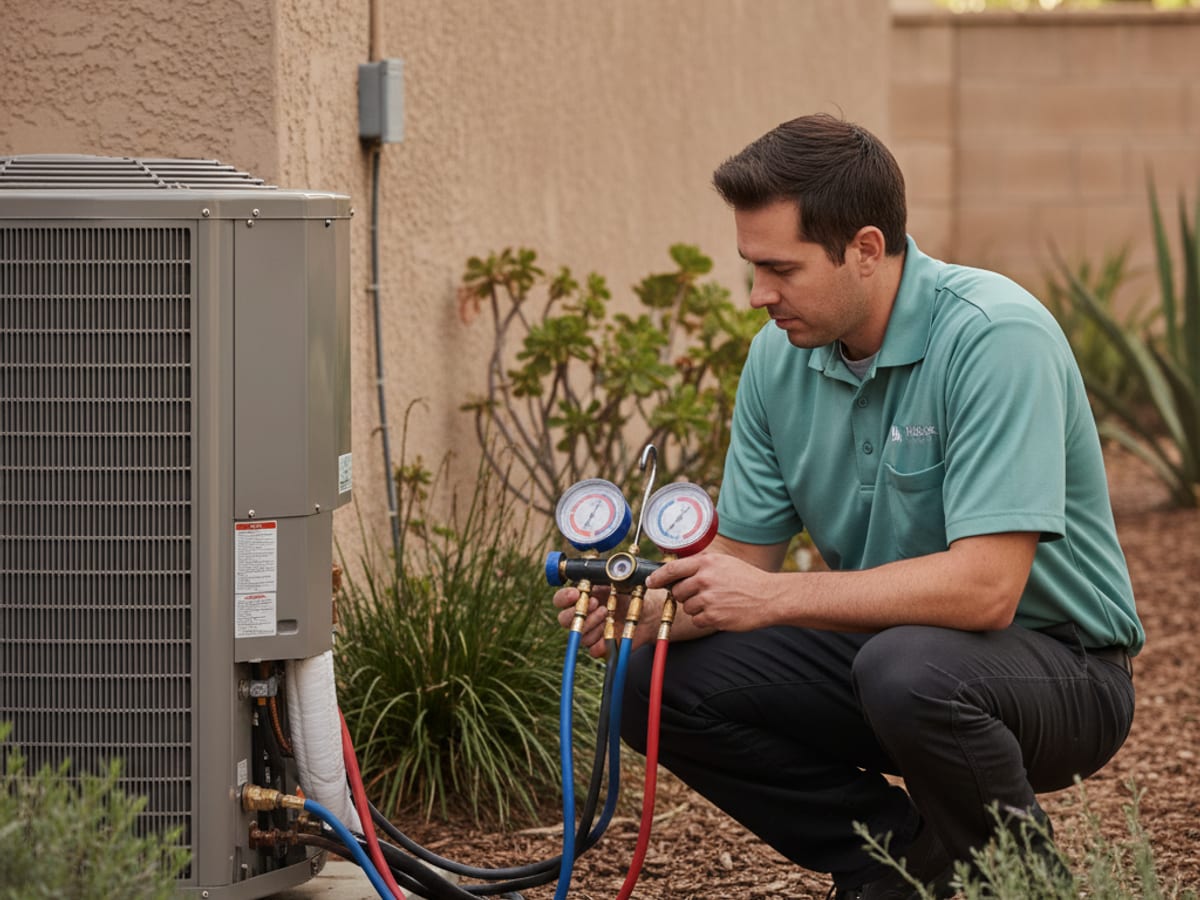
Climate Pros SD technician performing maintenance in Rancho Bernardo, CA

HVAC maintenance in Rancho Bernardo costs $149 for a single tune-up or $189 per year on the annual plan, which covers two visits: one before summer, one before winter. The 21-point inspection includes refrigerant level check, capacitor microfarad test, amp draw on the compressor and motors, condenser coil cleaning, and temperature split measurement. Most appointments run about 90 minutes.

Rancho Bernardo is a master-planned community in San Diego's North County inland zone, roughly 20 miles from the coast. Temperatures here reach 95 to 105 degrees in summer with no marine layer relief. The housing stock in Bernardo Heights, 7 Oaks, Westwood, Oaks North, and Eastview spans from the 1970s through the 1990s, which puts many of the original or early-replacement HVAC systems squarely in the 15 to 40 year range. These are systems that benefit from honest annual assessment.

We service all Rancho Bernardo HOA communities and know the standard equipment placement rules and access configurations common in the neighborhood. Annual plan documentation satisfies most HOA professional service requirements. R-22 systems are a specific focus here given the housing age: we document refrigerant charge on every visit and flag slow-leak patterns before they become urgent decisions.

What our Rancho Bernardo tune-up covers

A maintenance visit is not a filter swap and a signature. We run a 21-point inspection that catches the things that cause summer no-cooling calls before they happen.

  • Refrigerant level check with gauges: slow leaks documented visit by visit
  • Capacitor microfarad test: critical in PSPS territory where hard starts stress capacitors
  • Compressor and fan motor amp draw: aging motors flagged before failure
  • Condenser coil cleaning: removes inland dust and grit from North County terrain
  • R-22 system refrigerant level documentation and leak pattern tracking
  • Evaporator coil inspection for buildup or early freeze indicators
  • Static pressure check to catch duct leaks in 1970s-90s ductwork
  • Condensate drain flush and float switch test
  • Contactor and electrical connection inspection for heat damage on older systems
  • HOA-compliant equipment access and post-service cleanup documentation
  • Thermostat calibration and cycle timing check
  • Temperature split measurement: should read 16-22°F across the air handler
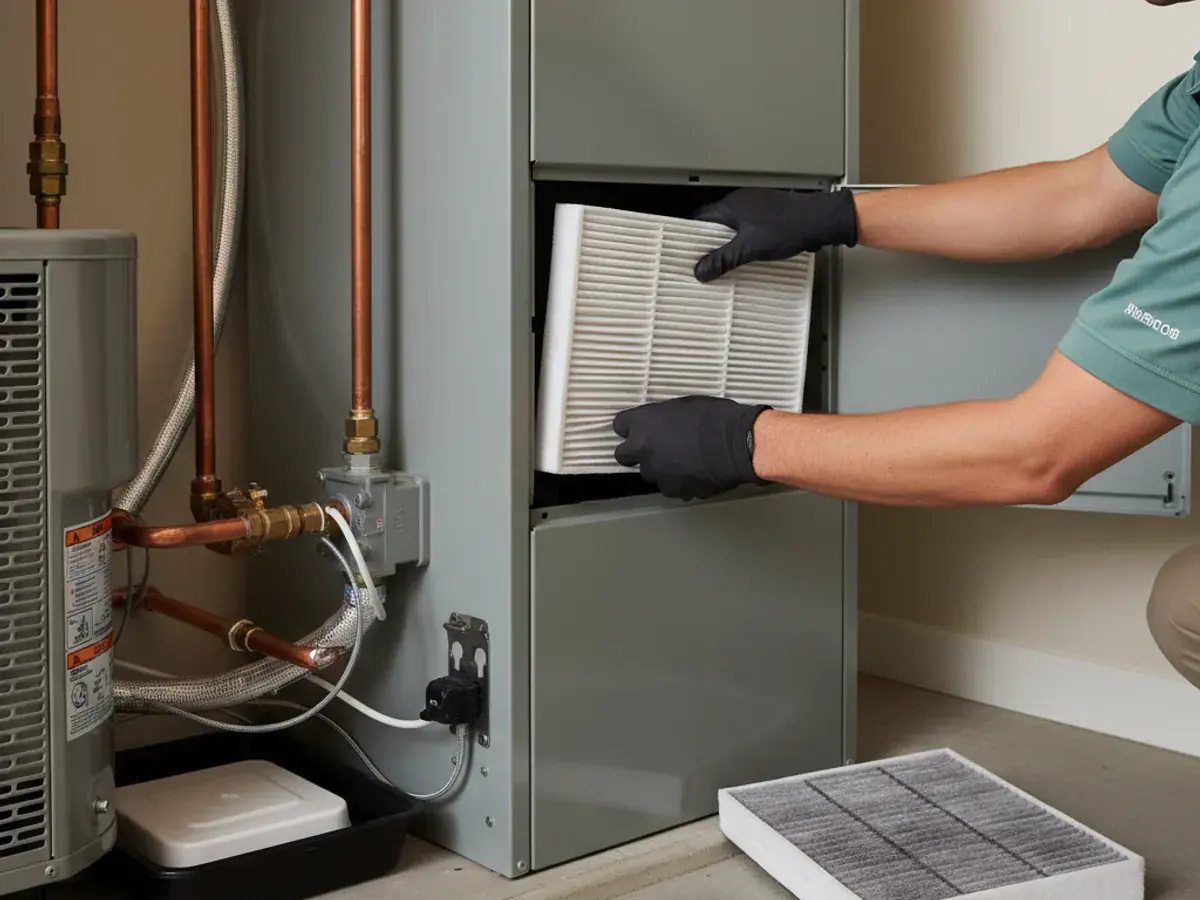
  • Filter condition check and replacement if needed (filter cost separate)
  • Blower wheel inspection for dirt buildup
  • Full written summary with any findings and recommended action items
Maintenance detail work by a Climate Pros SD technician in Rancho Bernardo, CA

HVAC maintenance cost in Rancho Bernardo

These are the flat rates for Rancho Bernardo in 2026. Every visit is quoted before we start, and there's no upsell pressure at the end of the appointment.

Repair Typical range Notes
Single tune-up visit $149 flat Full 21-point inspection, coil cleaning included
Annual maintenance plan (2 visits) $189/year Spring pre-summer + fall pre-winter, same 21-point process each
Filter replacement $25 - $65 Depends on filter type and MERV rating
Refrigerant top-off (R-410A) $150 - $350 If low charge is found during inspection; quoted separately before adding
Refrigerant top-off (R-22) $200 - $500 R-22 supply is limited; persistent leaks on older systems point toward replacement
Capacitor replacement $150 - $350 If the microfarad test fails during the tune-up
Hard-start kit installation $75 - $150 Reduces startup amp surge after PSPS restoration; recommended in Rancho Bernardo
Condensate drain line clear (severe blockage) $75 - $150 If the drain is fully blocked and requires more than a basic flush

Pricing is consistent across all Rancho Bernardo communities including Bernardo Heights, 7 Oaks, Westwood, Oaks North, and Eastview. HOA documentation is provided with every visit at no additional charge. If we find something during the inspection that warrants a repair, we quote it separately and you decide whether to proceed.

What maintenance prevents in Rancho Bernardo

A yearly tune-up in Rancho Bernardo serves two functions: it extends the life of systems that have useful life remaining, and it surfaces the findings on aging systems that inform the replacement decision before the failure forces it. The 1970s through 1990s housing stock means this second function is as important as the first.

Capacitor failure during PSPS restoration

Rancho Bernardo is in SDG&E PSPS territory. Santa Ana wind events that trigger red flag conditions in this part of North County result in power shutoffs affecting Bernardo Heights, the Westwood area, and other elevated zones within the community. When power is restored, an air conditioner compressor experiences a hard start: full voltage applied to a hot, pressurized system that has been sitting idle.

A capacitor already drifting below rated microfarads is most likely to fail at this exact moment. The capacitor cannot provide enough starting torque, the compressor hums without spinning, and the thermal overload trips to protect the motor. Testing and replacing a weak capacitor during the pre-summer tune-up costs $150 to $350. The hard-start kit we can install during the same visit, at $75 to $150, reduces startup amp surge and protects the compressor through future PSPS events.

R-22 refrigerant monitoring on aging systems

A significant number of Rancho Bernardo homes have systems built before 2010 that still run R-22 refrigerant. R-22 has been phased out of US production. Supply is limited and the price per pound has increased substantially. A system that is slow-leaking R-22 is not getting better: the leak exists somewhere in the refrigerant circuit and will continue to drain charge until it is repaired or the system is replaced.

We document R-22 refrigerant charge levels on every visit. If we topped off a system on the previous visit and it is low again now, that is a clear slow-leak pattern. The economics of repeated R-22 top-offs at $200 to $500 each, against the cost of a system replacement, is a straightforward calculation. We present the numbers without pressure and let you make the call.

Electrical component degradation on 1970s-90s systems

Capacitors, contactors, and wiring connections on systems that are 20 to 40 years old have seen thousands of heat cycles. Capacitors lose microfarad rating over time. Contactors develop pitting on the contact surfaces from years of electrical arcing. Wire connections that were torqued properly at installation can loosen over decades of thermal expansion and contraction.

Each of these failures is individually small and easy to address during a maintenance visit. Together, if left unaddressed, they create a system that is unreliable under heat load. We test capacitors and inspect contactors and connections on every visit. Findings are documented in the written report.

Duct system issues in original Rancho Bernardo construction

Homes built in the 1970s and 1980s have ductwork that is now 40 to 50 years old. Sheet metal duct systems from this era are generally durable, but the connections between sections can loosen over time, and the insulation on ducts running through unconditioned attic space degrades. Flex duct added during upgrades or renovations can sag, kink, or detach at the connections.

Static pressure measurement during the tune-up identifies duct restrictions without a full duct inspection. High static pressure for the system size points to something in the duct system: a blocked or detached run, excessive bends, or undersized sections for the equipment that replaced the original units over the decades.

Local angle

HVAC maintenance built for Rancho Bernardo homes

The Rancho Bernardo climate

Rancho Bernardo sits at roughly 1,100 feet elevation in the Bernardo Valley, about 20 miles from the Pacific. The marine layer from the coast rarely penetrates this far inland, and the valley location tends to trap heat. Summers here are reliably 95 to 105 degrees during peak heat weeks, and Santa Ana wind events in fall can push temperatures even higher while simultaneously creating the wildfire risk that triggers PSPS shutoffs.

The combination of sustained summer heat and PSPS events creates a specific risk profile for HVAC equipment: systems that run hard all summer and then face the hard-start stress of power restoration events in the fall. Both are addressed directly by the pre-summer tune-up.

HOA communities and equipment rules

Rancho Bernardo is largely HOA-governed. Bernardo Heights, 7 Oaks, Oaks North, Eastview, and Westwood all have HOA rules that address exterior equipment appearance, placement, and in some cases noise levels. Condenser units typically need to be within setback rules and in some communities need to be screened from street view.

We are familiar with the common equipment configurations in Rancho Bernardo HOA communities and work within those constraints when performing tune-ups. Some HOAs require documentation of annual professional service for warranty compliance. We provide a written inspection report after every visit that satisfies that requirement.

Housing ages by sub-community

The seven oaks area and parts of Bernardo Heights represent the earliest Rancho Bernardo development, with homes dating to the late 1960s and 1970s. Systems installed in these homes, even as replacements in the 1990s, are now 25 to 35 years old. These are the properties where the tune-up conversation most often turns toward honest end-of-life assessment.

Westwood, Oaks North, and Eastview are later builds, largely 1980s and 1990s construction. Systems here are typically in the 15 to 30 year range: old enough that capacitors, motors, and refrigerant circuits need annual attention, young enough that replacement is not necessarily imminent if the inspection shows solid mechanicals.

PSPS planning for elevated neighborhoods

SDG&E issues Public Safety Power Shutoffs in North County inland areas multiple times per year during high fire risk conditions. The elevated terrain in parts of Rancho Bernardo places some neighborhoods at higher PSPS frequency than the valley floor. When power returns after a multi-hour shutoff on a hot September day, an air conditioner that was running pre-shutoff is a pressurized, hot system being asked to start under full load.

Hard-start kits reduce the startup amp surge by providing additional capacitance at the moment of startup. They cost $75 to $150 and are installed during the tune-up visit. For any Rancho Bernardo home in a PSPS-affected zone, this is worth considering when the capacitor is already being tested.

The annual plan and HOA documentation

The annual plan at $189 for two visits is the right schedule for most Rancho Bernardo homes. The pre-summer visit in March or April catches electrical components, refrigerant levels, and coil condition before the first heat wave. The fall visit checks the heating side and documents post-summer equipment condition before winter.

Both visits generate a written inspection report. HOA requests for maintenance documentation, manufacturer warranty requirements, and your own service history all benefit from having both reports per year. The cost per visit at $189 per year is less than $95 per appointment.

SDG&E rebates and system replacement planning

SDG&E rebates through TECH Clean California are tied to equipment replacement, not maintenance. For Rancho Bernardo homeowners with aging R-22 systems who are planning to replace in the next one to three years, the timing of that replacement matters for rebate eligibility. We document system condition in the written inspection report, which gives you a clear baseline for the replacement conversation and supports the rebate application process when the time comes.

Rancho Bernardo maintenance questions

How much does HVAC maintenance cost in Rancho Bernardo?

A single tune-up is $149. The annual plan covers two visits for $189 per year, which works out to less than $95 per appointment. Filter replacement runs $25 to $65 depending on filter type. Hard-start kit installation runs $75 to $150 and is recommended for homes in PSPS-affected zones.

How often should I service my HVAC in Rancho Bernardo?

Twice a year. Pre-summer in March or April and fall in October or November. Rancho Bernardo summers run 95 to 105 degrees, many systems are aging into their final decade, and PSPS events add hard-start stress on top of normal heat load. One visit a year is not enough to stay ahead of this combination.

What does a 21-point tune-up include?

Refrigerant level check with gauges, capacitor microfarad test, compressor and motor amp draw, condenser coil cleaning, R-22 charge documentation where applicable, evaporator coil inspection, static pressure measurement, condensate drain flush and float switch test, contactor and electrical connection check, thermostat calibration and cycle timing, temperature split measurement, filter condition check, and blower wheel inspection. We finish with a written summary of everything found.

What are PSPS events and how do they affect my HVAC in Rancho Bernardo?

SDG&E issues Public Safety Power Shutoffs during high fire risk conditions. Parts of Rancho Bernardo, especially elevated neighborhoods, are affected several times per year. When power is restored after a shutoff, the AC compressor does a hard start: full voltage applied to a hot, pressurized system. A weak capacitor is most likely to fail at this moment. We test capacitors on every visit and can install a hard-start kit that reduces the startup amp surge.

My Rancho Bernardo home has an older R-22 system. What should I know?

R-22 refrigerant has been phased out of US production and supply is limited and expensive. If your R-22 system has a slow leak requiring repeated top-offs, the cost adds up quickly. We document refrigerant charge levels on every visit. If we see a pattern of repeated low charge, we tell you directly: that is a leak, not a routine top-off situation, and the economics of continuing to recharge versus replacing the system deserve a clear conversation.

Does my HOA require HVAC maintenance documentation?

Some Rancho Bernardo HOAs do require annual professional service documentation for warranty compliance or exterior equipment maintenance standards. We provide a written inspection report after every visit that satisfies those requirements. The annual plan at $189 generates two reports per year.

When should I schedule HVAC maintenance in Rancho Bernardo?

March or April for the pre-summer visit. The schedule starts filling in May. October or November for the fall visit on the annual plan.

What is a hard-start kit and should I get one?

A hard-start kit adds capacitance that helps the compressor motor start under load more easily. It reduces the startup amp surge that happens every time the system cycles on, and especially the surge that happens after a PSPS power restoration. In Rancho Bernardo, where PSPS events happen multiple times a year, a hard-start kit is worth the $75 to $150 cost for any home with a system older than 10 years.

Do you service all Rancho Bernardo HOA communities?

Yes. We service Bernardo Heights, 7 Oaks, Westwood, Oaks North, Eastview, and all other Rancho Bernardo communities. We know the common equipment configurations in these communities and work within HOA guidelines on every visit.

How long does the tune-up take?

Most appointments run 60 to 90 minutes. Older systems that need more thorough electrical inspection, or homes with two HVAC systems, run closer to 90 minutes. We do not rush the inspection.

Is my 25-year-old Rancho Bernardo system worth maintaining?

Yes, but with honest expectations. We will tell you what the inspection shows. If the compressor is running within amp spec, refrigerant charge is holding, and electrical components test within range, the system has useful life remaining and maintenance makes sense. If we see a compressor pulling high amps, multiple electrical components failing, and an R-22 system that has needed repeated top-offs, we tell you that too. The $149 inspection is the right first step.

Can maintenance extend the life of an aging Rancho Bernardo system?

Yes. Annual coil cleaning, capacitor checks, and refrigerant monitoring reduce compressor wear meaningfully. We see well-maintained North County inland systems reaching 18 to 22 years regularly. Neglected systems in this climate rarely make it past 12 to 15 years. The math over a 10-year span favors consistent maintenance over deferred service.
Service area

Where we serve Rancho Bernardo

We cover Rancho Bernardo and the surrounding North County Inland communities, with same-day service on most maintenance calls.

Serving Rancho Bernardo

Need maintenance in Rancho Bernardo?

Call for a free quote. Same-day service on most repairs, next-day on most installs.

Call now · (442) 777-6440 Same-day · a real tech answers Quote