Santee runs 86 to 89 degrees on summer afternoons with no coastal moderation: and almost every subdivision in the city was built with builder-grade equipment that was often undersized from day one. A pre-season tune-up keeps that equipment running through a cooling season that barely stops.
Climate Pros SD matches Santee homeowners with a licensed HVAC company. That company quotes in writing whether they offer a single visit or a maintenance plan, what they inspect, and any fees before work starts. Typical industry tune-ups look at capacitors, coils, and refrigerant charge. Ask the matched company which of those they include. Appointment length is set by that company.
Santee sits in the Santee Lakes corridor about 17 miles inland from the coast, with no marine moderation and a geography that traps summer heat. Peaks hit 86 to 89 degrees through July, August, and into September, and the effective cooling season runs ten months out of twelve. The city's residential development: largely Carlton Hills, Sky Ranch, and the Mission Gorge Road corridor: was built with builder-grade HVAC that was frequently undersized for the actual heat load. Those same units are now 25 to 50 years old and running harder than they were ever designed to.
We match homeowners with pros across all Santee neighborhoods: Carlton Hills, Sky Ranch, Mission Gorge Road, Mast Park area, and the newer developments along Cuyamaca Street. Ask the matched company how they price hillside or eastern-tract addresses.
What to ask a matched company to inspect in Santee
Ask the matched company what they inspect. Typical industry tune-ups look at capacitors, coils, and refrigerant charge. Get that list in writing.
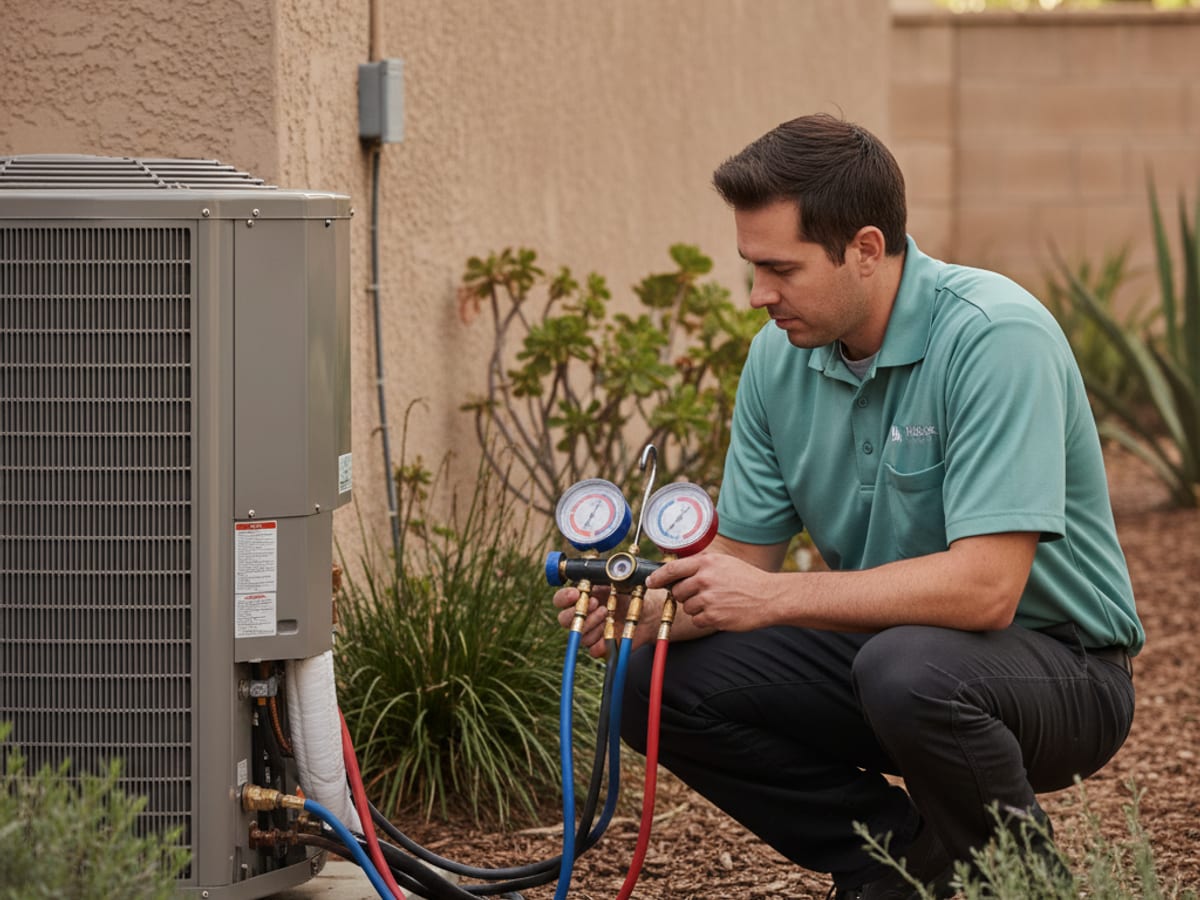
Refrigerant level check with gauges: slow leaks caught here, not during the first peak-summer week
Capacitor microfarad test: a common Santee summer failure, especially on builder-grade equipment now decades old years old
Compressor and fan motor amp draw: high amps flag undersized or failing equipment working beyond its design parameters
Condenser coil cleaning: dry inland dust and grit pack coils fast in Santee's climate
Evaporator coil inspection for buildup or early freeze indicators from restricted airflow
Static pressure check to catch duct leaks in slab-on-grade and attic duct systems common in Carlton Hills
Condensate drain flush and float switch test
Contactor and electrical connection inspection
Thermostat calibration and cycle timing check
Temperature split measured across the air handler
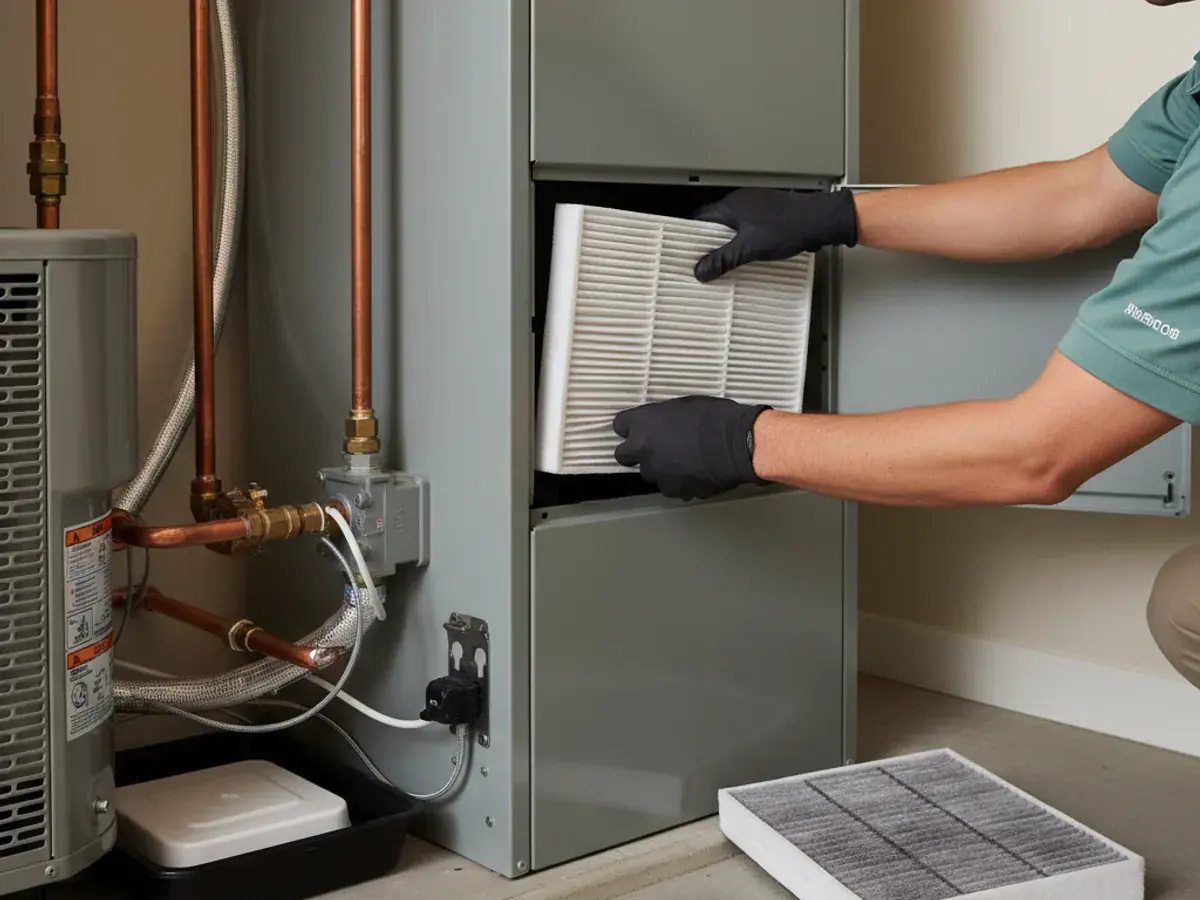
Filter condition check and replacement if needed (filter priced separately)
Blower wheel inspection for dirt buildup
Belt and bearing check on older direct-drive systems in older Santee stock
R-22 refrigerant assessment on pre-2010 systems: document levels, flag persistent leaks
Full written summary with findings and recommended action items
HVAC maintenance cost in Santee
The company you are matched with quotes the visit in writing before starting. Ask whether they offer a single appointment or a plan, what they inspect, and which fees are extra.
Repair
Typical range
Notes
Single tune-up visit
Quoted by the matched company
Ask what they inspect and whether coil cleaning is included
Annual maintenance plan, if the company offers one
Quoted by the matched company
Ask how many visits they include and what each visit covers
Filter replacement
Priced by filter type and MERV rating
Depends on filter type and MERV rating; peak-season monthly changes recommended
Heavy dust coil cleaning, if billed separately
Quoted after inspection
For units with compacted buildup from multiple seasons of deferred cleaning
Refrigerant top-off (R-410A)
Priced by how much charge is needed
If low charge is found during inspection; quoted separately before adding
Refrigerant top-off (R-22)
Priced by supply availability and charge needed
R-22 supply is limited; persistent leaks on older units point toward replacement
Capacitor replacement
Priced by part and labor
If the microfarad test fails during the tune-up
Condensate drain line clear (severe blockage)
Priced by severity of the blockage
If fully blocked and requires more than a basic flush
Pricing is set by the company you are matched with, not by neighborhood. If the inspection turns up something that warrants a repair, that gets quoted separately and you decide whether to proceed.
What maintenance prevents in Santee
A yearly tune-up is mostly about finding small problems before they become expensive ones. Santee's extreme inland heat and the undersized builder-grade equipment common in the city's subdivisions make this more urgent here than in most of San Diego. A unit already working at the edge of its design capacity has less margin for error than one properly sized for its load.
Capacitor failure on undersized builder-grade equipment
Capacitors on equipment that runs near the top of its amp rating degrade faster than those on properly sized units. Most Carlton Hills and Sky Ranch builder-grade systems are in the zone where they run high amps on a peak-summer afternoon: right at the margin where a capacitor drifting low will fail under load. A weak capacitor replaced in April is a scheduled part-and-labor cost. The same failure on a Friday afternoon in August means an emergency call premium and a wait that can stretch into the following week.
Filter overload during peak-heat months
Santee's dry inland climate means dust loads are higher than the coast. During the peak cooling months of June through September, a standard filter can hit maximum capacity in 30 to 45 days rather than the usual two to three months. A loaded filter restricts airflow, causes the evaporator coil to ice over, and forces the compressor to run at high amp draw trying to move air through the restriction.
Ask them to discuss filter change schedules. That is the single most impactful thing a homeowner can do between service visits. In Santee, monthly filter checks during the cooling season are not excessive: they are appropriate for the environment.
Refrigerant leaks on aging Santee systems
Slow refrigerant leaks are common on systems that are 20 or more years old. A system can lose charge gradually over one to two summers and still cool adequately through mild weather, then fail to hold temperature the first week of peak-summer heat. Santee's long cooling season means more refrigerant cycles per year, which accelerates the rate at which small leaks become significant. Ask whether they check refrigerant levels on the visit.
For pre-2010 units still running R-22 refrigerant, the conversation is more direct. R-22 is no longer manufactured in the US and supply is limited. A system that needs top-offs repeatedly is leaking, and a leak on an R-22 system in this age range frequently becomes the conversation that ends with a replacement decision rather than a repair.
Compressor failure from sustained high-load operation
Santee equipment runs at or near full capacity for a longer stretch per year than most of San Diego County. A compressor in Santee may log 2,500 or more operating hours annually: the equivalent of decades of work in a mild coastal climate. Systems that also run with low refrigerant, dirty coils, or weak capacitors are compressing that lifespan further. Annual maintenance addresses all three of those conditions. A tune-up that prevents a compressor failure is a straightforward trade against the cost of full replacement.
Local angle
HVAC maintenance built for Santee homes
Why Santee is one of the most demanding HVAC climates in San Diego County
Santee is a valley city with hills to the north and east that block any marine influence. The city gets no benefit from the ocean breeze that keeps coastal San Diego in the 70s during summer. When Mission Beach is 70 degrees in July, Santee is 104. The Santee Lakes area and the lower valley floor are the hottest sections; the Sky Ranch elevation to the north and east provides a few degrees of relief but nothing that changes the fundamental load on HVAC equipment.
The cooling season here runs approximately ten months, from early March through mid-December in most years. Systems run almost continuously through the hottest stretch. That is why builder-grade equipment: already undersized in many cases: wears faster here than it would in a forgiving coastal climate.
Carlton Hills and Sky Ranch: builder-grade equipment in the heat
Carlton Hills is one of the oldest developed sections of Santee, with tract homes dating back decades. Many of these homes still have their original or second-generation HVAC equipment, often in the 20- to 30-year-old range. Systems in Carlton Hills frequently show the patterns expected from undersized, aging units running in extreme heat: weak capacitors, low refrigerant, and condenser coils caked with seasons of dust.
Sky Ranch sits higher on the hills north of Carlton Hills and has newer construction. Equipment here is better sized and generally in better condition, but the hillside lots can present access challenges for outdoor units, and some homes have longer refrigerant line sets than typical valley lots that need monitoring for pressure balance.
Mission Gorge Road corridor and older Santee stock
The Mission Gorge Road corridor runs through the western edge of Santee and has a mix of older commercial and residential development. Homes in this area are often older vintage with systems that have been replaced at various points across the decades: sometimes with appropriately sized units, sometimes with whatever was cheapest at the time. Equipment sizing and ductwork condition in this corridor are more variable than in the planned subdivisions, and the tune-up here sometimes surfaces findings that point toward ductwork work or sizing reviews.
The Mast Park area near the Santee River basin has been developed more recently and has newer equipment, generally R-410A systems. These units are mid-life and at the point where maintenance matters most: catching issues now extends lifespan by years, while skipping service starts the clock on earlier failure.
The 30-45 day filter rule in Santee summers
The standard recommendation of filter changes every two to three months assumes normal residential air quality. Santee in summer does not have normal air quality relative to coastal cities. The dry inland conditions, dust from surrounding hills, and the sheer volume of air the system moves during a 10-month cooling season mean filters load significantly faster. Filters in Santee are consistently found maxed out after 30 to 45 days during peak summer.
A clogged filter causes the evaporator coil to ice over and drives the compressor into high-amp operation trying to push air through the restriction. Over weeks, that stress compounds. The simplest thing a Santee homeowner can do between service visits is check the filter monthly from June through September and replace it when it looks more than half loaded.
What else is hvac maintenance in Santee called?
Homeowners search for this a few different ways. In Santee it also goes by HVAC tune-up in Santee , seasonal HVAC tune-up in Santee , preventive HVAC maintenance in Santee , HVAC inspection in Santee , furnace maintenance in Santee , and AC maintenance in Santee . They all reach the same licensed local pros, and the operator who answers will
sort out which one your job actually is.
Santee maintenance questions
How much does HVAC maintenance cost in Santee?
The company you are matched with quotes the visit in writing. Ask whether they offer a single appointment or a plan, what they inspect, and which fees are extra. Climate Pros SD does not sell a branded maintenance plan or inspection protocol. Filter replacement is priced separately by type, and that is separate from the tune-up cost. Ask whether coil cleaning is included; units with heavy compacted buildup from deferred maintenance may have an additional heavy-cleaning charge quoted after inspection.
How often should I service my HVAC in Santee?
Twice a year is the right standard for Santee. The cooling season runs close to ten months, with sustained peak-summer peaks through July, August, and September. A spring visit in March or April catches problems before the heat arrives. A fall visit in October handles the furnace and heating controls before the cold nights that do reach Santee: valley temperatures drop into the mid-30s on cold winter mornings.
My Carlton Hills home has the original HVAC. What should I expect?
A system is 40-plus years old and by the calendar is well past its expected lifespan. What matters is what the inspection actually shows. Some systems that old are running surprisingly well: tight electrical connections, compressor within amp spec, refrigerant holding charge. Others are clearly past the point where maintenance can do much. A scheduled inspection gives you an honest picture before summer, not after.
How often should I change my filter in Santee?
Monthly checks from June through September, and every four to six weeks if you have pets or live on a dusty lot. Santee's dry inland conditions cause filters to load significantly faster than they do in coastal cities. A filter that would last three months in Encinitas may be maxed out in Santee after 30 to 45 days during peak summer. A loaded filter is a common avoidable cause of HVAC failure seen here.
What should I ask the matched company to inspect?
Refrigerant level check with gauges, capacitor microfarad test, compressor and motor amp draw, condenser coil cleaning, evaporator coil inspection, static pressure measurement, condensate drain flush and float switch test, contactor and electrical connection check, thermostat calibration and cycle timing, temperature split measurement, filter condition check, and blower wheel inspection. Every visit ends with a written summary of all findings.
Should I get my HVAC serviced before summer in Santee?
Yes. March or April is the right window. By May the schedule fills. By June it is full. A tune-up that catches a failing capacitor or low refrigerant in April is a scheduled repair. The same problem found during a peak-summer stretch in July is an emergency repair with a longer wait. Santee's summer heat arrives fast and stays for months.
My system seems to cool okay: does it still need a tune-up?
Usually yes. The issues most likely to cause a summer failure are not always visible through performance. A capacitor can be at 60% of its rated capacity and the system will still cool: until it fails under load on a hot afternoon. Refrigerant can be 10 to 15% low and the system will maintain temperature in mild weather, then fall apart during a heat wave. The tune-up catches those conditions before the weather exposes them.
Are Sky Ranch homes harder to service than valley-level homes?
Not harder to service, but sometimes different in configuration. Sky Ranch hillside lots can have outdoor units placed in tighter locations, and some homes have longer refrigerant line sets between the outdoor condenser and the indoor air handler. Longer line sets need monitoring for pressure balance. The inspection process is the same, and the pricing structure applies regardless of location.
What is the risk of skipping maintenance on a Santee HVAC system?
The condenser coil packs with dust and grit from the dry inland environment, forcing the compressor to work harder. Refrigerant levels drift low without anyone catching it until the system fails in a heat wave. A capacitor that should have been tested at 60% drifts to failure on a peak-summer afternoon. Filters load every 30 to 45 days in peak summer and nobody changes them. Any one of those is a repair call. All of them together is a compressor that dies three to five years earlier than it should have.
Do you service newer Santee construction near Cuyamaca Street?
Yes. Pros in our network cover all Santee neighborhoods including the newer developments along Cuyamaca Street, the Mast Park area, Sky Ranch, Carlton Hills, and the Mission Gorge Road corridor. Pricing structure is the same across the entire city. Newer construction typically has 15- to 20-year-old equipment: mid-life systems that benefit most from consistent annual maintenance.
Can maintenance extend the life of my Santee system?
Yes, meaningfully. Annual coil cleaning, capacitor testing, and refrigerant monitoring keep the compressor running at lower amp draw and within its design parameters. In a climate as demanding as Santee's, that matters. Systems that get consistent annual service regularly reach 18 to 22 years here. Systems that go without service rarely make it past 12 to 14 in this heat. The difference compounds year over year.