You can usually put an AC condenser in a side or rear yard, not the front, kept off the property line, with enough room around it to breathe and be serviced. It needs to stay under the local noise limit at the property line. In the City of San Diego that’s 50 dBA daytime for single-family homes. If you have an HOA, you’ll likely need approval and some screening. Here’s how all four rules fit together.
Most people ask this question right before an install. You’ve picked a unit, you’re ready to buy, and then you wonder where it can actually go. Good question to ask now. The wrong spot can mean a failed inspection, an angry neighbor, an HOA letter, or a system that runs hot and dies early. The right spot is rarely an accident. It’s planned.
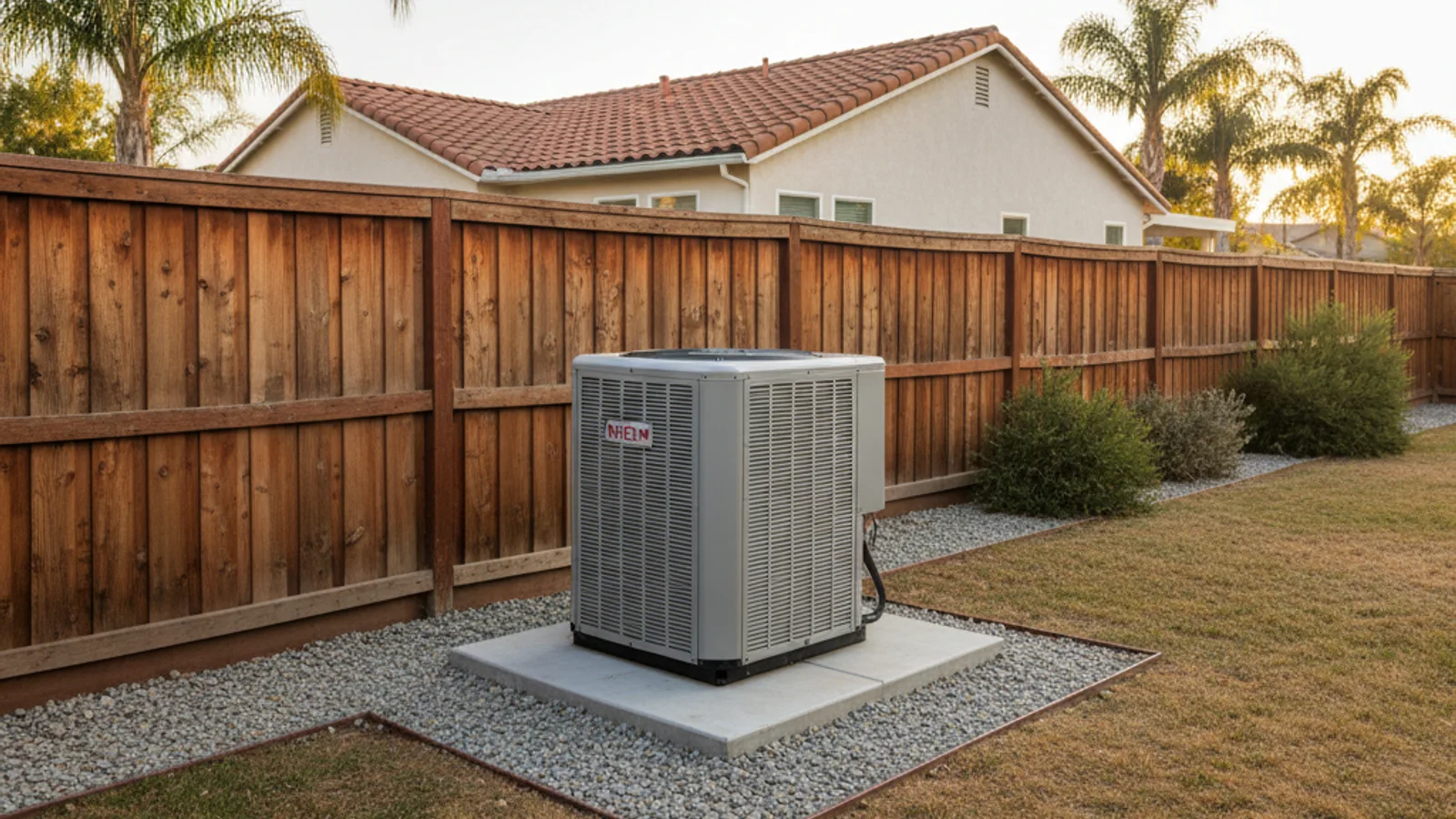
The four rules that decide placement
Every condenser location has to clear four separate hurdles at once. They don’t always agree with each other, which is why placement takes some thought.
| Constraint | Typical rule | Why it matters |
|---|---|---|
| Setback | Allowed in side and rear yard setbacks, not the front yard | Keeps equipment off the street and away from the lot line |
| Noise | Must stay under the local limit at the property line (50 dBA daytime in City of San Diego) | A loud unit at the fence line is a code violation, not just a nuisance |
| Clearance | Roughly 12 to 24 inches on the sides, about 5 feet overhead, and service access in front | Cramped units overheat, lose efficiency, and fail early |
| HOA approval | Written approval plus screening in many planned communities | An unapproved unit can be ordered moved at your cost |
Miss any one and the install can come back to bite you. Let’s take them one at a time.
Setbacks: how close to the property line
San Diego treats air conditioning equipment as something that can sit in the side and rear yard setbacks but not the front. Under the City of San Diego Municipal Code, air conditioning, ventilation, and similar equipment may be placed in rear and side yard setbacks, and it is not permitted in front yard setbacks. See Chapter 14, General Regulations for the equipment placement language.
There’s a practical limit too. The code notes that existing equipment less than three feet from a property line may be replaced at the same setback, as long as the setback doesn’t shrink. That tells you three feet is a sensible target for new work in many cases.
Setbacks vary by zone and by community plan. Coastal zones, hillside overlays, and planned districts each layer their own rules on top. The County of San Diego runs its own land development code for unincorporated areas. Don’t assume the city number applies to your address. Confirm your zone with the City planning department or your local jurisdiction before you settle on a spot.
Clearance: the airflow your unit actually needs
Setbacks are the law. Clearance is the physics. A condenser pulls air through its sides and pushes hot air out the top. Choke that airflow and it recirculates its own heat, runs hotter, and wears out faster.
Most manufacturers and the Air Conditioning Contractors of America call for roughly 12 to 24 inches of clearance on the sides, with about 5 feet of open space overhead. Two units side by side usually need a combined gap between them. The ACCA and manufacturer clearance guidance lays out the typical distances, and the real numbers live in your unit’s installation manual.
Service access matters just as much. Codes generally want a clear working space in front of the panel that opens for service, often cited as about three feet, so a tech can reach the components. A manufacturer clearance reminder from the field walks through how tight clearances quietly cut cooling capacity and shorten equipment life. Tuck a unit into a narrow side yard against a fence and you’ve created a slow-motion failure.
The pad underneath counts too. A condenser belongs on a level, solid base, raised enough to stay clear of standing water and yard runoff. A unit sitting in a puddle every winter corrodes from the bottom up.
Noise rules: how loud is too loud
This is the rule that surprises people. Your condenser has to obey the local noise ordinance, measured at the property line, not at your wall.
In the City of San Diego, the one-hour average sound limit for single-family residential is 50 decibels from 7 a.m. to 7 p.m., 45 decibels from 7 p.m. to 10 p.m., and 40 decibels from 10 p.m. to 7 a.m. Those limits live in Municipal Code Chapter 5, Article 9.5. The County of San Diego sets similar limits for unincorporated areas, generally 50 dBA daytime and 45 dBA at night under Section 36.404 of the County code.
Here’s why placement decides this. Sound drops off with distance. A unit that reads 50 dBA right next to it can fall well under the limit by the time it reaches a fence ten feet away. Put that same unit two feet from the lot line and a neighbor can file a valid complaint. Modern variable-speed condensers run far quieter than older single-stage units, which buys you flexibility. Still, the fix is usually distance, a buffer, or a different model, not hoping nobody notices.
HOA approval and screening
If you live in a planned community, the HOA is a fifth gatekeeper, and often the strictest one. Carlsbad, Rancho Bernardo, 4S Ranch, and similar master-planned areas commonly require written architectural approval before you install or relocate outdoor equipment.
Typical HOA conditions include keeping the unit out of public view, screening it with a fence, wall, or landscaping, and matching screening materials to the home. Some specify which side yards are allowed. The City code itself echoes this idea: in many zones, mechanical equipment must be screened from public view and architecturally integrated with the building.
Can your HOA make you move a unit you already installed? Often yes, if you skipped approval. That’s an expensive lesson. Submit the request first, in writing, and keep the approval. If you’re in an HOA-heavy area like Carlsbad or Rancho Bernardo and 4S Ranch, a contractor who knows local boards can save you weeks.
Permits and Title 24
One more layer. In California, replacing or relocating a condenser is permit work. The permit triggers an inspection where the inspector checks placement, setbacks, electrical, refrigerant piping, and noise compliance. New and replacement systems also fall under Title 24 energy rules, which often require third-party HERS testing for refrigerant charge and airflow. A California HVAC permit and Title 24 overview covers what gets verified. Skipping the permit doesn’t save money. It surfaces at resale.
Where pros actually recommend placing it
Put the rules together and a clear short list emerges. The best spot is usually a side or rear yard, three or more feet off the property line, on a level raised pad, with side and overhead clearance honored, positioned away from bedroom windows and the neighbor’s patio, and screened if your HOA asks.
North-facing and east-facing walls help in San Diego, since a condenser in afternoon shade runs cooler and more efficiently than one baking in west sun. Avoid tight dog runs and narrow side passages where heat builds. For homes where the yard simply can’t fit a traditional condenser well, a mini split installation gives you smaller, quieter outdoor units with more placement flexibility.
A good install plans all of this before the unit arrives. The matched company handles placement, the permit, HOA paperwork, and clearances. Climate Pros SD does not dispatch a truck. If you’re weighing a new system, our AC installation page covers what a proper install includes.
Call us at (442) 777-6440. We will match you with a licensed local pro. Climate Pros SD does not walk the pad or write the install quote.
FAQs
How far from the property line does an AC condenser need to be?
San Diego allows AC equipment in side and rear yard setbacks but not the front yard. The exact distance depends on your zone, with three feet a common practical target. The city code lets existing equipment under three feet from a line be replaced at the same setback. Confirm your specific zone with your local jurisdiction before you install.
How loud can an AC unit be in San Diego?
In the City of San Diego, single-family residential noise can’t exceed 50 dBA from 7 a.m. to 7 p.m., 45 dBA from 7 p.m. to 10 p.m., and 40 dBA from 10 p.m. to 7 a.m., measured at the property line. The County uses similar limits. Distance from the fence and a quieter variable-speed unit are the usual ways to stay compliant.
Can my HOA make you move your AC unit?
Yes, often, if you installed it without approval. Many San Diego planned communities require written architectural approval and screening before you place outdoor equipment. An unapproved unit can be ordered relocated at your expense. Submit the request in writing first and keep the approval letter.
How much clearance does a condenser need?
Most manufacturers and the ACCA call for roughly 12 to 24 inches on the sides, about 5 feet overhead, and clear service access in front, often around three feet. Tight clearances cut cooling capacity and shorten the unit’s life. Your specific model’s installation manual lists the exact required distances.
Do you need a permit to move or install a condenser in San Diego?
Yes. In California, installing, replacing, or relocating a condenser is permit work, and the inspection checks placement, setbacks, electrical, and noise. New systems also fall under Title 24, which often requires HERS testing for charge and airflow. A reputable installer pulls the permit as part of the job.
Related service: AC repair.