Carlsbad is mild most of the year. The marine layer keeps summer temperatures in the mid-70s to low 80s on typical beach-side days, and most homes west of El Camino Real go through stretches of summer without touching the AC. But Santa Ana events push inland heat into Carlsbad with very little warning, and La Costa and Calavera Hills neighborhoods east of I-5 run noticeably hotter than the coast during those events. When it gets hot in Carlsbad, it gets hot fast.
Carlsbad rule of thumb: coastal-rated equipment is required within five miles of the ocean, and Carlsbad is almost entirely within that zone. Standard residential HVAC equipment isn’t designed for continuous salt-air exposure. Within a few years of a coastal install, non-rated components show accelerated corrosion on coils, electrical connections, and cabinet finishes. A standard-spec condenser installed near the Carlsbad coast might last seven to ten years before corrosion causes a failure. A coastal-rated unit with a treated coil and protective cabinet typically runs fifteen to twenty years under the same conditions. The upfront cost difference is roughly 10 to 15%, but you’re buying years of service life.
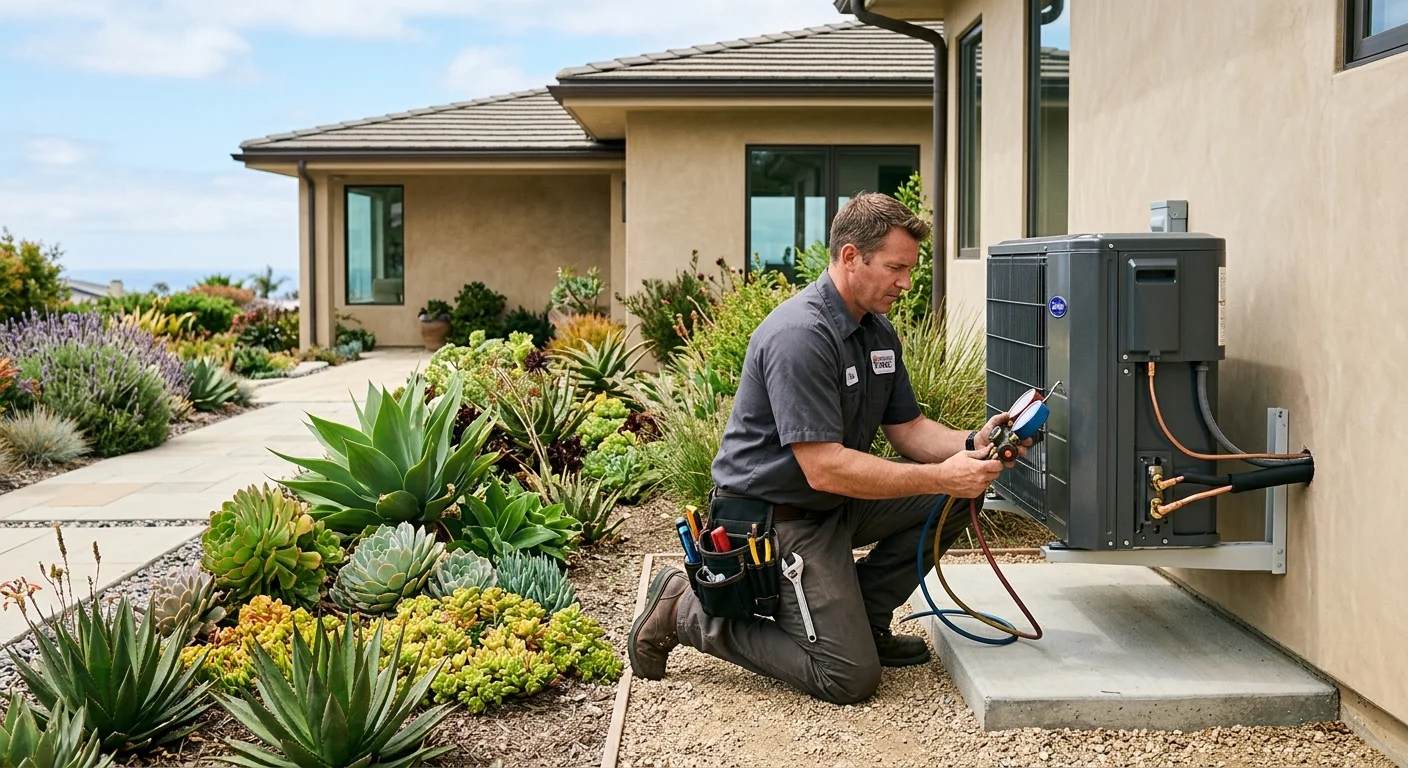
What makes Carlsbad AC installs different from inland
Three things change the install picture in Carlsbad compared to North County inland cities.
Coastal-rated equipment. Any condenser unit installed within five miles of the Pacific in Carlsbad should have a manufacturer-applied coated coil and corrosion-resistant cabinet finish. This applies to properties in Carlsbad Village (92008), the coastal La Costa area (92009), Aviara (92011), and most of the city east to around the 78. It’s not optional if you want the equipment to reach its design service life. Quality contractors include coastal-rated equipment as the standard spec in Carlsbad; be cautious of quotes that are significantly cheaper because they’re speccing inland-rated units.
HOA architectural review. Aviara, La Costa Valley, Bressi Ranch, and Calavera Hills all have active HOA oversight. Exterior equipment changes, including condenser placement, screening, and refrigerant line routing, typically require review and approval before the install. This adds a week or two to the timeline in most cases. It doesn’t add to the cost, but it needs to be accounted for in scheduling.
Carlsbad Village older housing stock. The original Carlsbad Village neighborhoods along Carlsbad Boulevard and east into the older grid predate the newer development. These homes often have original ductwork and in some cases original electrical panels. Retrofit installs here are more likely to involve additional scope, duct sealing or replacement, and occasionally electrical upgrades.
What belongs on a Carlsbad install quote
Ask for installed price in dollars, including coastal-rated equipment, labor, refrigerant, and permit, with ductwork called out separately:
- Central AC replacement (single-stage, coastal-rated)
- Central AC replacement (two-stage or variable-speed, coastal-rated)
- Heat pump (full replacement, La Costa or Aviara estate scale)
- Mini-split, single zone (ductless, coastal-rated)
La Costa and Aviara estate-scale properties with higher square footage, multi-zone systems, or larger tonnage sit at the top. Carlsbad Village older homes that need ductwork work add a separate line.
Climate Pros SD does not publish those bands. The Carlsbad premium over inland cities reflects coastal-rated equipment and HOA-dense project management.
La Costa and Aviara vs. Carlsbad Village vs. Bressi Ranch and Calavera Hills
Each neighborhood has a different typical install profile.
La Costa and Aviara are the premium end of Carlsbad’s housing market. Larger homes, often with multiple zones or two-story layouts with zoning requirements, higher cooling loads, and property values that make high-efficiency variable-speed equipment the right match. These homeowners are also more likely to have solar PV already installed, which changes the heat pump economics meaningfully. HOA review in Aviara is thorough, and equipment placement and screening requirements are specific.
Carlsbad Village older housing is the highest-variability category. A pre-1970s home near the village core might have original ductwork, single-pane windows, and an electrical panel that needs attention before a new condenser can be installed. It’s worth budgeting conservatively and getting a scope review before signing a contract, rather than discovering additional work mid-install.
Bressi Ranch and Calavera Hills are newer tract construction, primarily from the 2000s. These homes have more standardized HVAC footprints, better insulation than older stock, and ductwork that’s still in reasonable shape. HOA review applies in both neighborhoods. Most installs here are straightforward replacements with predictable scope.
Why a heat pump makes particular sense in Carlsbad’s mild climate
This is counterintuitive: the milder your climate, the better heat pump economics get. Here’s why.
A heat pump’s efficiency advantage shows most strongly at part load. In Carlsbad, where most summer days are cool enough that the system runs for a few hours rather than all day, the heat pump spends most of its operating hours at part load, which is exactly where variable-speed inverter-driven systems pull away from single-stage equipment on efficiency. You’re not paying for peak-capacity performance you rarely need.
On the heating side, Carlsbad winters are mild enough that a heat pump almost never has to work hard. Temperatures rarely drop below 45°F, which keeps the heat pump in its highest efficiency operating range all winter. A gas furnace burning fuel at the same outdoor temperature is doing so at a fraction of the efficiency a heat pump achieves by moving heat rather than generating it.
One 2026 incentive applies to Carlsbad heat pump installs:
- SDG&E heat pump rebates: Confirm current amounts on sdge.com/rebates. Higher amounts typically go to whole-home heat pump conversions using variable-speed equipment.
The federal 25C Energy Efficient Home Improvement Credit expired for systems installed after December 31, 2025, so it no longer applies to a 2026 install. A 2025 install could still claim up to $2,000 on the 2025 return per the IRS.
Ask the matched installer for the live stack. A standard central AC carries no heat pump rebate. The rebate often narrows the gap between the two options.
If you already have solar PV, the math tilts more sharply toward the heat pump because all-electric heating runs on your own generation during SDG&E’s peak winter rate periods.
See our San Diego heat pump rebate stack guide for 2026 for full eligibility details.
Permitting and install day in Carlsbad
A changeout in the City of Carlsbad normally needs a mechanical permit. The matched company confirms the current requirement with the building department. The permit covers refrigerant handling, electrical connections, and a final inspection by the city. Permit fees are published by the city for that scope. Climate Pros SD does not publish a permit-fee table. A licensed contractor handles the permit paperwork. Ask for the permit number before work begins.
Most Carlsbad replacements in newer tract housing finish in one to two days. Older Carlsbad Village installs with ductwork or electrical scope add a day. Full heat pump conversions including furnace removal typically run two to three days. HOA approval needs to be in hand before scheduling, which means getting the review process started as soon as you decide to proceed.
Before signing any contract, verify the contractor on the CSLB website.
FAQs
How much does AC installation cost in Carlsbad in 2026?
Ask the matched installer. Climate Pros SD does not publish coastal-rated install bands. The federal 25C tax credit expired for systems installed after December 31, 2025, so it no longer applies. Confirm current SDG&E rebate status at quote time.
Do I really need coastal-rated HVAC equipment in Carlsbad?
Yes, for any property within five miles of the ocean, which covers most of Carlsbad. Standard HVAC equipment degrades significantly faster under salt-air exposure. A coastal-rated unit with a factory-applied coated coil typically outlasts a standard unit by five to eight years in a coastal environment. The 10 to 15% upfront premium pays back in avoided early replacement.
Does my Aviara or La Costa HOA need to approve a new AC unit?
Most Aviara and La Costa HOA agreements require architectural review for exterior equipment changes. Condenser placement, screening requirements, and refrigerant line routing are typical review items. Start the HOA approval process as soon as you decide to proceed, since it adds one to two weeks before the install can be scheduled.
Is a heat pump worth it in Carlsbad’s mild climate?
Particularly yes, for two reasons. Mild weather means the system operates at part load most of the time, which is where heat pump efficiency advantages are largest. And an SDG&E rebate, when funded, often brings the real out-of-pocket cost closer to a conventional AC replacement. The federal 25C credit expired for 2026 installs, so it’s no longer part of the math.
What about Carlsbad Village older homes?
Pre-1970s construction in the village core needs careful scoping before committing to a system. Ductwork condition, electrical panel capacity, and attic access vary significantly. Budget conservatively and ask for a full scope review before signing, rather than discovering additional work after the crew arrives.
When to call us
If your Carlsbad home is running aging equipment or you’re replacing a system that failed during a heat event, getting accurate sizing and a coastal-spec cost estimate before summer demand peaks is the right move. Call us at (442) 777-6440 for an estimate. For full line-item pricing, coastal equipment specs, and the rebate stack breakdown, see our AC installation in Carlsbad service page.