San Marcos doesn’t get the coastal marine layer that keeps Encinitas and Carlsbad mild through July. Once you’re east of I-5 and into the valley terrain around 92069 and 92078, summer temperatures run well above the coastal normals on a normal weekday, not just during Santa Ana events. A system sized for coastal San Diego will run nonstop and still leave your house ten degrees warmer than the thermostat says.
San Marcos rule of thumb: most inland valley homes need 0.5 to 1 full ton more cooling capacity than the national square-footage estimate suggests. The “one ton per 600 square feet” shortcut was built around a design temperature closer to 85°F. San Marcos’s 95th-percentile design day runs a full 10 to 15 degrees hotter than that, with direct southern and western sun exposure on most tract lots. Skip the proper load calculation and your new system short-cycles through August, wears out years early, and never quite keeps up.
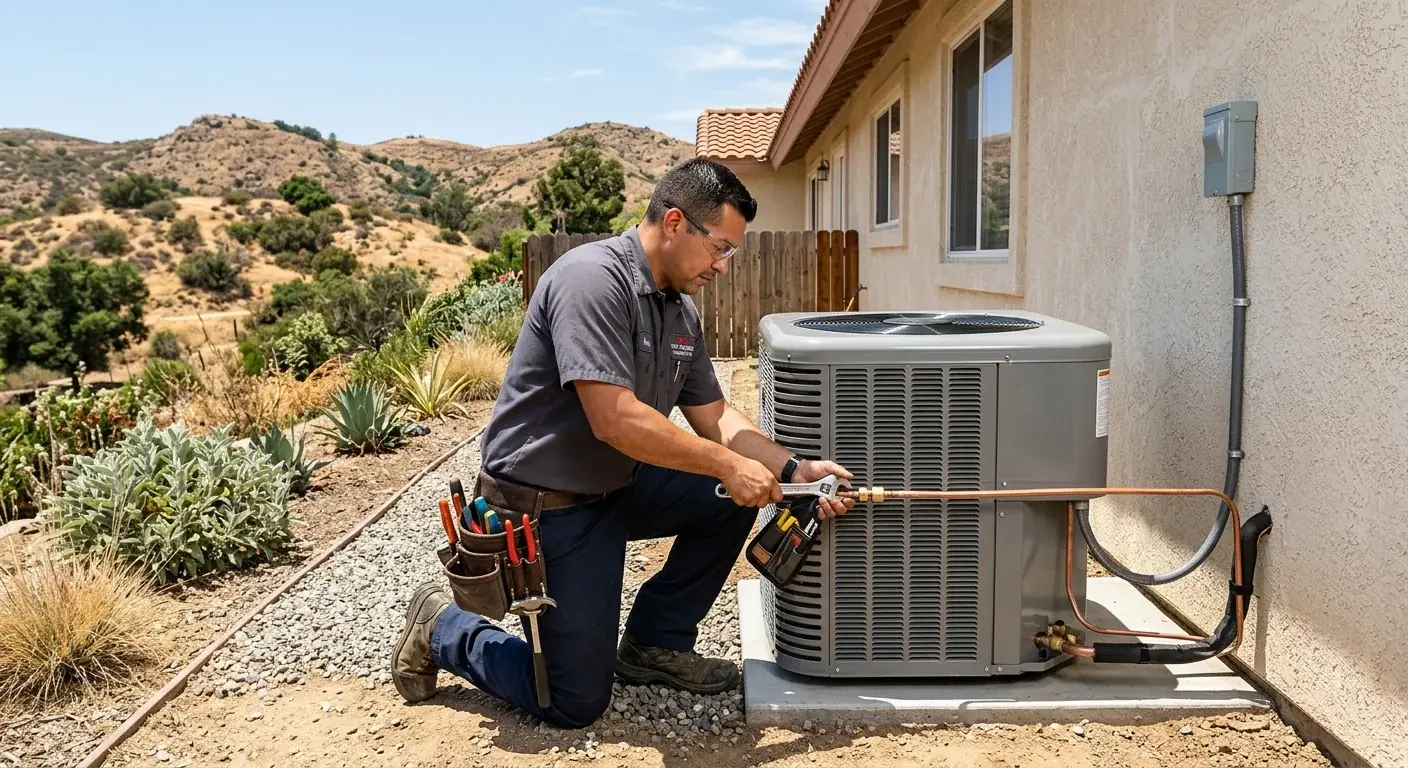
Why Manual J matters more in San Marcos than on the coast
San Marcos covers meaningfully different housing stock depending on the neighborhood, and each type sizes differently.
San Elijo Hills is largely newer construction, built from the early 2000s through today, with tighter building envelopes, dual-pane windows, and modern insulation. Those homes tend to be two-story with significant south and west glazing, which raises the cooling load despite better insulation. The good news is that attic access is typically clean and ductwork is usually in workable condition.
Lake San Marcos housing is almost entirely from the 1960s and 1970s, built as a retirement community. Single-story, lower ceilings, original single-pane windows in many cases, and ductwork that’s been in place for fifty years. These homes often calculate at a higher load than their square footage alone would suggest, and the duct system frequently needs attention before a new unit will perform correctly.
Twin Oaks Valley and the areas around Cal State San Marcos lean toward 1980s and 1990s tract construction, plus a fair amount of rental stock given the proximity to the university. Rental properties in particular often have deferred HVAC maintenance and ductwork that hasn’t been inspected in a decade.
No reputable contractor should quote you a system size without walking the house. If someone gives you a tonnage number over the phone based on square footage alone, that’s a sign to keep calling.
What drives install cost in San Marcos
Several factors move the number up or down:
Equipment type and efficiency tier. A single-stage conventional AC is the cheapest upfront. A two-stage or variable-speed unit costs more but runs more efficiently in San Marcos’s long cooling season, where a system might run eight to ten hours a day through June, July, and August. A heat pump replaces both the AC and the furnace in one unit and qualifies for significant rebates (more on that below).
Ductwork condition. This is the wild card in Lake San Marcos especially. Original 1970s flex duct loses significant capacity to leaks and collapse over time. If an inspection finds that more than 20% of duct capacity is being lost, replacing or resealing the duct system before installing new equipment makes sense. A high-efficiency unit on a leaky duct system will never perform to spec.
City of San Marcos permit. Mechanical permits for HVAC replacement in San Marcos are published by the city for that scope. Climate Pros SD does not publish a permit-fee table. Any contractor who says they’ll skip the permit to save you money is creating a problem for your homeowner’s insurance and resale.
HOA architectural review in San Elijo Hills. Most San Elijo Hills HOA agreements require approval for exterior equipment changes. The condenser placement and screening requirements add a step to the timeline, not the cost, but plan for it.
Title 24 compliance. California’s Title 24 energy code applies to HVAC replacements. Any system installed in San Marcos must meet the current minimum efficiency standards for the climate zone.
What belongs on a San Marcos install quote
Ask for installed costs, including equipment, labor, refrigerant, and permit, with ductwork in serviceable condition called out separately:
- Central AC replacement (single-stage)
- Central AC replacement (two-stage or variable-speed)
- Heat pump (full replacement, replacing AC and furnace)
- Mini-split, single zone (ductless)
If ductwork needs full replacement, that is a separate line. Older Lake San Marcos homes with original flex duct and tight attic crawl space sit at the high end.
Climate Pros SD does not publish those bands.
Heat pump vs. central AC in San Marcos: the rebate math
San Marcos is exactly the situation where the 2026 incentive stack makes heat pumps worth a serious look, even if a conventional AC seems cheaper upfront.
One incentive applies:
- SDG&E heat pump rebates: Confirm current amounts on sdge.com/rebates. The higher end typically goes to whole-home heat pump conversions using high-efficiency variable-speed equipment.
The federal 25C Energy Efficient Home Improvement Credit expired for systems installed after December 31, 2025, so it no longer applies to a 2026 install. A 2025 install could still claim up to $2,000 on the 2025 return per the IRS.
A standard central AC carries no heat pump rebate, so after an SDG&E incentive the gap between AC and heat pump often narrows. Ask the matched installer for the live stack.
Beyond the rebate math, San Marcos has genuine winter nights. Temperatures drop into the low 40s from December through February, which means you actually use a heating system. A heat pump handles both seasons from one unit with no gas combustion, which also positions the home better if SDG&E rates continue to shift in favor of electrification.
The TECH rebate has eligibility rules and requires a contractor enrolled in the program. See our San Diego heat pump rebate stack guide for 2026 for the full breakdown on who qualifies.
Permitting and install day in San Marcos
A changeout in the City of San Marcos normally needs a mechanical permit. The matched company confirms the current requirement with the building department. The permit covers refrigerant handling, electrical connections, and a final inspection. A properly licensed contractor handles the paperwork. You should see the permit number before the crew starts work, not after.
Most standard replacements in San Marcos finish in one to two days. Add a day for ductwork repairs or if an electrical panel upgrade is needed. Heat pump conversions that remove the gas furnace typically run two to three days.
Verify any contractor you hire on the CSLB website before signing anything.
FAQs
How much does AC installation cost in San Marcos in 2026?
Ask the matched installer. Climate Pros SD does not publish AC or heat-pump install bands. Rebate programs change year to year. Confirm current SDG&E rebate status at quote time. When a rebate is active, a heat pump can land close to a straight AC replacement out of pocket.
Do I need a bigger AC unit in San Marcos than on the coast?
Most San Marcos homes need 0.5 to 1 ton more capacity than the national square-footage formula suggests. Inland valley heat loads run materially higher than coastal design temperatures. Always get a Manual J load calculation, not a tonnage estimate based on square footage alone.
What’s the condition of ductwork in Lake San Marcos homes?
Original 1970s flex duct in Lake San Marcos housing is almost universally degraded. Before installing any new system, a duct leakage test or visual inspection is worth doing. Replacing severely degraded ductwork alongside the new equipment usually costs less than revisiting it separately two years later.
Does my San Elijo Hills HOA need to approve my new AC unit?
Most San Elijo Hills HOA agreements require architectural review for exterior equipment changes. That typically covers condenser placement and any required screening. The process adds to your planning timeline but not to your cost. Your contractor should be familiar with this step.
How long does AC installation take in San Marcos?
Standard replacements finish in one to two days. Ductwork repairs add a day. Full heat pump conversions that replace the furnace run two to three days. The mechanical permit inspection adds a separate visit after install, usually within a week.
When to call us
If your San Marcos home is running a 15-year-old system through another San Diego County summer, or you’re replacing equipment after a failure, the right time to get sizing and cost information is before the peak of summer demand, not during it. Call us at (442) 777-6440 for an estimate. For full line-item pricing and the rebate stack math on a heat pump conversion, see our AC installation in San Marcos service page, or start from the San Marcos HVAC hub for everything we do in the city.