El Cajon earns its reputation as one of the hotter cities in San Diego County, but winters are real here. NOAA 1991-2020 January normal low at El Cajon is about 43F. Some nights push colder. Furnaces in El Cajon run several months a year, which is enough to matter when something breaks.
Climate Pros SD matches you with licensed HVAC companies. We do not repair equipment, own trucks, or publish repair prices.
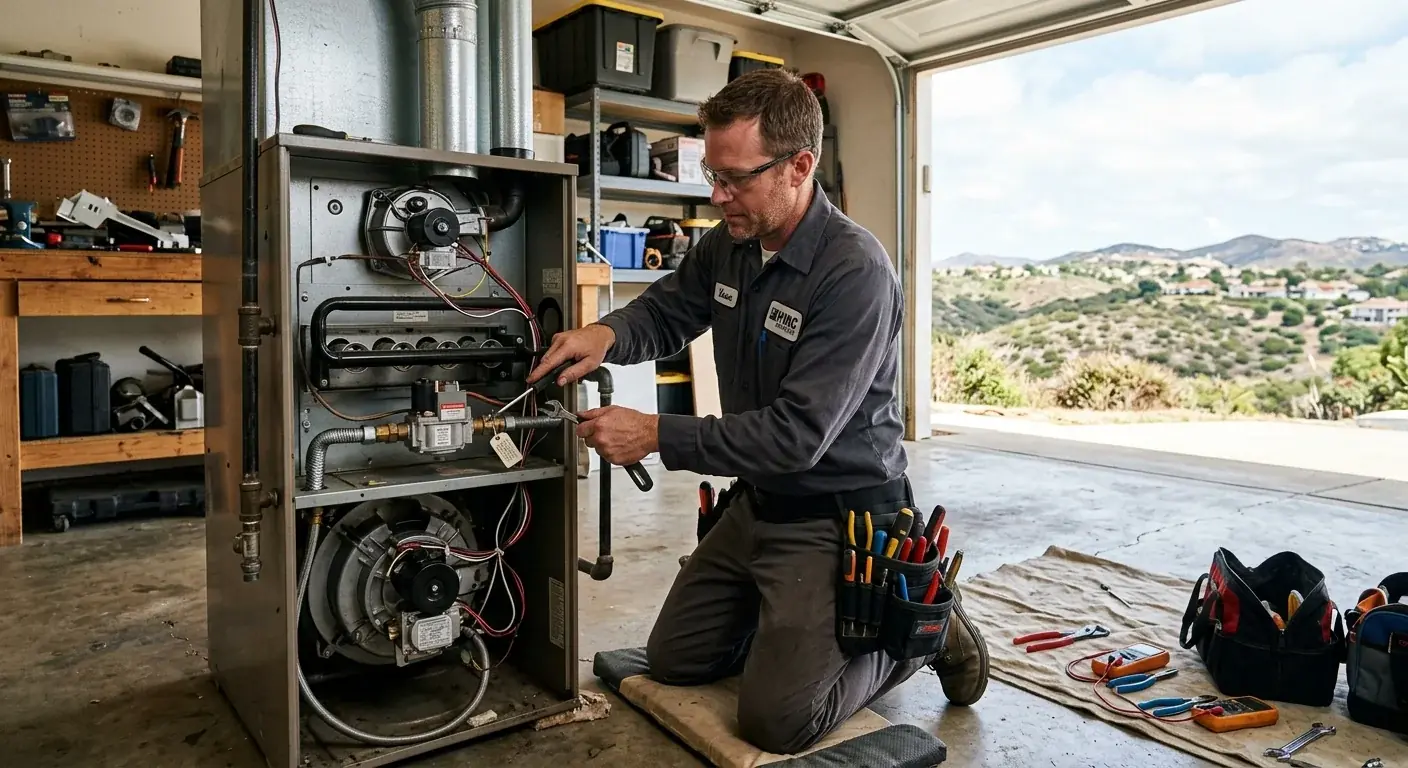
What makes El Cajon different from coastal cities is the housing stock. A significant portion of homes around downtown El Cajon and Bostonia were built in the 1960s and 1970s. Those furnaces are deep into their replacement window, or already past it. The rental-heavy pockets around these neighborhoods add another layer: filters that haven’t been changed in years, and systems that haven’t seen a service call in a decade.
This guide covers what fails most in El Cajon homes, how to read a 2026 quote, and when replacement makes more sense than repair.
Why El Cajon’s heating season creates predictable problems
El Cajon’s AC-dominant climate means furnaces sit idle for eight months or more. They accumulate dust through a long, dry, hot summer and don’t get used until fall. When October cools down and a homeowner finally turns on the heat, that’s when problems surface.
The extended idle period is hard on two specific components: the ignitor and the flame sensor. Both are sensitive to contamination, and both are sitting in a dusty, dry environment for most of the year. The result is the most common fall call in El Cajon: the furnace won’t start, or it starts and shuts off within a few seconds.
Rental properties in 92020 and 92021 add a maintenance gap that makes this worse. Tenants don’t change filters, landlords don’t schedule annual service, and systems run with restricted airflow until something breaks. A clogged filter doesn’t just reduce comfort. It causes the furnace to overheat, trips the high-limit safety switch, and eventually damages other components.
Common furnace failures in 92020 and 92021
Dirty filters causing fall lockout is the most preventable problem in El Cajon. A filter clogged with a summer’s worth of dust blocks airflow into the furnace. The unit overheats, the high-limit switch trips, and the furnace shuts down. Sometimes a new filter and a reset is all it takes. But repeated high-limit trips can damage the switch itself, adding a component replacement to what started as a filter change.
Ignitor and flame sensor failures are the top mechanical failures in El Cajon. The hot-surface ignitor glows orange to light the gas burner. The flame sensor confirms the flame is lit. When either fails or gets coated in residue from sitting idle, the furnace won’t start or shuts down as a safety measure immediately after ignition. You might hear the furnace attempt to fire two or three times before giving up. This is a common pattern and a straightforward repair for a licensed tech.
Cracked heat exchangers in older downtown and Bostonia stock are a serious safety concern. Homes from the 1960s and 1970s in central El Cajon often have furnaces that are 20 to 30 years old, or older. After that many years of heating cycles, heat exchangers develop cracks. A cracked heat exchanger allows combustion gases, including carbon monoxide, to mix with the air circulating through the house. It’s not a repair situation. It’s a replacement situation.
Blower motor wear shows up across all El Cajon housing, given how hard the blower runs during the long cooling season. The same motor that pushes cold air in August pushes warm air in December. High annual runtime adds up. Signs include grinding or squealing noise, weak heat distribution even when the furnace is running, or intermittent blower operation.
What a 2026 furnace quote in El Cajon should include
These are the jobs that come up, not a price list. The matched pro sets the diagnostic fee and confirms it before the visit.
- Ignitor replacement
- Flame sensor cleaning or replacement
- Filter replacement and high-limit switch reset (or switch replacement if it was damaged by repeated trips)
- Blower motor capacitor
- Blower motor replacement (varies by motor type)
- Gas valve replacement (safety-critical)
- Heat exchanger: a cracked heat exchanger is not a repairable condition. Replacing just that component typically exceeds the value of the furnace. Full unit replacement is the appropriate response.
Ask for the diagnostic fee in dollars, whether it applies toward repair if you approve the work, the failed part named, and warranty in writing.
Older downtown and Bostonia housing vs. Fletcher Hills newer stock
The neighborhood matters when evaluating whether a repair is worth making.
Downtown El Cajon and Bostonia have a concentration of older housing stock from the 1960s through the 1980s. Furnaces in these homes are often original equipment or were replaced once in the 1990s or early 2000s, putting them in the 20 to 30-plus year range now. These units operate at lower efficiency, parts are harder to source, and the heat exchangers are at elevated risk of cracking. A major repair on a 25-year-old system in this part of El Cajon almost always fails the 50 percent heuristic.
Fletcher Hills and the newer hillside developments to the east have more recent construction, with many homes built in the 1990s and 2000s. Systems there are typically 15 to 25 years old, which puts some of them in the repair window and some approaching replacement territory. A Fletcher Hills furnace that needs an ignitor or flame sensor is worth repairing. One that needs a blower motor and is already 20 years old deserves a closer look before committing to the repair.
Rental properties throughout El Cajon are a special case. Deferred maintenance means failures cascade. A repair that fixes today’s problem may not fix tomorrow’s if the system has been running with dirty filters and no service for years.
Repair vs. replace: how the math works in El Cajon
The standard benchmark is the 50 percent rule: if the repair costs more than 50 percent of the cost of a new furnace, replace instead. Use the actual new-system quote from a licensed contractor, not a blog range. Climate Pros SD does not publish installed furnace prices.
With older El Cajon housing stock, that threshold is reached more often than it is in newer North County neighborhoods. A blower motor replacement on a 28-year-old downtown El Cajon unit is often the last expensive repair before something else fails. Age shifts the math toward replacement even when the specific repair cost falls under the threshold.
A cracked heat exchanger bypasses the rule entirely. When a technician finds one, the conversation is about replacement, not cost comparison. It’s a safety issue.
If you’re not sure which side of the line you’re on, the diagnostic visit tells you the unit’s age, AFUE efficiency rating, and overall condition. That information makes the decision straightforward.
Related services: furnace repair and AC repair.
When to call us
If your El Cajon furnace isn’t starting, is cycling on and off without heating your home, is making unusual noise, or you haven’t had it serviced and want to catch problems before they become emergencies, call (442) 777-6440. Climate Pros SD matches you with a licensed pro for downtown El Cajon, Bostonia, Fletcher Hills, Rancho San Diego, and all of 92020 and 92021. Ask whether a tech is available today, yes or no. This brand does not prioritize calls or promise arrival windows.
Before hiring any HVAC company, verify their contractor licensing on the CSLB website.
For El Cajon housing-stock notes and repair vs. replace guidance for older East County homes, see our furnace repair in El Cajon service page.