Poway’s inland valley location means genuine cold winters by San Diego standards. NOAA 1991-2020 January normal low at Rancho Bernardo (the station used for Poway) is about 46F. Colder snaps happen. The heating season runs several months, which is longer than most coastal cities in the county. That’s real furnace use, and it creates real wear.
Climate Pros SD matches you with licensed HVAC companies. We do not repair equipment, own trucks, or publish repair prices.
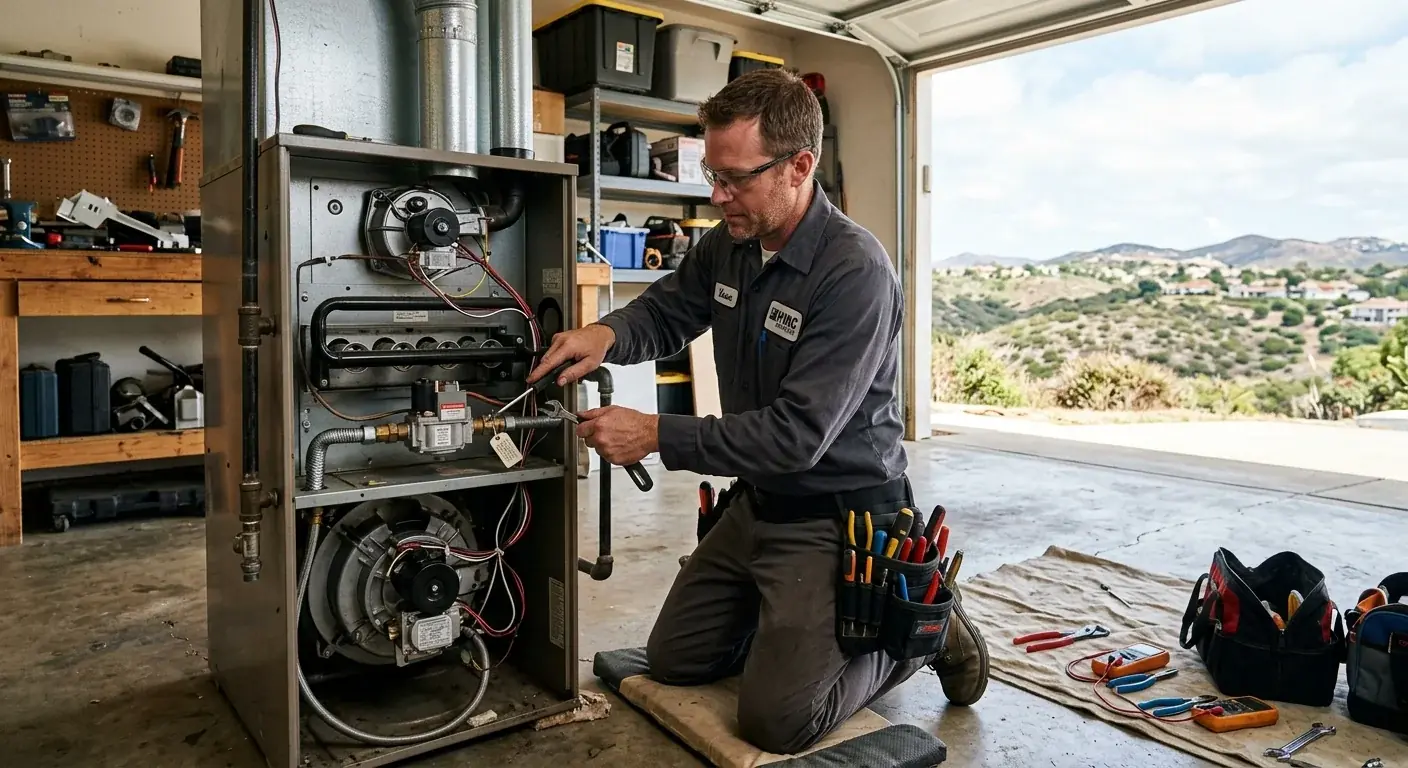
Poway also has a quirk that most other San Diego cities don’t: PSPS events. When SDG&E cuts power to eastern Poway during high fire-risk weather and then restores it, the power surge that follows can damage furnace control boards and electronic ignitors. It’s a failure pattern that shows up repeatedly in Poway homes, and it’s worth understanding before you assume your furnace failed for any other reason.
This guide covers what fails most in Poway, how to read a 2026 quote, and how to decide whether to fix or replace your heating system.
What makes Poway furnace failures different
Green Valley Trails is one of Poway’s most established neighborhoods, with many homes built in the 1980s and early 1990s. That stock is now 30 to 45 years old, and the furnaces in many of those homes are deep into their replacement window. Some have been replaced once already. Others are still running on the original equipment.
Old Poway Village has an even older mix of custom homes, some dating back to the 1960s and 1970s. These properties tend to have had more maintenance than rental stock, but decades of cycling still takes a toll on burner assemblies, heat exchangers, and blower motors.
The PSPS factor is specific to eastern Poway and the hillside communities. SDG&E shuts off power to reduce wildfire ignition risk during high wind events, sometimes for many hours at a stretch. When power comes back, the restoration surge can damage sensitive electronics in modern furnaces. Control boards and electronic ignitors are the most common casualties. If your furnace stopped working after a PSPS restoration, that’s almost certainly the cause.
Common furnace failures in Poway
PSPS surge damage to control boards and electronic ignitors is the failure type HVAC techs see most often in eastern Poway homes. A power surge hits the board’s microprocessor or the ignitor’s heating element. The furnace tries to start, you hear a click or nothing at all, and no heat comes out. The fix is a control board replacement or a new ignitor. The smarter follow-up, quoted separately, is a whole-home surge protector so the next event doesn’t cook the new part. The matched licensed electrician or HVAC contractor installs that; Climate Pros SD does not.
Cracked heat exchangers in Green Valley Trails are a growing concern as that housing stock ages past 30 years. Heat exchangers are metal chambers that separate the combustion gases from the air you breathe. After decades of expansion and contraction cycles, cracks develop. A cracked heat exchanger puts carbon monoxide into your home’s airflow. It can’t be patched. When one is found, the furnace needs to be replaced.
Flame sensor buildup is a Poway-specific maintenance issue driven by the dry inland climate. Dust accumulates on the flame sensor rod during the long dry season. When the furnace fires up in fall, a coated sensor fails to detect the flame reliably and the furnace shuts down as a safety measure. A cleaning or replacement resolves it, but it’s preventable with annual service before heating season starts.
Blower motor wear shows up across all Poway neighborhoods, especially in homes where the system runs heavily during both heating and cooling seasons. Poway summers are hot, and the blower works hard. A motor that’s been running for 15 to 20 years through both seasons is going to show wear. Signs are grinding or squealing noise, weak airflow, or a furnace that runs but doesn’t distribute heat through the house.
What a 2026 furnace quote in Poway should include
These are the jobs that come up, including parts and labor from a licensed technician. The pro sets the diagnostic fee and confirms it with you before the visit. Climate Pros SD does not publish dollar ranges.
- Electronic ignitor replacement (a common PSPS casualty)
- Flame sensor cleaning or replacement
- Control board replacement (PSPS surge damage puts it at risk; more complex boards in newer high-efficiency units)
- Whole-home surge protector as a follow-on after a PSPS-caused board or ignitor failure
- Blower motor capacitor
- Blower motor replacement (varies by motor type and furnace model)
- Gas valve replacement (safety-critical)
- Heat exchanger: a cracked heat exchanger is not a repair situation. Replacing just the heat exchanger typically costs more than the furnace is worth. Replacement of the full unit is the standard recommendation.
Green Valley Trails estate stock vs. Old Poway Village custom homes
The distinction matters when you’re evaluating a repair vs. replace decision.
Green Valley Trails homes from the 1980s often have standard mid-efficiency furnaces that were solid equipment for their era. Many of them have been maintained reasonably well by long-term homeowners. A Green Valley Trails furnace that’s 25 to 30 years old and needs a control board or blower motor is at the threshold where the 50 percent rule applies. The age alone pushes it toward replacement, especially since parts for older models can be hard to source.
Old Poway Village custom homes vary more widely. Some have had updated HVAC systems over the years. Others are running on equipment that’s older than expected given the home’s pedigree. These homes tend to have more complex ductwork than tract homes, so installation for a furnace replacement can run higher. The matched licensed contractor installs; Climate Pros SD does not.
If you’re not sure what you have, a diagnostic visit answers the question. Age, AFUE rating, and overall condition are assessed as part of every service call.
When a heat-exchanger swap is never the right answer
There’s one scenario where the answer is almost always replacement rather than repair: a cracked heat exchanger. Contractors sometimes quote heat exchanger replacements. By the time that repair is complete, you’ve spent most of what a new furnace would cost, on a unit that’s still old, still inefficient, and still going to fail in other ways in the near future.
The general rule: if the repair costs more than 50 percent of the cost of a new furnace, replace it. Use the actual new-system quote. Climate Pros SD does not publish a Poway install range.
Age is the other factor. A furnace under 10 years old is almost always worth repairing, assuming the heat exchanger is sound. A furnace over 20 years old is rarely worth a major repair. Green Valley Trails homes with 30-year-old systems are deep in replacement territory unless the issue is a minor part.
Related service: AC repair.
When to call us
If your Poway furnace won’t start, is cycling repeatedly without heating the house, is making grinding or squealing noise, or stopped working after a PSPS restoration, call (442) 777-6440. Climate Pros SD matches you with a licensed pro. Ask for the diagnostic fee in dollars, what they found, and what the repair includes before you authorize work.
Before hiring any HVAC company, verify their contractor licensing using the CSLB website.
For Poway neighborhood notes and eastern Poway PSPS damage, see our furnace repair in Poway service page.