A whole-home air purifier in San Diego usually means one of five add-ons on a ducted system. For most homes the useful first move is a 4- to 5-inch MERV 13 media filter cabinet, not UV, ionization, or true HEPA. Those other technologies solve narrower problems. Climate Pros SD does not install this equipment or publish installed prices. A matched licensed HVAC company quotes the retrofit after they see the filter slot, static pressure, and duct layout.
What counts as a whole-home air purifier?
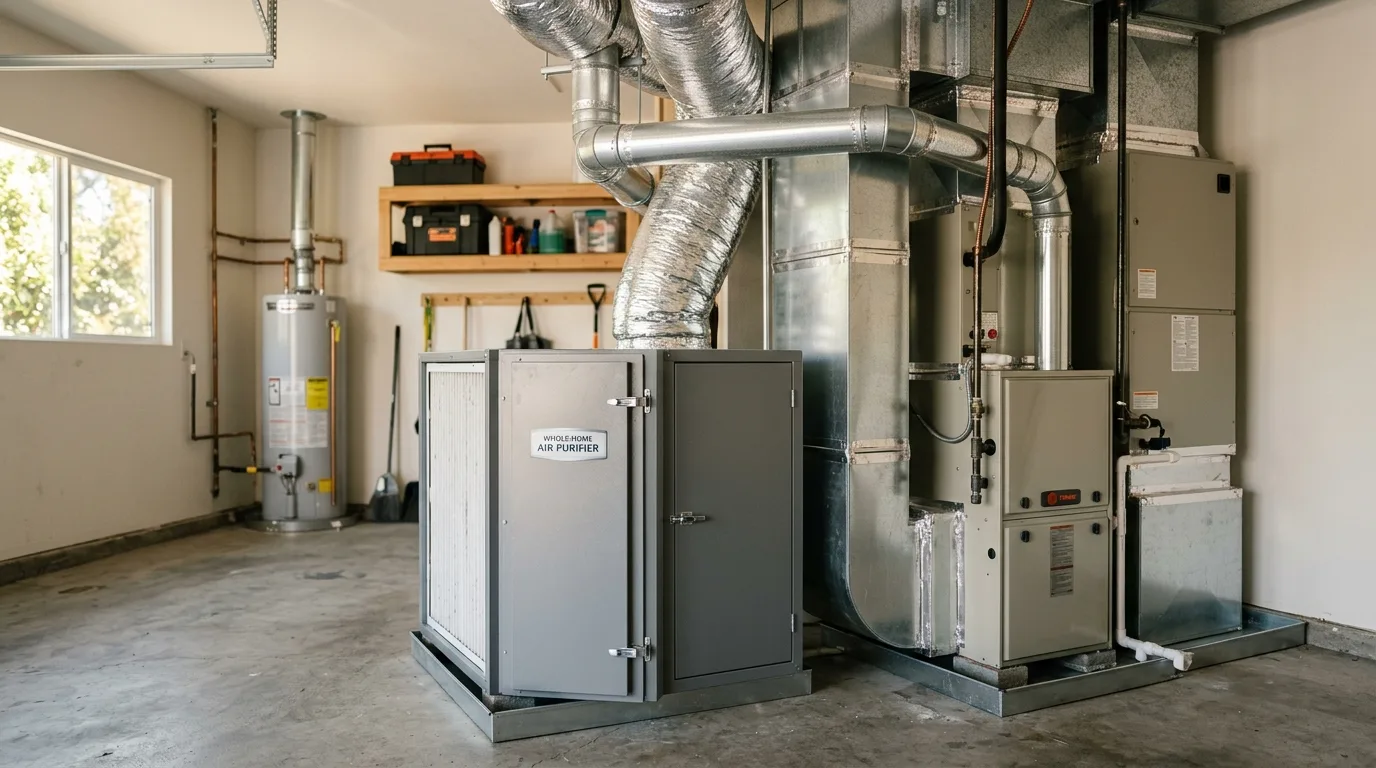
A whole-home air purifier is a device on the ducted HVAC system that treats the air the blower moves for the whole house. That is different from a portable that cleans one room.
Five common types, and they are not interchangeable:
- High-MERV media filtration. A thick pleated filter in a dedicated cabinet. Catches particles by trapping them.
- Whole-house HEPA bypass. A separate filter box with its own fan pulling air through true HEPA.
- UV-C germicidal lights. Lamps at the coil that inactivate microbes on wet surfaces.
- PCO (photocatalytic oxidation). UV plus a catalyst aimed at odors and some gases.
- Bipolar or needlepoint ionization. Charges particles so they clump and get caught downstream.
The usual San Diego mistake is buying a gadget before fixing the filter. Filtration is the foundation. Everything else is a supplement.
Which whole-home air purifier is best for a San Diego home?
For most houses here, start with a MERV 13 media cabinet. It is aimed at what local air actually carries: fine wildfire smoke in fall, oak and eucalyptus pollen, inland dust, and marine aerosols at the coast. It has no ozone byproduct from the filter itself, no UV bulbs, and it works whenever the blower runs.
| System | What it is for | Weakness |
|---|---|---|
| MERV 13 media cabinet | Smoke, pollen, dust, dander | Needs a deep slot; 1-inch slots starve high-MERV filters |
| Whole-house HEPA bypass | Finest smoke and particles at HEPA efficiency | Extra fan, more restriction, higher upkeep |
| UV-C at the coil | Mold and biofilm on wet coil and pan | Does not filter pollen, dust, or smoke |
| PCO | Niche odor/gas claims | Limited evidence; ozone risk on some devices |
| Bipolar ionization | Helps particles clump | Modest real-world particle benefit; ozone risk on some devices |
The highest-value upgrade is often moving from a 1-inch slot to a 4- or 5-inch cabinet. More media area means MERV 13 without choking the blower or freezing the coil. A licensed contractor can say whether your cabinet and static pressure allow it.
For asthma and allergy setup, see HVAC for asthma and allergies. For ratings, MERV rating guide.
Do UV-C and ionizer air purifiers actually work?
UV-C does one job well and gets sold as if it did filtration. A coil-mounted lamp can limit mold and biofilm on a wet evaporator and drain pan. That biofilm is a common source of dirty-sock smell. Coastal marine-layer houses keep coils damp longer, which is when UV is worth discussing. UV does not capture pollen, dust, or smoke.
Ionization is a harder call. Charged particles can clump and hit the filter, but independent testing often shows a modest benefit, and some ionizing and PCO devices emit ozone. CARB regulates ozone-generating air cleaners because ozone irritates lungs. Ask for CARB certification and measured ozone output before anything goes in the ducts. When in doubt, a media cabinet does the particle job without adding ozone.
How should you compare cost without a fake installed table?
Climate Pros SD does not have a parts-and-labor ledger. Ask the matched company to price, separately:
- Cabinet or bypass box and the filter it uses
- Sheet-metal transitions and whether static pressure stays in spec
- Electrical for UV or a HEPA fan
- Replacement media, HEPA cartridges, or UV bulbs, and the change interval they actually recommend
Ongoing replacements often matter more than the first invoice. A media cabinet is cheap to feed. UV and HEPA need scheduled parts.
Whole-home vs a portable air purifier: which should you buy?
Buy whole-home if you want every room treated whenever the system runs. Buy a portable if you rent, cannot open the ducts, or you mainly care about one bedroom. They are not rivals. A media cabinet plus one portable HEPA in the bedroom is a strong smoke-season setup.
Portables are rated by CADR. Match CADR to the room. A portable cannot treat the whole house; a whole-home system cannot give one room extra punch on a bad-air night.
The San Diego angle: what you’re actually filtering
- Wildfire smoke (often September to November). Fine PM2.5. On smoke days, fan “on” instead of “auto” so air keeps moving through the filter. If you have a fresh-air ventilator, switch it off during the event. Santa Ana winds and wildfire smoke.
- Oak and eucalyptus pollen. Heavier inland and in canopy neighborhoods. MERV 13 is the particle tool.
- Coastal humidity and mold. From Imperial Beach to Oceanside, damp coils are a UV or dehumidification question, not a filter-only problem. Coastal humidity and AC.
- Agricultural and road dust inland. Ramona, Valley Center, Fallbrook, and Jamul. Thicker media and a real change schedule matter more than add-on gadgets.
EPA does not recommend routine duct cleaning on a fixed schedule; it recommends cleaning as needed when there is substantial visible mold, vermin, excessive dust, or particles blowing from supplies. Duct cleaning has not been shown to prevent health problems. See EPA duct cleaning guidance. Sealing leaks is a different job from cleaning. ENERGY STAR duct sealing.
Whole-home air purification in Scripps Ranch, San Marcos, and the rest of the county
Scripps Ranch
Scripps Ranch grew through the 1970s through 1990s under a eucalyptus canopy. That canopy is a pollen and debris source. The same inland-adjacent position that puts the neighborhood on PSPS maps in fall wind also puts it downwind of backcountry smoke. A deep MERV 13 cabinet is the particle answer. Fan “on” on smoke days.
San Marcos
Inland North County runs long cooling cycles in summer. That is good for air cleaning (more air through the filter) and hard on a packed 1-inch filter. True HEPA is a step up for a documented medical need, not a default for tract air handlers. Oak pollen is heavier inland than on the coast.
Coastal and beach cities
From Imperial Beach through Oceanside the limiter is often moisture on the coil. Filtration will not fix a musty coil. Ask about UV-C versus a dehumidifier. Coastal humidity.
East County and the backcountry
Alpine, Ramona, Jamul, and Valley Center carry dust and higher fire exposure. Filter thickness and change interval beat exotic add-ons.
FAQs
Which whole-home air purifier is best for a Scripps Ranch home?
A 4- to 5-inch MERV 13 media cabinet is the usual first recommendation, because the problems are particles (eucalyptus debris and smoke). UV-C and ionization do not capture those particles. The matched company confirms static pressure and cabinet fit.
What is the best whole-home air purifier for a San Diego home?
For most homes, a 4- to 5-inch MERV 13 media cabinet. Step up to whole-house HEPA only for a specific medical or smoke-prep need after a contractor checks airflow.
Do whole-home air purifiers really work against wildfire smoke?
Filtration does. MERV 13 captures a large share of fine smoke; HEPA captures more. UV-C and ionizers are not smoke filters. Keep the blower moving on smoke days.
Are ionizing or ozone air purifiers safe?
Some bipolar and PCO devices produce ozone. Ask for CARB certification and measured output. A media cabinet has no ozone from the filter itself.
How much does a whole-home air purifier cost to install in San Diego?
Climate Pros SD does not publish installed prices. Ask for itemized equipment, labor, and replacement-part schedule. Scope depends on the filter slot, static pressure, and whether UV or HEPA needs its own power.
Is a whole-home air purifier better than a portable one?
They do different jobs. Whole-home covers the house when HVAC runs. A portable is better for renters or one bedroom. Many smoke-sensitive homes use both.
Will a whole-home air purifier help with allergies and asthma?
Good filtration can reduce pollen and dander in the airstream. UV and ionization do not filter allergens. This is not medical advice. See HVAC for asthma and allergies.
Related: AC repair.
Where to start
Check the filter slot. If it is 1 inch, a media cabinet retrofit is usually the first conversation, ahead of UV, HEPA, or ionization. Add the other technologies only for a named problem: musty coastal coil, documented medical-grade need, or one room that still needs a portable.
Also: indoor air quality and wildfire smoke, duct cleaning worth it, indoor air quality service, duct cleaning.
Climate Pros SD connects San Diego homeowners with licensed local HVAC companies for filtration and IAQ add-ons. Call (442) 777-6440. This guide is general information, not medical advice.