When Santa Ana winds drive smoke into San Diego, do four things. Set your system to recirculate so it pulls indoor air, not smoky outdoor air. Change your filter more often, because wind-blown dust and smoke clog it fast. Keep debris off your outdoor condenser. And if the unit struggles or the air gets bad, shut it down and call for help after the event.
San Diego sees Santa Ana winds most years between roughly October and February. The region gets about 10 to 25 events a year, with December through February the busiest stretch. The winds blow hot, bone-dry, and downslope from the desert. They drop humidity to single digits and push fire risk to its peak. They also carry grit, ash, and smoke straight into your HVAC system.
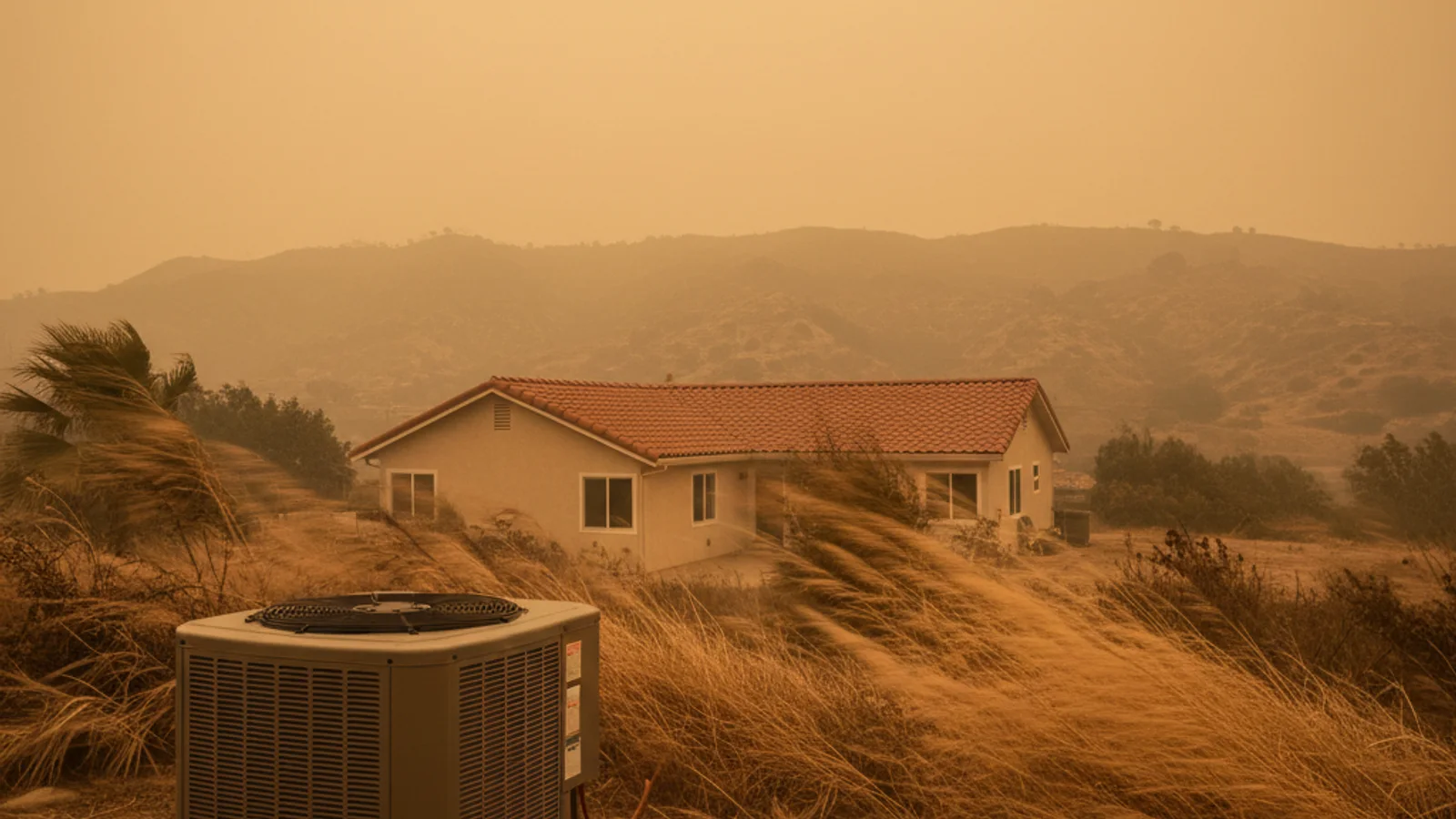
Santa Ana smoke protocol: recirculate, change filters sooner, keep the condenser clear
Do not use fresh-air economizers or open windows during a smoke event. Outdoor coils pack with dust after wind events and then overheat. East County and backcountry addresses see stronger wind-driven dust. Coastal houses still get the smoke plume on the same AQI map.
Checklist
- Set fan to recirculate.
- Stock spare filters before fire season.
- See indoor air quality wildfire.
- See AirNow.
- Use indoor air quality service.
Related: HVAC maintenance and thicker filter airflow.
This post covers the mechanical side: protecting the equipment itself. For the air you breathe inside, read our companion guide on wildfire smoke and your indoor air quality.
Set your system to recirculate, not fresh-air intake
Some San Diego homes have an HVAC system with a fresh-air intake or an outdoor damper. During a smoke event, that’s the last thing you want open, since it pulls smoky outdoor air inside.
The EPA’s guidance is direct. Set the system to recirculate mode, or close the outdoor intake damper when smoke is in the air. Most standard central systems already recirculate by default. Check whether yours has an economizer or a fresh-air setting, and call if you’re not sure.
Run the fan on continuous, not auto. Switch the thermostat fan from “Auto” to “On” so air keeps moving through the filter even when the system isn’t cooling. The EPA recommends this to maximize the filter’s effectiveness during smoke. When the air clears, even briefly, reverse it: open the intake or windows to air the house out, then go back to recirculate if smoke returns.
How Santa Ana dust and smoke clog filters and coils
A clean filter is your first line of defense, and Santa Ana conditions chew through filters fast. The winds carry desert dust and fine ash. Wildfire smoke is mostly PM2.5, particles under 2.5 microns, small enough to load up a filter quickly.
For smoke, filter rating matters. The EPA recommends a MERV 13 or higher filter if your system can handle it, since it captures a much larger share of fine smoke particles than a basic MERV 8. But there’s a catch. Higher-MERV filters add resistance, and during heavy smoke they can clog in 30 to 60 days instead of months, starving the blower and dropping airflow.
So the fire-season rule is simple: check the filter monthly, and change it the moment it looks loaded.
| Condition | Filter check schedule | Notes |
|---|---|---|
| Normal months | Every 60 to 90 days | Standard maintenance interval |
| Santa Ana event, no smoke | Every 30 days | Wind-blown dust loads filters fast |
| Active wildfire smoke | Every 30 days, inspect weekly | Heavy smoke can clog a MERV 13 in 30 to 60 days |
| After a major event | Replace once, inspect again in 2 weeks | Coils may also need a clean |
Before you jump to a higher MERV, confirm your system can take it. A filter that’s too restrictive for your blower causes more harm than good. If you’re unsure, a tech can check static pressure during a maintenance visit and confirm the highest MERV your system handles safely.
Protect the outdoor condenser from blowing debris
Your condenser sits outside, exposed, taking the full force of Santa Ana winds. They blow leaves, palm fronds, dust, and ash straight into the coil fins. That debris blocks airflow and insulates the coil, so the unit runs hotter and longer. Even a thin layer of dust can cause a meaningful loss in efficiency, and during a multi-day event that buildup happens fast.
Here’s how to protect it:
- Clear the area. Keep at least two feet of clearance on all sides and trim back plants before wind season.
- Pick up debris during the event. Remove fronds, leaves, and trash that pile against the unit so air can still pass through.
- Rinse the fins gently after the wind dies down. Use a garden hose at moderate pressure, never a pressure washer, which flattens fins. Spray from the inside out to push debris back the way it came.
- Skip the full wrap-around cover. A sealed cover traps moisture and invites rodents that chew wiring. If you cover anything, cover only the top.
If the fins are bent or the coil is packed with ash you can’t rinse clean, leave it to a pro. Bent fins and a fouled coil are a standard part of a maintenance tune-up.
When to shut the system off
Most of the time, running your AC on recirculate with a good filter is the right call during smoke. But there are moments to shut it down.
Turn the system off if any of these happen:
- The condenser is buried in debris and you can hear it straining or short-cycling.
- Smoke indoors is heavy despite recirculation, and you have a portable air cleaner you can rely on instead.
- The unit is tripping its breaker or making grinding, rattling noises.
- An evacuation order or power-shutoff event is underway and you’re leaving.
A unit pulling against a blocked coil or clogged filter can overheat and damage the compressor, the most expensive part on the system. When in doubt during a rough event, shutting down for a few hours beats a compressor repair. Inland and backcountry homes in fire-prone areas like Alpine and Ramona face this most, since they sit closest to the wind corridors and the burn zones.
After the event: post-Santa Ana maintenance
Once the winds pass and the smoke clears, your system has been through a lot. A short post-event checklist protects it from the damage that shows up weeks later.
| Task | Why it matters |
|---|---|
| Replace the filter | It loaded up fast during the event, even if it doesn’t look full |
| Rinse the condenser coil | Ash and dust insulate the coil and drop efficiency |
| Clear debris around the unit | Restores the airflow clearance the unit needs |
| Reopen the fresh-air intake | Return to normal operation once air quality is clean |
| Inspect the air handler and ducts | Fine ash gets past filters and settles in the system |
| Book a professional tune-up | Catches coil fouling, low airflow, and electrical wear from the event |
The piece most homeowners skip is the duct and air-handler check. Fine ash slips past even a good filter, settles deep in the system, and recirculates for weeks. A tune-up with a coil clean and airflow check clears that out and confirms nothing got stressed. Pair it with an indoor air quality review if smoke was heavy. Santa Ana events come back every season, so building this into your routine keeps your system ready for the next one.
Related service: AC repair.
When to call us
If your AC struggled through a smoke event, sounds different, or you just want it checked before the next Santa Ana, that’s worth a visit. We’re a referral service that connects San Diego homeowners with vetted local HVAC pros for filter service, coil cleaning, and post-event tune-ups.
Call us at (442) 777-6440 to book a post-event tune-up or filter service.
FAQs
Should I run my AC during wildfire smoke in San Diego?
Yes, in most cases, with two conditions. Set the system to recirculate so it filters indoor air instead of pulling in smoke, and run the fan on “On” not “Auto” so air keeps moving through the filter. Use a MERV 13 filter if your system handles it. Shut the unit down only if it’s straining against a clogged coil or filter, or if indoor smoke stays heavy despite recirculation.
Does Santa Ana wind damage my AC?
Indirectly, yes. The winds blow dust, leaves, and ash into the outdoor condenser coil, which blocks airflow and forces the system to run hotter and longer. That extra strain wears the compressor over time. The winds themselves rarely damage a properly secured unit, but the debris they carry does the real harm if you don’t clear and rinse the coil after the event.
How often should I change my filter during fire season?
Check it monthly, and replace it the moment it looks loaded. During active wildfire smoke, heavy particle loads can clog even a MERV 13 filter in 30 to 60 days, far faster than the usual 60 to 90 day interval. A clogged filter starves your blower and drops airflow, so don’t wait for the calendar during a smoke event.
What MERV filter is best for wildfire smoke?
The EPA recommends MERV 13 or higher for smoke, since it captures a much larger share of the fine PM2.5 particles than a basic MERV 8. The catch is that higher-MERV filters add airflow resistance, and not every system can handle one safely. Confirm your blower can take a MERV 13 before installing it. A tech can check static pressure and tell you the highest rating your system supports.
What should I do for my HVAC after a Santa Ana wind event?
Replace the filter, rinse the condenser coil with a gentle garden hose from the inside out, clear debris around the unit, and reopen the fresh-air intake once the air is clean. Then book a tune-up that includes a coil clean and an airflow check. Fine ash settles deep in the air handler and ducts where filters don’t catch it, so a professional inspection after a major event is worth it.