A standard 10 to 13.5 kWh home battery can run a right-sized variable-speed AC or heat pump for roughly 3 to 8 hours, but only if the inverter can handle the startup surge. Single-stage compressors draw a locked-rotor surge of 15,000 watts or more for a fraction of a second, and plenty of battery inverters can’t deliver that without a soft-start kit installed first. Climate Pros SD does not publish a kit or battery dollar menu. Here’s what actually determines whether your battery keeps the air on during a San Diego outage.
Will a battery backup actually run your AC?
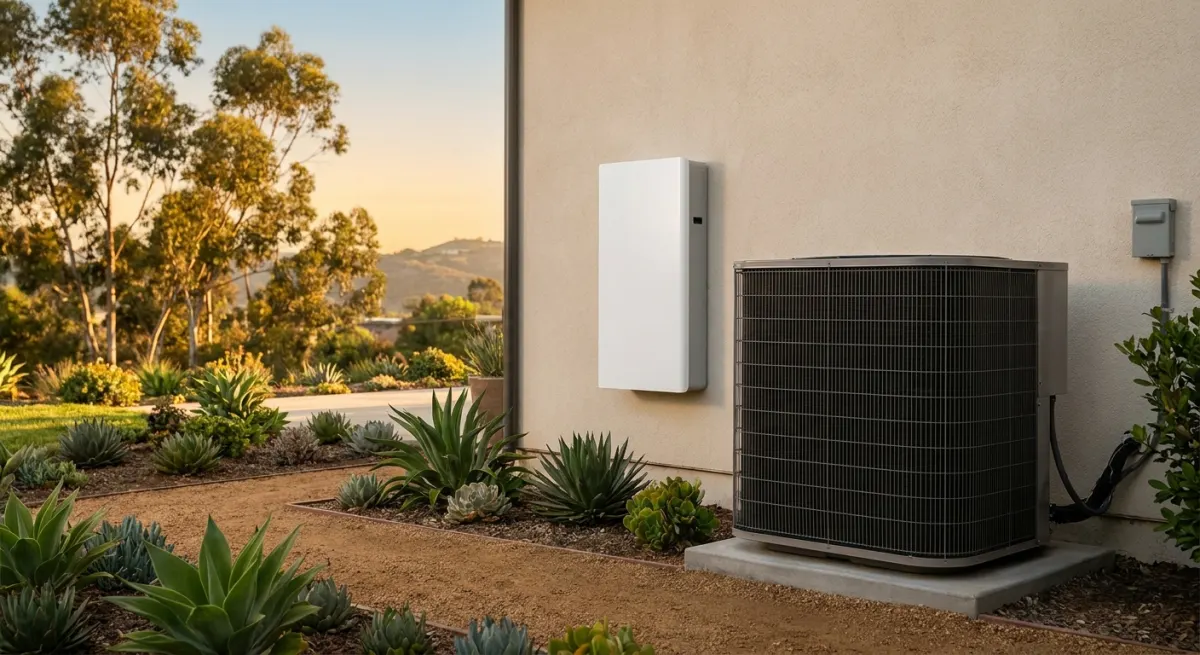
Yes, but two different numbers decide it, and most people only check one. A battery’s kWh rating tells you how long it lasts. A battery’s kW output rating tells you whether it can start your compressor in the first place, and that second number is where most AC-battery pairings fail.
Every AC and heat pump compressor pulls a short surge of power when it kicks on, called locked-rotor amps (LRA). A single-stage 3-ton central AC might run at 3,500 to 4,000 running watts once it’s spinning, but its startup surge can spike past 15,000 to 18,000 watts for a quarter-second. Most residential battery inverters are rated for continuous output in the 5,000 to 11,500 watt range, which handles the running load fine but can trip on the surge and shut the circuit down.
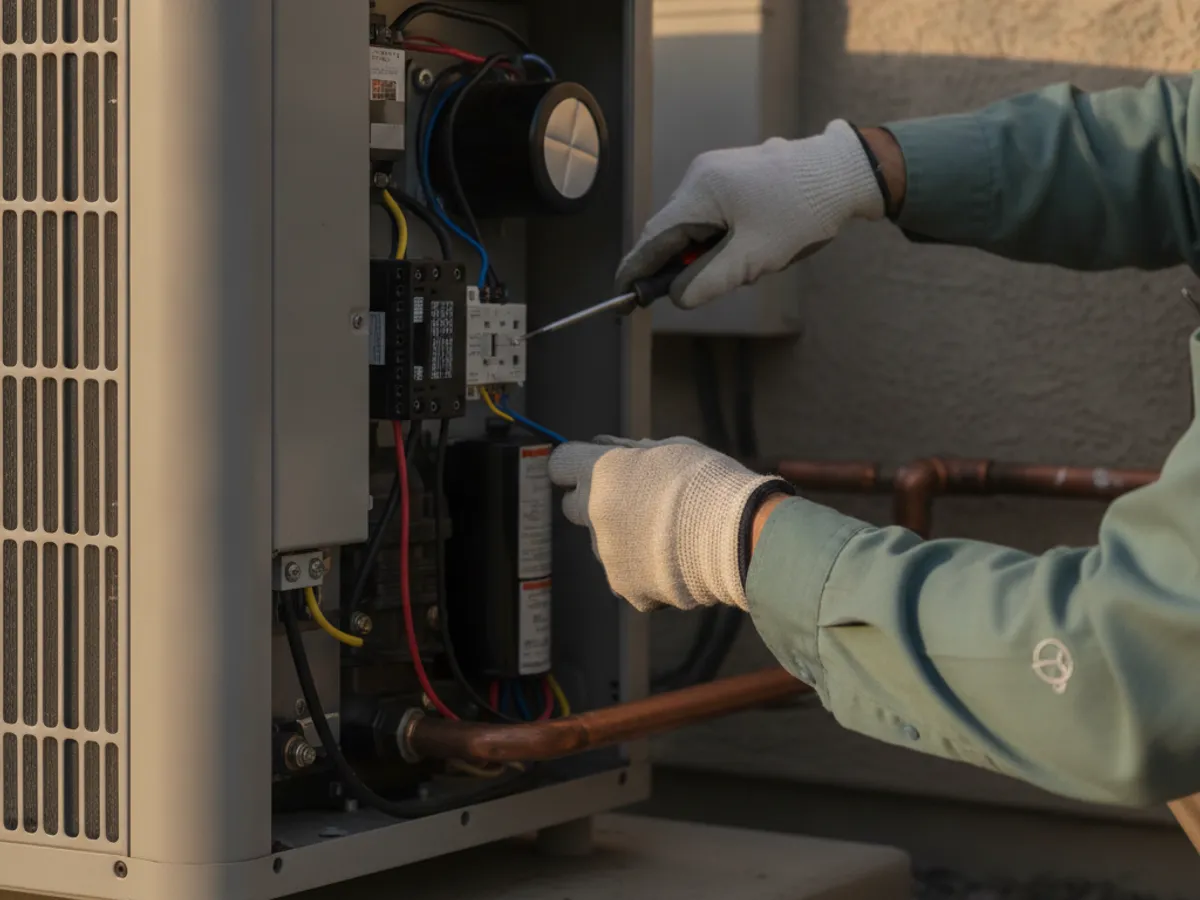
The fix is a soft-start kit wired into the compressor’s contactor. It stretches the startup current over a couple of seconds instead of one spike, cutting the surge by 60 to 75 percent. For most single-stage systems pairing with a home battery, a soft-start kit isn’t optional, it’s the difference between the AC starting and the breaker tripping every time the compressor cycles.
Variable-speed and inverter-driven compressors, the kind in most modern heat pumps and higher-end AC systems, ramp up gradually on their own. Their startup surge is a fraction of a single-stage unit’s, which is why they pair with home batteries far more reliably without any extra hardware.
How to size a battery for your AC or heat pump
Sizing comes down to matching running watts to the battery’s continuous output, then dividing capacity by draw to get real runtime. The numbers vary a lot by equipment type, and this is where most online guides give a single generic answer that doesn’t hold for San Diego’s mixed housing stock of central systems and mini splits.
| HVAC type | Running watts | Surge watts | Hours on a 13.5 kWh battery |
|---|---|---|---|
| Window unit (8,000-12,000 BTU) | 900-1,400 | 2,500-3,500 | 9-15 |
| Ductless mini split (1-ton) | 700-1,100 | 1,800-2,800 | 12-19 |
| Variable-speed central heat pump (3-ton) | 1,800-2,800 | 4,000-6,000 | 5-7 |
| Single-stage central AC (3-ton) | 3,500-4,500 | 15,000-18,000+ | 3-4 |
The pattern holds across every row: the more the compressor surges on startup, the shorter and less reliable the runtime, even when the running-watt number looks manageable. A mini split or variable-speed heat pump is the forgiving choice for battery backup. A single-stage central AC is the hardest thing in a San Diego home to keep running on stored power alone.
Runtime also assumes the battery is dedicated to HVAC. In practice, most homeowners are running a fridge, some lighting, and a router off the same battery during an outage, which cuts every number in this table by 20 to 40 percent depending on what else is on the panel.
Battery vs. portable generator for AC backup in San Diego
A battery wins on convenience and single-stage surge is the honest tradeoff. A battery starts instantly, makes no noise, needs no fuel, and can be scheduled to charge off solar or off-peak grid power before an outage even hits. That matters in dense neighborhoods where a generator’s noise and exhaust are genuinely a problem, and it matters during a PSPS event that can start with almost no warning.
A gas or propane portable generator in the 7,000 to 10,000 watt range handles a single-stage AC’s surge with room to spare, something a battery often can’t do without a soft-start kit. Generators also refuel indefinitely, where a battery is capped at its stored kWh until the grid or solar recharges it. Ask the battery installer and a generator dealer for written prices. Climate Pros SD does not publish a portable-generator band or a 13.5 kWh installed-battery band. The federal residential clean energy credit (the 30 percent ITC for qualified expenditures) ended for expenditures after December 31, 2025, so price a 2026 battery at full cost and confirm any remaining incentives (like SGIP) at quote time.
The honest answer for most San Diego homes: a battery bought purely to keep the AC running during outages is a hard case to justify without solar. It starts to pencil when it’s paired with solar, where the same battery is doing double duty storing daytime solar production and backing up the house, not just idling as insurance against a PSPS event that might hit a handful of days a year. Our AC and solar under NEM 3.0 guide breaks down when that math actually works.
The San Diego PSPS angle: who actually needs this
SDG&E shuts off power proactively during high fire-danger weather, mainly wind events in the fall, and the areas that get cut most often are the same eastern and inland-adjacent zones with the mature tree canopy and overhead lines that make PSPS necessary in the first place. Scripps Ranch, Mount Helix, Poway’s eastern hills, Del Mar Heights and Crest Canyon, and the Ramona corridor see PSPS activations more than coastal flatland neighborhoods, sometimes for a day, sometimes longer during an extended red-flag event.
For homeowners in those zones, the AC backup question usually isn’t about comfort on a normal day, it’s about heat exposure during a fire-weather outage, which is exactly when outdoor temperatures tend to be highest and smoke may keep windows shut. That’s the scenario where a mini split or variable-speed heat pump paired with a battery earns its keep: it’s the HVAC equipment most likely to actually start and run on stored power when the grid goes down.
At Climate Pros SD, the local network we connect homeowners with covers all of San Diego County, so PSPS-prone inland and eastern-hills homes get the same response as coastal ones. If you’re weighing a battery purely for outage resilience, the more useful first question usually isn’t “what battery” but “does my current AC or heat pump even qualify for reliable battery backup,” and that’s a five-minute conversation, not a sales pitch.
Frequently asked questions
Can a Tesla Powerwall or similar battery run central AC?
Yes, for a variable-speed system. A Powerwall-class battery (roughly 13.5 kWh, 5 to 11.5 kW continuous output depending on model and stacking) comfortably runs a variable-speed heat pump or mini split. A single-stage central AC’s startup surge can still exceed the inverter’s peak rating without a soft-start kit installed on the compressor.
Do I need a soft-start kit for battery backup?
If you have a single-stage AC or heat pump, almost certainly. A soft-start kit stretches the compressor’s startup current over a couple of seconds instead of a single spike, cutting the surge by 60 to 75 percent. Ask the HVAC company to quote the kit as a line. Climate Pros SD does not publish a $300 to $500 kit. Oversizing the whole battery system to swallow the surge is usually the larger electrical job.
How long will a home battery run my AC during a power outage?
For a variable-speed 3-ton heat pump, expect roughly 5 to 7 hours on a 13.5 kWh battery if it’s the only major load. A single-stage central AC draws more per hour and struggles with the startup surge, so realistic runtime is closer to 3 to 4 hours, and less if a fridge and other essentials share the same battery.
Is a home battery worth it just for AC backup in San Diego?
For most homes, not on its own. The case improves when the battery is paired with solar under NEM 3.0, where it’s storing daytime production for evening use and providing outage backup as a second benefit, rather than sitting idle as single-purpose insurance against occasional PSPS events. Climate Pros SD does not publish a payback.
Which parts of San Diego lose power most from PSPS?
Eastern and inland-adjacent zones with heavier tree canopy and overhead power lines see PSPS activations more often, including Scripps Ranch, Mount Helix, Poway’s eastern hills, Del Mar Heights, Crest Canyon, and the Ramona corridor. Coastal flatland neighborhoods are affected less often but aren’t exempt during extended red-flag wind events.
Related services: AC repair and HVAC maintenance.
Where to start
If your AC stopped working after a recent outage and you’re not sure whether it’s a battery-related issue or something else, start with our AC not working after a power outage troubleshooting guide. If you’re deciding between a heat pump and a straight AC replacement with future battery pairing in mind, what is a heat pump and mini split vs. central AC cover the equipment tradeoffs. Homes on an older panel should also check heat pumps and 100-amp panels before adding a battery to the mix.
For city-specific PSPS and equipment guidance, see our Scripps Ranch HVAC service page and Poway HVAC service page. For new installs built with battery pairing in mind from day one, see our AC installation service page.
Climate Pros SD connects San Diego County homeowners with vetted local HVAC contractors who can size a soft-start kit, spec a battery-ready heat pump, or troubleshoot a system that isn’t handling stored power well. Call (442) 777-6440 for a straight answer about what your home actually needs. This guide is general information, not an engineering or electrical specification.