Within a few miles of the water, a good tune-up spends most of its time on two things the inland version barely touches: corrosion and the faults that low runtime keeps hidden. The checklist looks similar. The emphasis is completely different.
A system in Encinitas or Ocean Beach may run a fraction of the hours a Santee system runs. That sounds like an advantage, and for wear it is. For diagnosis it’s the problem, because a part that’s failing quietly never gets stressed hard enough to announce itself until the one week of the year you need the system most.
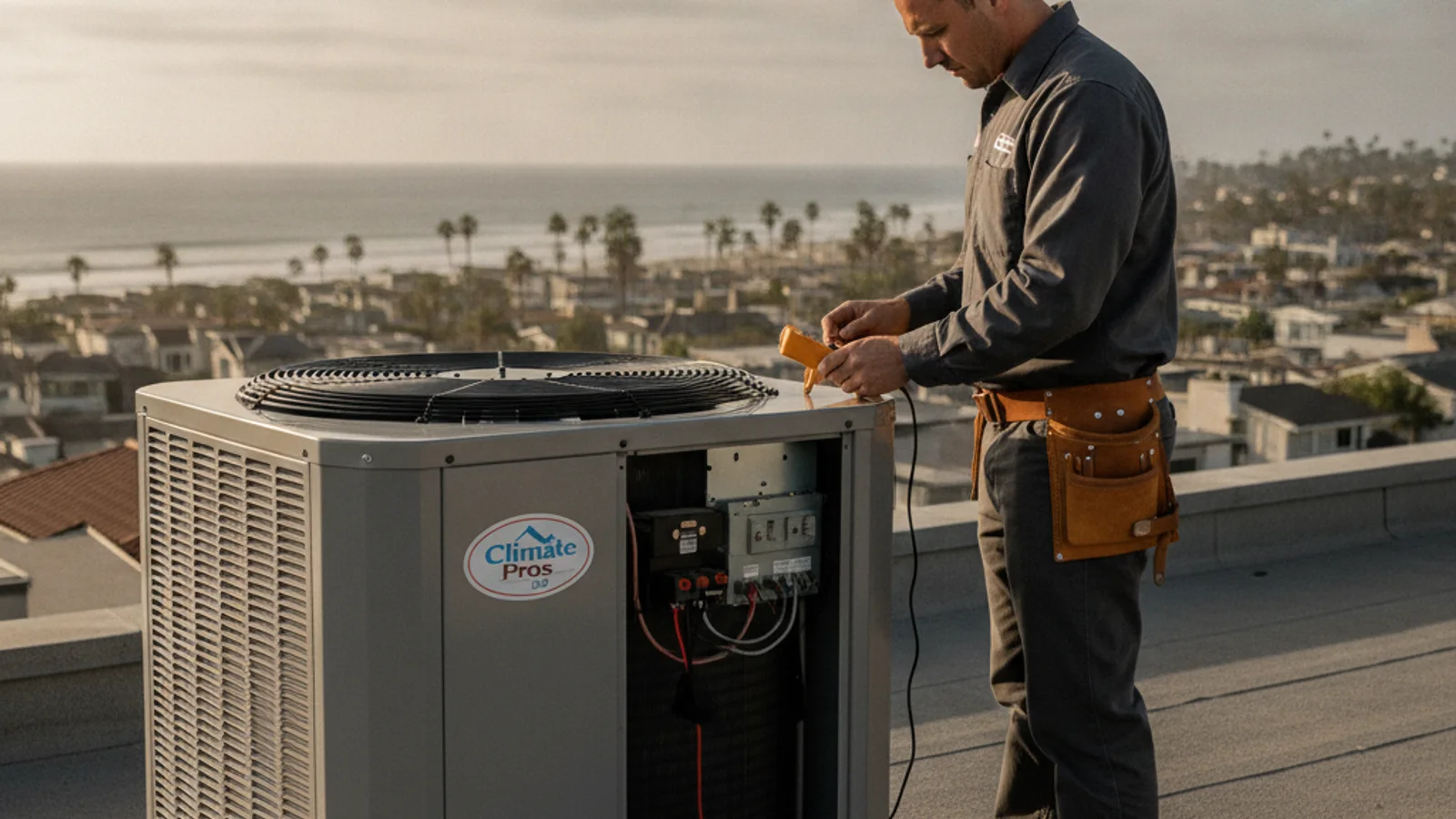
Coastal tune-ups hunt corrosion, not runtime
Ask the contractor to inspect salt on fins, the disconnect, fan motor, and low-use faults that stay hidden because the compressor barely runs in marine air. Homes within a few miles of the water often have mild cooling loads and aggressive metal corrosion. An inland checklist that only chases capacitors will miss the real risk.
Checklist
- Photograph rust at screws, the cabinet, and the disconnect.
- Ask for coil cleaning method that will not flatten fins.
- Confirm the condensate line is not packed with sand.
- Note last time the system ran more than a short cycle.
- See Carlsbad AC maintenance.
Related: AC tune-up and Pacific Beach HVAC.
Salt is the first thing a coastal tech looks at
Marine air carries chloride, and chloride attacks the aluminum and copper in a condenser coil. The damage isn’t dramatic. It shows up as white powder in the fin pack, then as fins that crumble when you brush them, then as capacity you can measure but the homeowner just experiences as a system that doesn’t cool like it used to.
On a coastal visit the coil inspection comes before the electrical work, because what the coil looks like changes what everything else means. A tech should get light through the fin pack, look at the tube-to-fin bond rather than just the surface, and check the bottom of the cabinet where salt-laden water pools and eats the base pan from the inside. Fasteners, the disconnect box, and the contactor all corrode on the same schedule. A pitted contactor near the surf line is a normal finding, not an upsell.
Rinsing matters more here than anywhere inland. A low-pressure fresh water rinse of the coil, done regularly, is the cheapest thing a coastal homeowner can do for equipment life. High pressure is a mistake: it folds fins over and makes the airflow problem worse than the salt did.
If the coil is already far gone, coated-coil replacement equipment exists and is worth asking about at replacement time, not at tune-up time. We go deeper on what salt air does to equipment in our Coronado coastal AC repair guide.
Low runtime hides the faults inland systems expose
An inland system finds its own weak points. Run it eight hours a day in July and a marginal run capacitor, a dry blower bearing, or a slightly low charge will surface within weeks. Coastal systems don’t get that free diagnostic.
So the coastal tune-up has to force the issue with measurement instead of runtime. The run capacitor gets read against its nameplate microfarad rating rather than eyeballed, because a capacitor drifting low will still start a compressor on a mild day and fail on a hot one. Amp draw on the compressor and the condenser fan gets compared to the nameplate. Motor bearings get listened to under load, not at rest.
Charge is the one people get wrong. A system that’s been slowly leaking for two years still cools acceptably on a 74 degree afternoon, so nobody notices. Verifying charge properly means superheat or subcooling readings taken against the manufacturer’s charging chart for that model, at the actual outdoor conditions, not a pressure gauge compared to a rule of thumb. At low outdoor ambient temperatures the simple temperature split across the coil becomes a much weaker signal, which is exactly why the shortcut version of a tune-up misses coastal problems.
Ask for the numbers in writing: capacitance readings, amp draws, static pressure, and the charging method used. A report with measurements is the difference between a tune-up and a visit. Our spring AC tune-up checklist covers the full item list that applies countywide.
Damp coils, drains, and the smell that follows
Coastal homes run their systems at low load in humid air, and that combination keeps the evaporator coil wet without ever drying it out. Standing moisture in the pan and biofilm on the coil are the source of the sour smell that shows up in June and disappears in October.
That makes the condensate side a real inspection item rather than a formality. The pan gets checked for standing water and rust, the primary drain gets cleared and flow tested, the trap gets confirmed, and the secondary drain or float switch gets tested rather than assumed. A plugged drain in a closet air handler is how a comfort problem becomes a drywall problem.
The other coastal wrinkle is that the system may not be dehumidifying at all. Short cycles on mild days never get the coil cold long enough to condense meaningful moisture, so the house reads 72 degrees and still feels heavy. That is not an AC fault and no tune-up will fix it. It’s a load and equipment question, and we cover the options in our coastal humidity and dehumidifier guide.
While the panel is open, the filter and the return matter too. A coastal home with the windows open half the year loads a filter with salt aerosol and fine dust faster than the packaging suggests. Check it on your own schedule rather than the printed interval.
Time it around your real peak, not the inland one
The standard advice is to book a tune-up in spring, before summer demand. That advice was written for inland homes, and inland homes should follow it.
Coastal homes have a different pattern. The marine layer keeps daytime highs down through much of the summer, and the hottest, most uncomfortable stretches near the water often arrive with offshore wind events rather than in the middle of the season. The National Weather Service San Diego office publishes local temperature records and cooling degree day data at weather.gov/sgx if you want to see how your part of the coast actually behaves.
The practical version: get the system checked before you need it, and treat a long idle period as a reason to check it rather than a reason to skip. A system that sat unused from November through June is a system whose contactor has corroded, whose capacitor has aged, and whose drain has had seven months to grow something. That’s the visit that pays for itself.
If your home sits inland of the marine influence, the inland calendar and the inland priorities apply instead. The AC tune-up service page and the Encinitas HVAC hub cover what local contractors handle along the coast. Manufacturer efficiency ratings and what they mean for equipment you’re considering are explained at ENERGY STAR.
What you can do between visits
Coastal equipment rewards small habits more than inland equipment does, because the damage here is continuous rather than seasonal.
Rinse the condenser coil with a garden hose on a low setting a few times a year, top to bottom, with the disconnect pulled first. You’re washing salt off, not blasting dirt out, so pressure is the enemy. If the unit sits where irrigation spray reaches it, move the sprinkler head instead of the unit. Landscape water in coastal soil carries minerals that scale a coil faster than sea air alone.
Keep the clearance the manufacturer asks for around all four sides and above. Coastal side yards are narrow and it’s tempting to let a hedge close in on the condenser. A coil that can’t breathe reads on the gauges exactly like a coil that’s fouled.
Change the filter on what you observe, not on the box. Homes near the water run with doors and windows open for months, and that pulls in far more fine particulate than a sealed inland house does.
Finally, run the system for a full cycle once a month even in winter. Ten or fifteen minutes proves the contactor pulls in, the fan spins, and the drain flows, and it finds the failure in February instead of during the first offshore heat event.
When to call us
Coil corrosion, refrigerant charge, and condensate work are licensed trade work, and charge verification in particular requires EPA certification and calibrated instruments. Every HVAC pro in the network is licensed and insured, and you can verify any California license at the CSLB. If your coastal system has been sitting idle, or the air feels damp even when the thermostat is satisfied, get measurements before the next heat event. Call us at (442) 777-6440 and we will match you with a licensed local pro.