Split system AC maintenance should cover both the indoor equipment and outdoor condenser. The scope should connect airflow, controls, drainage, visible conditions, and operating measurements. Inland homeowners should expect a visit shaped around their equipment, not a generic checklist count.
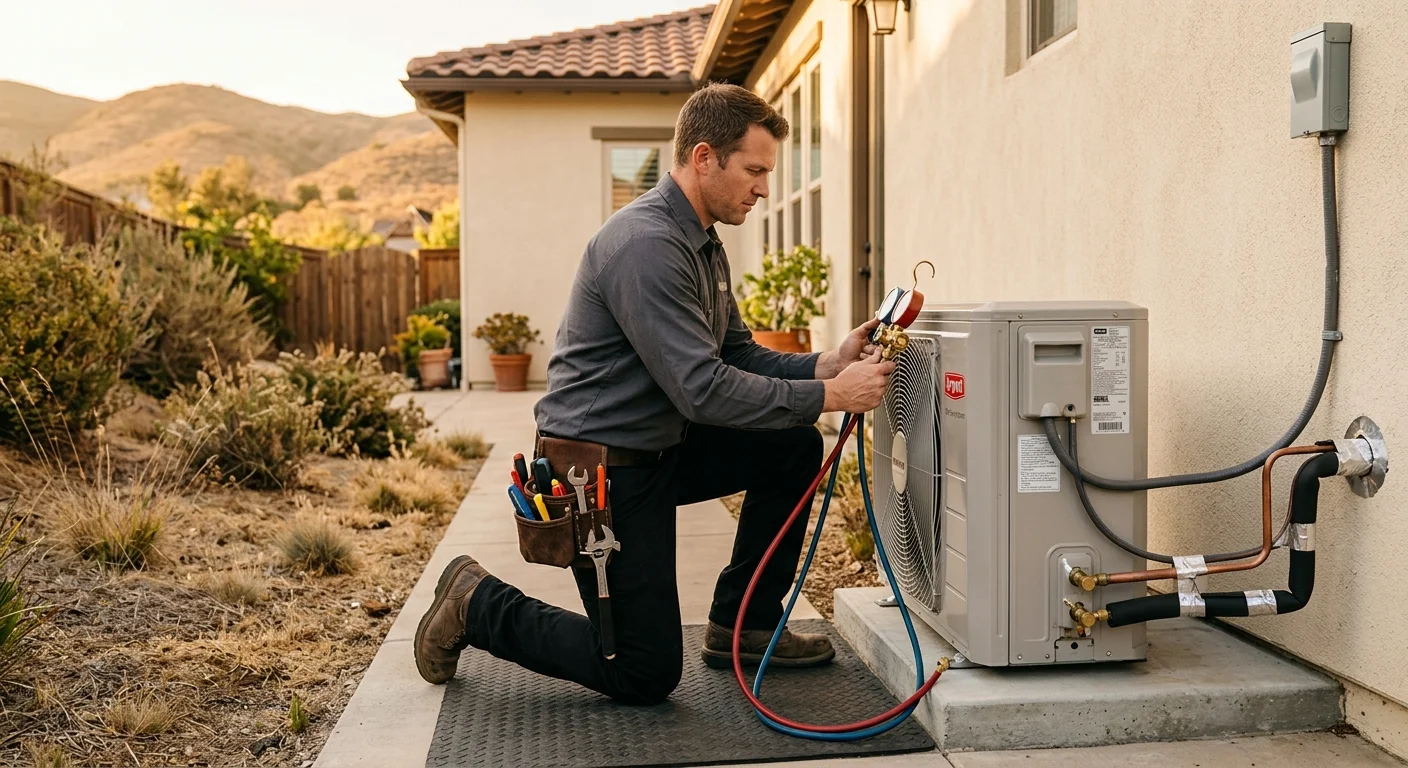
Inland split-system maintenance covers indoor and outdoor halves
The visit should include filter, indoor coil and drain, outdoor coil, electrical connections, and operating temperatures. Inland dust and long runtimes make outdoor coil cleaning more than a courtesy. Escondido, El Cajon, and San Marcos yards collect dry debris. A coastal rinse schedule is too light here.
Checklist
- Ask for temperature split in the report.
- Require outdoor coil cleaning method in writing.
- See El Cajon inland repair.
- See Fallbrook AC maintenance.
- Use HVAC maintenance.
Related: AC tune-up and AC repair.
What does split-system AC maintenance include?
A useful maintenance scope begins by identifying the complete system. The indoor equipment may share a cabinet with a furnace. Another home may have an air handler instead. The outdoor condenser is the other side of that cooling setup.
Both sides belong in the maintenance conversation. So do the thermostat, filter arrangement, drain components, and accessible connections between the units. The contractor should explain what the proposed visit covers before starting.
Look for clear divisions between observation, cleaning, testing, adjustment, and repair. Those aren’t interchangeable services. A proposal might include some cleaning but reserve repairs for separate approval. Another may document operating measurements without including corrective work.
Ask these questions before comparing offers:
- Which indoor and outdoor equipment will you inspect?
- What cleaning is included in the quoted scope?
- Which operating readings will you record?
- What conditions would lead to a repair recommendation?
- What work requires separate approval?
This approach is more useful than relying on the words “tune-up” alone. Contractors may define that term differently. Our AC tune-up service page explains how Climate Pros SD connects homeowners with independent local professionals.
Cooling maintenance can also sit within broader heating and cooling care. If you want both sides of your home comfort equipment considered, review the HVAC maintenance service page. Tell the matched contractor which equipment you want included.
How can inland conditions shape the inspection?
Inland San Diego County deserves its own maintenance conversation. Escondido and Poway sit along the I-15 corridor. El Cajon and Santee are farther east than the central coast. Their local climate records aren’t identical.
NOAA’s 1991-2020 normals provide useful context. The Escondido #2 station has an August normal high of 89.0°F. The El Cajon station has an August normal high of 88.6°F. That station also supports the verified local climate data used for Santee. The Rancho Bernardo station, used for Poway, has an August normal high of 82.8°F.
These are monthly normal highs, not heat-wave peaks. They don’t establish how long a particular AC should run. They do support asking how the home’s inland setting affects the contractor’s inspection.
Show the contractor the outdoor unit’s actual surroundings. Note nearby soil, landscaping, fencing, walls, irrigation, and direct sun. Don’t assume any one condition has caused a problem. Ask the pro to inspect what’s present and explain relevant findings.
Indoor details matter too. Tell the contractor which rooms feel different and when that happens. Mention recent filter changes, thermostat behavior, unusual sounds, odors, or visible moisture. Those observations help define the visit without pretending to diagnose the cause.
For another inland example, see our Escondido AC maintenance guide. Use it as a comparison point, not a universal checklist for every split system.
Which observations can a homeowner record first?
Start with what you can see, hear, and describe. A short record gives the contractor a clearer starting point. It also helps separate an ongoing pattern from something noticed once.
Write down the thermostat setting and displayed room temperature. Note whether the system starts when expected. Record any repeated stopping, unusual sound, odor, or visible moisture. Identify rooms that feel different from the rest of the house.
Timing and location make those notes more useful. “The upstairs bedroom feels warmer in late afternoon” gives more context than “the AC struggles.” “The outdoor unit makes a new sound after startup” is clearer than “the condenser is bad.”
Photos can preserve labels and visible conditions. You can photograph the thermostat display, filter label, equipment data plate, and the outdoor unit’s surroundings. Keep the task observational. Leave equipment opening, electrical work, and refrigerant diagnosis to the licensed contractor.
Bring any earlier service paperwork you still have. Don’t rely on memory for equipment names, previous recommendations, or replaced parts. If the paperwork uses unfamiliar terms, ask the new contractor to explain them.
Avoid assigning a cause before the inspection. Warm airflow doesn’t identify one specific failed component. A sound doesn’t prove which part made it. Moisture doesn’t reveal its source by itself. Record the symptom in plain language and let the pro determine which tests fit.
A simple maintenance log can help organize these notes. Our broader HVAC maintenance service guide explains what to discuss when reviewing a contractor’s proposed visit.
What should a licensed pro test at both units?
Ask the contractor to describe the testing plan for your installed equipment. The answer should cover the indoor unit, outdoor condenser, thermostat, and related components included in the scope. It should also explain which readings will appear on the final report.
At the indoor side, ask how the pro will evaluate the filter arrangement, accessible cabinet areas, drainage components, thermostat response, and airflow. The exact method may depend on the equipment and the symptoms you reported. There’s no useful reason to demand a measurement that doesn’t apply to that system.
At the outdoor unit, ask what visual checks, cleaning, and operating measurements are included. The contractor may consider electrical readings, temperatures, refrigerant data, or other equipment-specific information. Ask which readings matter for your unit and what reference will be used to interpret them.
A result should be more specific than a bare “pass” or “fail.” Ask the contractor to identify unusual readings, visible conditions, and recommended next steps. If a reading can’t be taken during the proposed visit, ask why.
The California Contractors State License Board describes the C-20 classification as covering the maintenance, service, and repair of air-conditioning systems and associated controls and filters. You can check a contractor’s license status through CSLB before authorizing work.
Climate Pros SD matches homeowners with licensed, independent HVAC professionals. The matched contractor determines the appropriate tests, explains the findings, and proposes any additional work. You contract with and pay that professional directly.
How do you compare tune-up scopes without fixed checklists?
Compare what each contractor will do, document, and exclude. Don’t choose by checklist length alone. A longer list can divide one task into several lines, while a shorter proposal may describe the same work more clearly.
Start with equipment coverage. Confirm that the proposal identifies both the indoor and outdoor portions of your split system. If the thermostat, filter, drain, or duct connections are outside the scope, ask the contractor to say so.
Next, separate the service categories. A useful proposal states what will be inspected, cleaned, measured, or adjusted. It also distinguishes maintenance from diagnosis and repair. That separation helps you understand what the quoted visit does and doesn’t include.
Ask how findings will be recorded. A written report may include actual readings, photos, condition notes, or repair recommendations. The contractor should explain the format they plan to provide. Don’t assume every company uses the same report.
Then review these practical differences:
- Does the scope name your actual equipment?
- Are both units included?
- Are cleaning tasks described clearly?
- Are operating readings identified?
- Are exclusions visible before authorization?
- Are repair recommendations handled separately?
- Does the contractor explain who sets the service price?
Each independent contractor sets their own prices and policies. Climate Pros SD doesn’t set prices, define contractor checklists, or provide warranties. Ask the matched pro what their diagnostic fee is and whether it applies toward a repair. Each company sets its own policy.
Choose the scope that answers your concerns and fits the installed system. A fixed point count can’t replace a clear explanation of the work.
When to call us
Call when your split system needs professional maintenance, its operation has changed, or competing scopes remain unclear. Climate Pros SD will connect you with an independent licensed HVAC professional serving San Diego County. Call us at (442) 777-6440 and we will match you with a licensed local pro.