Everything that shortens equipment life in Fallbrook restricts airflow: grove dust, pollen, ash, animal nesting, and a runtime long enough to keep pulling all of it through the machine. Corrosion is a coastal problem. This is a filtration problem.
That distinction should shape the whole plan. A maintenance routine copied from an Encinitas or Carlsbad home spends its effort on the wrong things out here.
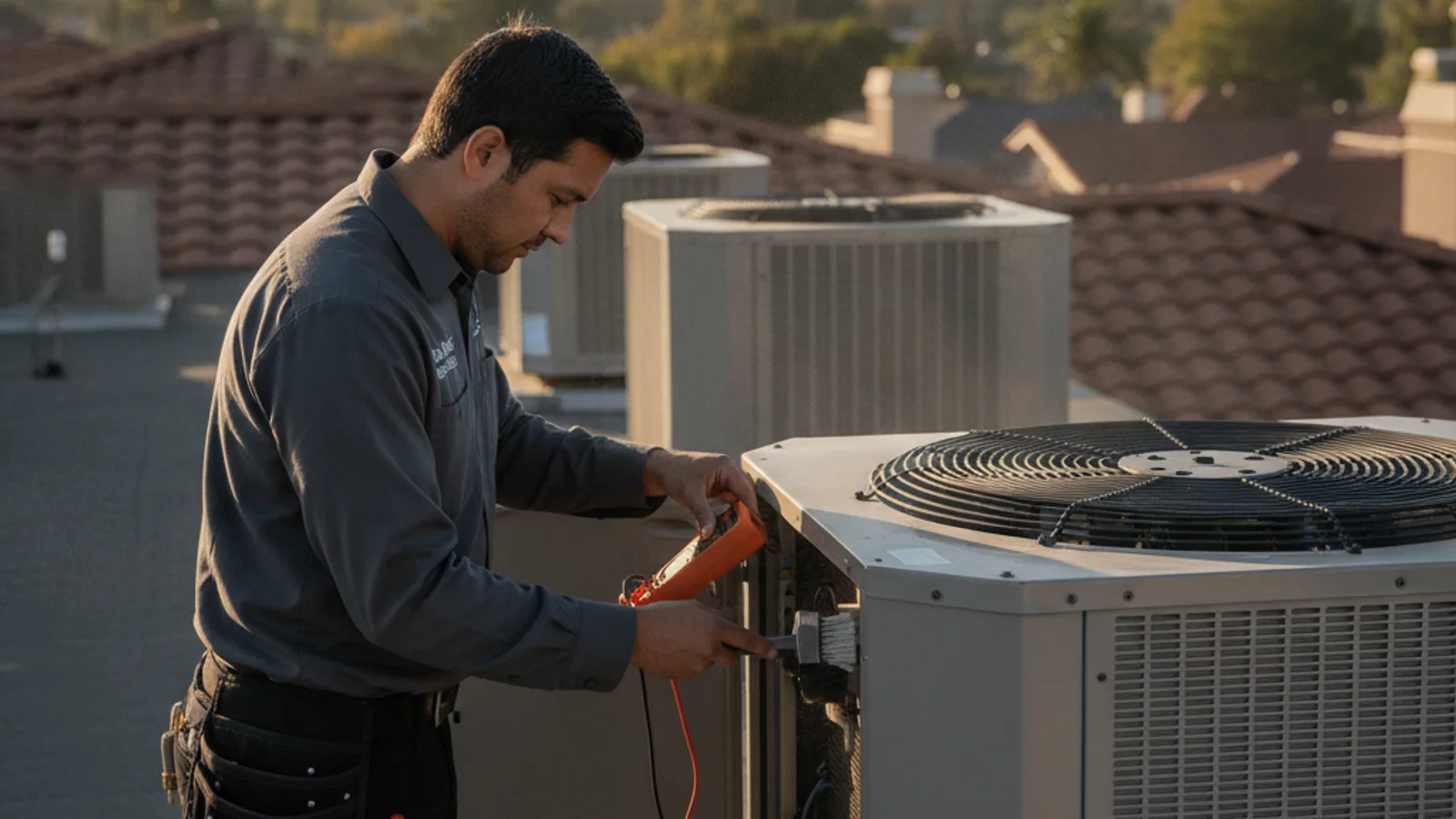
Fallbrook AC maintenance is a filtration job
Change filters on a shorter interval than a coastal house, keep grove trimmings off the condenser, and have coils cleaned when dust and pollen pack the fins. Avocado and citrus lots throw organic debris into condensers. Long inland runtime pulls that debris through filters until airflow collapses.
Checklist
- Record filter size, MERV, and the date you last changed it.
- Clear leaf litter and fruit drop from the pad before summer.
- Note animal nesting under the unit or in the air handler.
- Write how many hours the thermostat ran yesterday on a 95-plus afternoon.
- Ask whether the quote includes outdoor coil cleaning, not only a filter swap.
Related: Fallbrook HVAC and inland split-system maintenance.
Runtime is the number that changes everything
The single biggest difference between a Fallbrook system and a coastal one is hours. Inland North County systems run through long, hot afternoons across the summer, while equipment near the water can idle for days at a stretch during the same week.
Every maintenance interval scales off that. Filters load faster because more air moves through them. Bearings, capacitors, and contactors accumulate more cycles. Condensate drains handle more water. A schedule built around a calendar year understates what a hard-running inland system actually needs.
Runtime also changes what a failure costs you. A coastal unit that quits in July is an inconvenience. A Fallbrook system that quits during a heat stretch on a rural property, potentially with the nearest help further away than in the city, is a bigger problem. That argues for catching things during a planned visit rather than discovering them at the worst moment.
The National Weather Service tracks cooling degree days for San Diego County, which is the measure that reflects cooling demand rather than raw temperature. If you want to compare seasons at your own address, NWS San Diego publishes the local data. We’re deliberately not quoting a temperature spread between inland and coastal zones here, because we couldn’t confirm one from a primary source, and a number that sounds right isn’t the same as a number that is right.
Grove dust, bloom, and what lands on the coil
Fallbrook’s avocado and citrus groves are the defining feature of the maintenance problem. Cultivation stirs soil, orchard equipment raises dust off dry ground, and dirt roads along Reche Road, Live Oak Park Road, and the rural stretches toward De Luz add to it.
That material lands on the outdoor coil and packs between the fins. Unlike the salt film on a coastal unit, this is visible: a grey or tan mat across the coil face that you can see from a standing position. The effect is a drop in the unit’s ability to reject heat, which shows up as a house that cools fine in the morning and falls behind by mid-afternoon.
Bloom season adds a second layer. Pollen is fine, sticky, and it binds dust into a crust rather than sitting loose. A coil rinsed before bloom stays cleaner than one rinsed after, so timing matters more than frequency.
Rinsing here is straightforward and worth doing. Cut power at the outdoor disconnect, use a garden hose with no pressure washer, and work the water through the coil so debris exits the face rather than being pushed further in. Bent fins from too much pressure cause the exact restriction you were clearing. The full technique is in our guide to cleaning AC coils.
One rural-specific addition: check the pad and the ground around the unit. Dry decomposed granite and loose soil get kicked up into the coil from below every time wind moves across an open lot.
The condenser is a warm, sheltered box
Rodent nesting inside outdoor equipment is uncommon in dense city neighborhoods and routine on rural properties. A condenser cabinet is dry, elevated off open ground, sheltered from predators, and warm after the unit has been running. From an animal’s point of view it’s ideal.
The damage isn’t usually the nest itself. It’s the wiring. Chewed low-voltage control wire, chewed insulation on line-voltage runs, and nesting material packed against the fan motor are all common enough that any pro working rural North County looks for them. Chewed thermostat wiring produces symptoms that mimic control-board faults, which is how people end up paying for the wrong part.
Ask for the electrical compartment to be opened and inspected at every visit, not just when there’s a complaint. Ask for the fan motor area and the base pan to be checked for nesting material and droppings. A cabinet cleaned out in spring rarely becomes a wiring failure in August.
Between visits, do the low-effort things. Keep vegetation cut back from the unit so it isn’t a covered approach. Don’t stack wood, feed, or storage against the cabinet. Check that the disconnect box cover and any service panel are properly closed and latched, because an open gap is an invitation.
If your system also serves outbuildings, a casita, or a converted structure, check those units too. Equipment that runs seasonally gets nested in more often than equipment that runs daily, simply because nothing disturbs it.
Filters, when the system runs most of the year
The standard advice to change a filter every three months was not written for a house that runs cooling hard through a long inland summer while sitting downwind of cultivated ground.
Look at the filter monthly during the cooling season instead of changing it on a fixed schedule. A filter that’s grey and matted at six weeks needs replacing at six weeks. A restricted filter starves the indoor coil of air, which can drop the coil below freezing and ice it over. That reads to the homeowner as low refrigerant, and it isn’t.
Filter selection matters too. A high-MERV filter captures more of the fine dust that’s genuinely present here, but it also creates more resistance, and a system with marginal ductwork can’t always tolerate it. The right answer depends on the equipment and the duct design, so ask the pro what your specific system can handle rather than buying the highest number on the shelf. Our filter and MERV rating guide explains the tradeoff.
Larger rural homes on well systems or with multiple zones often have more than one filter location. Find all of them once and write down the sizes. Plenty of Fallbrook homes have a return filter someone forgot about entirely.
After smoke or ash
Wildfire smoke and ash are part of the operating environment in this part of the county, and they call for a response rather than a routine.
Ash is fine and abrasive, and it loads both the outdoor coil and the indoor filter far faster than ordinary dust. After a significant ash fall, plan on inspecting and likely replacing the filter regardless of how recently you changed it, and on rinsing the outdoor coil once conditions allow.
During an active smoke event the work shifts indoors. Our post on Santa Ana winds and wildfire smoke covers how to manage a system while smoke is in the air, and wildfire indoor air quality covers filtration choices.
Fallbrook also sits in territory where SDG&E may call Public Safety Power Shutoff events. That’s a power availability question rather than a maintenance one, but it’s worth knowing how your equipment restarts after an outage and whether any settings need checking afterward.
Timing the visit, and who’s allowed to do the work
Book the annual professional visit before the heat arrives, not during it. A system that gets its coil cleaned, its charge verified, and its electrical connections checked in spring goes into the hard months with margin. One serviced in August gets serviced after the damage.
Most of Fallbrook is unincorporated San Diego County, so the City of San Diego’s mechanical permit rules don’t apply here. County requirements weren’t something we could verify from a primary source, so ask your contractor to confirm what the County requires before any replacement work. California requires a C-20 contractor for HVAC work above the Business and Professions Code section 7048 threshold of $1,000 or where a permit is required, and any license can be checked at the CSLB license lookup. Every HVAC pro in the network is licensed and insured.
For a broader view of what HVAC work in this area involves, the Fallbrook HVAC services guide and the Fallbrook service page cover the local housing stock. The maintenance service page lists what a professional visit includes.
When to call us
Coil cleaning on a heavily loaded system, refrigerant charge, and any suspected rodent damage to wiring need a licensed HVAC pro rather than a weekend fix. Call us at (442) 777-6440 and we will match you with a licensed local pro.