The first question in Scripps Ranch isn’t which air cleaner to buy. It’s how much filter resistance your air handler can absorb before the blower starts losing airflow. Get that wrong and a better filter makes the house worse.
That order surprises people. Air cleaning gets sold as a product decision, and it’s really a duct and blower decision with a product attached at the end. If a home has a one-inch filter slot at the return grille, the constraint may be the slot, not the technology.
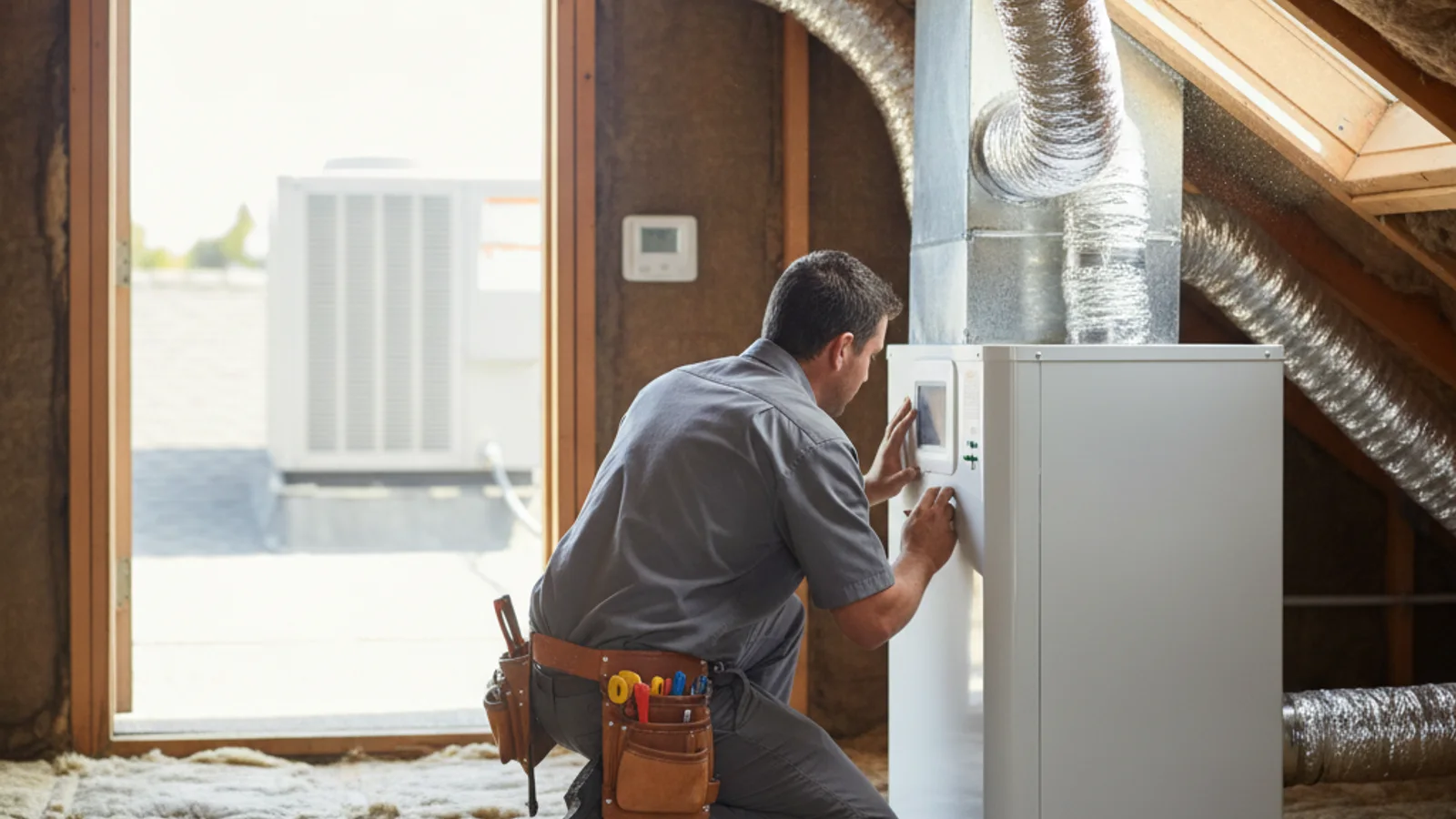
Scripps Ranch air cleaners are limited by the air handler’s static budget
Ask what pressure drop the blower can accept before you buy a high-MERV cabinet, UV, or electronic cleaner. A denser filter that starves return air makes attics even harder on the coil. Scripps Ranch sits inland with pollen, dust, and occasional wildfire smoke. Attic air handlers already fight heat. Filter restriction stacks on that load.
Checklist
- Photograph the current filter slot depth.
- See thicker filter airflow.
- See maintenance Scripps Ranch.
- See IAQ wildfire.
- Use indoor air quality.
Related: Scripps Ranch HVAC and HVAC maintenance.
What your air handler can actually take
Every filter is a restriction. Denser media catches smaller particles and costs you pressure to do it, and a residential blower only has so much pressure to give.
The number that governs this is total external static pressure, measured across the air handler with the system running. Manufacturers publish a maximum for each unit, and most residential equipment is designed around a modest budget that the duct system alone often eats most of. A tech reads it with a manometer through two test ports in a few minutes. If nobody has taken that reading, nobody knows what your system can handle, and any filter recommendation is a guess.
Here’s why the one-inch slot is the villain. A one-inch filter has very little media surface area, so getting high efficiency out of it means packing the media tight, and tight media at low surface area is a large pressure drop. Push a high-MERV one-inch filter into a system that’s already near its limit and airflow drops, the coil runs colder than it should, capacity falls, and in the worst case the coil ices and the compressor suffers. Homeowners then report that the new filter “broke the AC,” which is close to the truth.
A four or five inch media cabinet solves it with geometry rather than compromise. Deep pleats give several times the surface area, so the same efficiency rating costs far less pressure. Retrofitting one means cutting in a cabinet at the return side of the air handler, which is straightforward on most Scripps Ranch attic installations but does need attic access and clearance. Ask for the static pressure reading before and after. That before-and-after is the proof the upgrade didn’t cost you airflow. Our MERV rating guide explains what the numbers mean.
What Scripps Ranch air actually carries
Filtration only makes sense against a specific load, and this neighborhood’s load is not the county average.
The eucalyptus canopy is the obvious one. Scripps Ranch grew up inside mature eucalyptus stands, and the trees along Pomerado Road and through the older sections shed bark, leaf litter, and pollen in volumes most of San Diego doesn’t deal with. That debris is coarse enough to load a filter fast and fine enough, in its pollen fraction, to matter to allergy sufferers. Fast loading is its own problem: a clogged filter is a bigger airflow restriction than a dense clean one.
Then there’s the geography. Scripps Ranch sits between canyon systems, with open space on multiple sides and the backcountry to the east. Canyons channel wind, and offshore wind events push air from the interior toward the coast right across the neighborhood. That’s the mechanism that brings smoke here during a fire elsewhere in the county, and the reason this area’s wildfire exposure is a matter of public record rather than speculation. Cal Fire and the San Diego County Office of Emergency Services publish current incident and evacuation information, and those are the sources to watch during an event, not a blog.
Road and construction dust from the I-15 corridor and ongoing infill work adds a steady background load. Homes backing to open space also pull in more of everything, because the vegetation is right there.
None of this changes the physics from the previous section. It changes how fast your filter loads and how often you check it, which for a canopy-adjacent home usually means more often than the box suggests. The county-wide comparison of system types lives in our whole-home air purifier guide for San Diego.
Media cabinets, UV, and electronic cleaners
Three categories get sold as the same thing, and they solve different problems.
Media filtration is mechanical. It physically traps particles: pollen, dust, dander, and the fine particulate in wildfire smoke. For a Scripps Ranch home, this is the load, so this is the technology that addresses it. Everything below is supplemental.
UV-C at the coil is biological. Lamps mounted to shine on the evaporator coil and drain pan suppress mold and biofilm growth on wet surfaces, which is the source of the musty smell some systems develop. UV-C does nothing to pollen, dust, or smoke, because those particles were never alive. No verified comparison between Scripps Ranch coils and coastal coils was confirmed. Ask the pro to inspect the coil and identify the problem UV would address.
Electronic and ionizing cleaners charge particles so they clump and get caught downstream, or claim to break down gases. The independent evidence for real-world benefit is mixed, and the important caveat is ozone: some ionizing and photocatalytic devices emit it as a byproduct, and ozone is a lung irritant. California’s Air Resources Board maintains a certification program for air cleaning devices sold in the state, so if you’re considering one, ask the contractor for the CARB certification and the measured ozone output in writing, and verify it with CARB rather than taking the brochure’s word.
The honest sequence for most homes here: fix the filter slot, seal the return, then add a supplemental technology only for a named problem. The indoor air quality service page covers what local contractors install.
Seal the return, or the filter is optional
This is the step that quietly defeats good filters, and it’s very common in attic and closet installations.
Air follows the path of least resistance. If the filter rack leaks, if the return plenum has open seams, or if the return duct connection at the air handler isn’t sealed, the blower will happily pull unfiltered attic air through those gaps instead of through the filter you just paid for. Attic air in a Scripps Ranch summer is hot, dusty, and during a smoke event it is smoky, because attics are ventilated to the outdoors by design.
The test is simple. With the system running, a tech checks the filter rack and plenum joints for pull, and a smoke pencil or a pressure reading confirms it. The fix is mastic and tape on the plenum seams, a gasketed filter access door, and a properly sized rack that the filter actually fills.
Bypass at the filter face matters too. A filter that’s a half inch too small in its slot lets air slip around the edges, and the difference between “filtered” and “mostly filtered” is larger than it sounds. Measure the slot, buy to the slot.
While you’re in there, look at whether the return is large enough at all. A single undersized central return raises static pressure on its own, which shrinks the budget available for filtration before you’ve installed anything.
Running the system during a smoke event
Equipment is half the answer. Operation is the other half, and it’s free.
Switch the thermostat fan from auto to on during a smoke event so air keeps cycling through the filter even when the system isn’t calling for cooling. Keep windows and doors closed, and don’t run a whole-house fan or an attic-driven ventilation strategy, since both pull outdoor air straight in. If your system has a fresh-air intake or an energy recovery ventilator, close or disable it for the duration and remember to restore it afterward.
Add a portable HEPA unit in the bedroom. A whole-home system treats the whole house evenly, and a portable gives one room extra protection during the nights that matter. The two aren’t competitors.
After the event, change the filter regardless of how long it’s been in. Smoke loading is heavy and invisible, and a saturated filter is both a restriction and a source of residual odor. Check the coil and the blower wheel as well if the event was long. Our Santa Ana winds and wildfire smoke guide has the full protocol, and the Scripps Ranch HVAC hub covers local service coverage. General efficiency and equipment guidance is published at ENERGY STAR.
When to call us
Start with a static pressure measurement before deciding on a media cabinet or return-plenum work. If your Scripps Ranch home has a one-inch filter slot and you want real smoke and pollen filtration, start with the static pressure reading. Call us at (442) 777-6440 and we will match you with a licensed local pro. This is general information, not medical advice.