A Scripps Ranch maintenance plan has to cover heating as well as cooling, and it has to account for equipment sitting in an attic where nobody looks. Most annual plans here quietly become a summer AC check and leave half the system unexamined.
The tract homes built through the 1980s, 1990s, and early 2000s across Old Scripps Ranch, Miramar Ranch North, and the Stonebridge and Sycamore Creek sections share a set of design choices that make this specific. Start there.
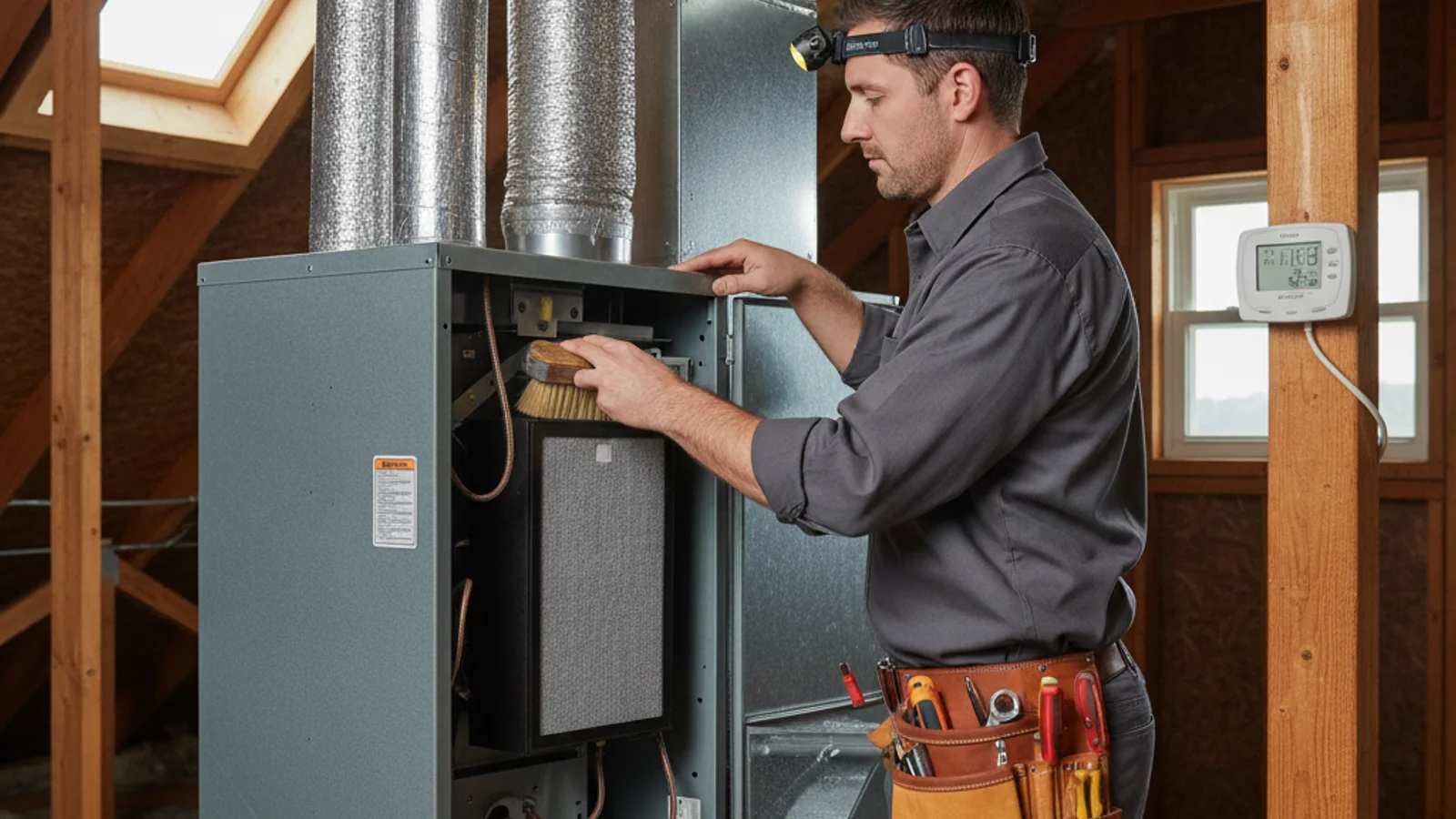
Scripps Ranch maintenance must include attic heat and heating season
A summer-only condenser rinse leaves the furnace and attic air handler unexamined. This neighborhood needs both because inland nights still use heat. Scripps Ranch attics run extremely hot. Ducts and air handlers up there need inspection, not only the backyard condenser.
Checklist
- Ask whether the visit includes the attic.
- Schedule a heating check, not only cooling.
- See mini split repair Scripps Ranch.
- See whole-home air purification.
- Use Scripps Ranch HVAC.
Related: HVAC maintenance and AC tune-up.
The attic is where the system lives, and that changes things
In most Scripps Ranch homes of this era, the furnace or air handler sits in the attic, with duct runs distributed through unconditioned space above the ceiling. That single design decision drives several maintenance items that a closet-mounted or garage-mounted system doesn’t have.
The first is condensate. An attic air handler has a drain pan sitting directly above finished ceilings, plus a secondary pan or an overflow switch as backup. When the primary drain clogs and the backup isn’t working, water finds drywall. It’s the most expensive routine failure in these homes and it’s entirely preventable. Ask for the primary drain to be cleared, the pan inspected, and the float switch tested by actually tripping it, not by looking at it.
The second is attic heat. Summer attic temperatures run far above outdoor air, and equipment and ductwork sitting up there operate in that. Air moving through a duct in a hot attic picks up heat before it reaches the room, which is part of why upstairs bedrooms in these two-story homes lag behind the thermostat. Duct insulation degrades over decades, and the flex duct in a thirty-year-old attic is often crushed, disconnected at a boot, or sagging into a low spot.
The third is simply access. Attic work in summer is genuinely hot, and the technician’s time in the space is limited. That’s an argument for scheduling attic-side work in cooler months when the inspection can be thorough rather than rushed.
Ask specifically for photographs from the attic. You aren’t going up there, and photos are the only way you’ll know what the ductwork actually looks like.
The cooling side, before the season and not during it
Scripps Ranch is an inland valley community, and the cooling load here is real and sustained through summer. Systems run hard for months, which means the cooling check has to happen before that stretch begins.
The outdoor unit needs its coil clean, its clearances open, and its electrical connections checked. Capacitors and contactors are the two components that most often fail mid-season on equipment that’s been running for years, and both are inspectable before they quit. A pro can measure a capacitor’s actual capacitance against its rating rather than waiting for it to fail.
Refrigerant charge should be verified rather than assumed, and if it’s low, that means there’s a leak. Adding refrigerant to a leaking system is a temporary measure, not a repair. Ask for the leak to be found.
Airflow is the item most often skipped. Filter condition, return sizing, and duct integrity all determine whether the system can actually deliver its rated capacity. A correctly charged system with restricted airflow still won’t cool the upstairs.
Much of the original equipment in Scripps Ranch is well into or past its expected service life, so a maintenance visit here often surfaces a replace-or-repair decision. That’s a reasonable outcome, not a sales pitch, and the AC repair guide for Scripps Ranch covers how those calls usually break down.
The heating side, which most annual plans skip
San Diego’s heating season is short, and that’s precisely why heating maintenance gets dropped. A furnace that sits idle for eight or nine months is not a furnace in good condition, it’s a furnace nobody has looked at.
For a gas furnace, the items that matter are the heat exchanger, the burners, the flame sensor, the igniter, the draft path, and the safety controls. The heat exchanger inspection is the one you should never let slide. A cracked exchanger is a carbon monoxide risk, and it’s found by inspection, not by symptoms. If you don’t have working carbon monoxide alarms on every sleeping level, fix that this week regardless of what your HVAC schedule says.
Flame sensors and pressure switches account for a large share of the first-cold-night calls, and both are cleanable during a planned visit. That’s the entire argument for a fall heating check: an hour in November instead of an emergency in December.
If your home has converted to a heat pump, the heating side is a different inspection entirely. Reversing valve function, defrost control, and auxiliary heat operation all need checking, and none of them get exercised during a summer cooling visit. Heat pump maintenance covers the differences. Homeowners weighing a gas furnace against a heat pump for their next replacement can read the Scripps Ranch furnace replacement guide.
Our fall HVAC checklist is the seasonal companion to this, and the US Department of Energy’s heating and cooling guidance is a good neutral reference on what maintenance does for operating cost.
Eucalyptus litter and the outdoor unit
The eucalyptus that define Scripps Ranch also produce a steady load of narrow leaves, bark strips, and seed capsules, and a condenser coil is an efficient filter for all of it.
Eucalyptus leaves are the awkward shape: long and thin enough to slip between fin edges and lodge there rather than sitting loose on top where a leaf blower would clear them. Bark strips do the same thing at a larger scale, wrapping around the fan guard and the cabinet base.
Two habits handle most of it. Clear the area around the outdoor unit whenever you clear the yard, keeping the manufacturer’s clearances open rather than just tidying the visible side. And rinse the coil with a garden hose, power off at the disconnect, no pressure washer, working the water through the coil so debris exits rather than packing deeper.
Check the base pan too. Leaf litter that falls inside the cabinet decomposes there, holds moisture against the metal, and gives the base a head start on rusting through.
Trees also matter for the attic side of the system, because overhanging branches feed roof debris into gutters and can create the moisture conditions that damage attic-run ductwork over time. That’s a roofing conversation rather than an HVAC one, but the two connect in these homes.
Canyon smoke and the days to close the system up
Scripps Ranch borders canyon terrain and sits in an area where wildfire smoke is a periodic reality. That belongs in an annual plan, not just an emergency response.
Before fire season, know two things about your system: whether it has an outside air intake or economizer that can be closed, and what filter your equipment can accept without airflow problems. A higher-MERV filter helps during a smoke event, but only if the duct system can handle the pressure drop, so get that answer from the pro during a normal visit rather than during an emergency.
After a smoke or ash event, replace the filter regardless of its age and plan on rinsing the outdoor coil once conditions allow. Ash loads a coil quickly and it’s abrasive.
The wildfire indoor air quality guide covers the filtration and sealing side in detail. This part of the county also sees SDG&E Public Safety Power Shutoff events, so knowing how your system restarts after an outage is worth confirming while a technician is on site.
One plan, one record
Book a single contractor for both visits and keep one file. Equipment model and serial numbers, every service date, what was found, what was deferred and why, plus attic photographs. That record is what turns a decade of separate service calls into an actual maintenance history.
It also settles the replacement conversation honestly when it comes. A documented pattern of rising repair frequency is a real basis for a decision. A gut feeling isn’t.
The maintenance service page lists what a professional visit includes, and the Scripps Ranch service page covers the local housing stock in more detail. California requires a C-20 contractor for HVAC work above the Business and Professions Code section 7048 threshold of $1,000 or where a permit is required, and any license can be checked at the CSLB license lookup. Every HVAC pro in the network is licensed and insured.
When to call us
Heat exchanger inspection, refrigerant work, and attic condensate systems all need a licensed HVAC pro, and the heating side needs looking at even in a mild climate. Call us at (442) 777-6440 and we will match you with a licensed local pro.