In Carlsbad, the call that can’t wait is usually electrical or a refrigerant problem, not a house that got too hot. Salt air eats the parts that carry current, and the marine layer keeps indoor temperatures survivable long enough that the real risk is damage to the equipment, not to the people in the house.
A homeowner off Tamarack Avenue and a homeowner in Bressi Ranch may report different failures. The symptom, not the address, should determine how fast it needs attention.
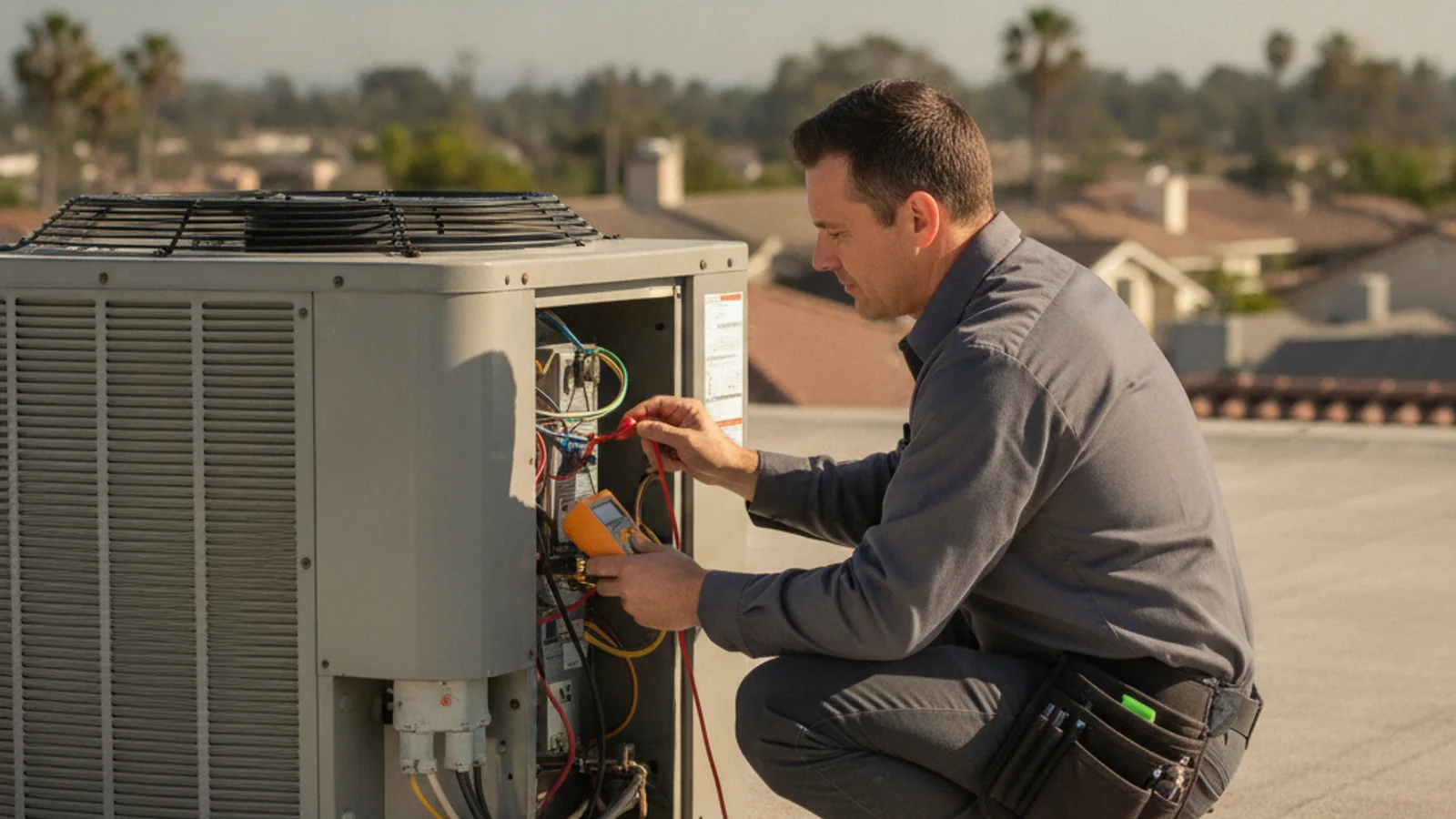
Carlsbad emergencies are often electrical, not temperature
Salt corrodes contactors and disconnects. The marine layer can keep indoor air survivable while the outdoor unit is already failing. Treat burning smells and repeated breaker trips as stop conditions. A house that is merely warm on a 72-degree Carlsbad day is usually not an emergency. A unit that trips or smells like hot plastic is.
Checklist
- Smell the disconnect before resetting anything.
- Photograph rusted lugs only from a safe distance.
- Do not operate a unit that sparks.
- See AC maintenance in Carlsbad.
- Call for a licensed match via emergency HVAC.
Related: Carlsbad HVAC and AC repair.
Salt air changes which parts fail
Everything west of Carlsbad Boulevard, through Terramar and the streets feeding the state beach, sits in genuine salt exposure. The equipment there ages on a different clock than the same model installed in Calavera Hills.
Corrosion doesn’t usually announce itself by killing the compressor. It works on the small electrical parts first. Contactor points pit and weld shut, so the outdoor unit runs when nothing is calling for it. Capacitor terminals corrode and read fine on a meter until they’re under load. Fan motor bearings pick up salt and start to howl. Aluminum fins on the condenser coil turn chalky and white, and the coil quietly loses its ability to reject heat.
Standard equipment on a coastal block often gives up years earlier than the same unit set on a lot east of I-5. Coastal-rated cabinets with corrosion-protected coils and stainless hardware are available. Ask the contractor whether those features make sense for the address.
The practical consequence is that a Carlsbad emergency call is often the second symptom, not the first. The howling fan motor was noticed three weeks ago. The unit that ran all night when the house was empty was written off as a thermostat quirk. Both were the same corrosion story, and the failure that finally stops the system is downstream of them.
If the outdoor cabinet has visible rust streaks, chalky fins, or a hot smell around the electrical panel, that’s worth a look before it becomes the reason you’re calling on a Saturday.
There’s a maintenance version of the same point. On the western blocks, rinsing the outdoor coil with plain water on a hose, with the power off at the disconnect, removes accumulated salt before it sets. It isn’t a repair and it won’t reverse corrosion that’s already there, but it’s the one thing a homeowner can do that measurably changes how long coastal equipment lasts.
The failures that justify an immediate call
Four situations in Carlsbad get the system shut off and a licensed pro on the phone.
A gas smell anywhere near the furnace. Leave the building and call 911 or SDG&E from outside. This one is not weather dependent and not negotiable.
A breaker that will not hold. Pull the outdoor disconnect and leave it out. A welded contactor or a shorted compressor can keep drawing current through wiring that was never sized for it, and salt-degraded connections run hotter than clean ones.
Water coming through a ceiling. Many Carlsbad homes have the air handler in the attic. A clogged condensate line with a failed or missing float switch puts water into the drywall, and in the Village core’s older construction it can reach a ceiling fixture.
Refrigerant you can hear or see. A hiss at the line set, oily residue at a joint or at the service valves, or a coil frosted solid. Shut it down. The specific credential required for refrigerant handling couldn’t be confirmed from the approved sources, so verify the contractor through the CSLB license check before work starts. Running a system that’s low on charge is how the compressor dies.
Everything else, including a house that’s simply warmer than you’d like on a rare Santa Ana day, can generally wait for a scheduled visit. The approved sources don’t confirm a standard duration for Carlsbad’s cooling demand. The honest advice is that most no-cool calls here are not a safety problem, and treating them as one usually just means paying an after-hours rate for a repair that would cost less on a weekday. Ask what that after-hours rate is, as a dollar figure, before you agree to anything. Each company sets its own.
Heat pumps stuck in the wrong mode
The current mix of heat pump conversions across Aviara, La Costa, Bressi Ranch, Robertson Ranch, and Sycamore Estates couldn’t be confirmed from an approved source. This section covers a heat pump that runs, moves air, and delivers the wrong temperature.
The reversing valve is what flips a heat pump between heating and cooling. When its solenoid fails, or the valve itself sticks part way, the system keeps operating and keeps sending air. It just sends it at the wrong end of the range. Homeowners often chase this as a thermostat problem for days.
Defrost boards and outdoor sensors cause the mirror image. The board thinks the coil is iced, runs a defrost cycle it doesn’t need, and dumps warm air in July. Salt-corroded sensor connections are a common trigger on the coastal blocks.
What matters in the moment: stop cycling the system. Turning it off and back on repeatedly to see if it “catches” puts start current through a compressor that may already be struggling, and it tells the technician nothing. Set it to Off, note which mode it was in when it misbehaved, and note whether the outdoor unit was running. Our guides on the reversing valve and on a heat pump that won’t heat cover the diagnosis in more depth.
One more thing worth knowing before you call about a heat pump: describe the symptom as air temperature, not as “it’s broken.” A pro hearing “the vents are blowing air that feels cooler than the room, in heating mode, and the outdoor fan is spinning” already has a short list. A pro hearing “the heat pump doesn’t work” starts from zero. Heat pump service on an inverter system is largely a diagnostic exercise, and the diagnosis is faster when the symptom is described precisely.
If the home has a variable-speed inverter system, that adds another wrinkle. These systems may display fault codes rather than simply stopping. Photograph the code on the thermostat or the outdoor board before you cut power, because clearing the fault may erase it.
Access details that slow a Carlsbad repair down
Two things about this city delay repairs that have nothing to do with the equipment.
Gated and HOA communities. Aviara, La Costa, Bressi Ranch, and Calavera Hills all run architectural standards, and several have gate access. Architectural review applies to changing or relocating exterior equipment, not to repairing what’s already there, so a repair doesn’t wait on a committee. What does cost time is nobody being able to get through the gate. Have the gate code or the guard-list arrangement ready when you book.
Condenser screening. Screening walls and landscaping installed to satisfy an HOA often leave no working clearance around the unit. If a hedge has closed in on the condenser, cut it back before the visit. It shortens the job and it’s part of why the unit was running hot in the first place.
In the Village core along Grand Avenue and State Street, small commercial and mixed-use buildings run rooftop package units, and roof access has to be arranged with the building owner. For anything on a historically designated property, changes go through a different permit path than a straight replacement. The Carlsbad service area page covers what’s handled locally, and if the failure turns out to be terminal, heat pump installation in coastal Carlsbad covers what a replacement involves here.
Verify any contractor’s license before work starts through the CSLB license check.
When to call us
Gas odors, breakers that won’t hold, water in a ceiling, and anything involving refrigerant need a licensed pro, and the system stays off until one has seen it. A heat pump delivering the wrong temperature is worth a look soon, even though it isn’t dangerous, because running it that way stresses the compressor. Call us at (442) 777-6440 and we will match you with a licensed local pro.