A heat pump that runs but will not heat usually traces to one of six causes: wrong thermostat mode, a stuck reversing valve, low refrigerant, a stuck defrost cycle, an iced outdoor coil, or failed backup heat strips. Start by setting the thermostat to Heat a few degrees above room temperature, then check a supply register.
Climate Pros SD matches you with licensed HVAC companies. We do not repair equipment, own trucks, or publish repair prices.
One thing first. Heat pump supply air is often cooler than gas-furnace air. It can feel lukewarm at the register even when the system is working. If the house is slowly warming, you may not have a failure.
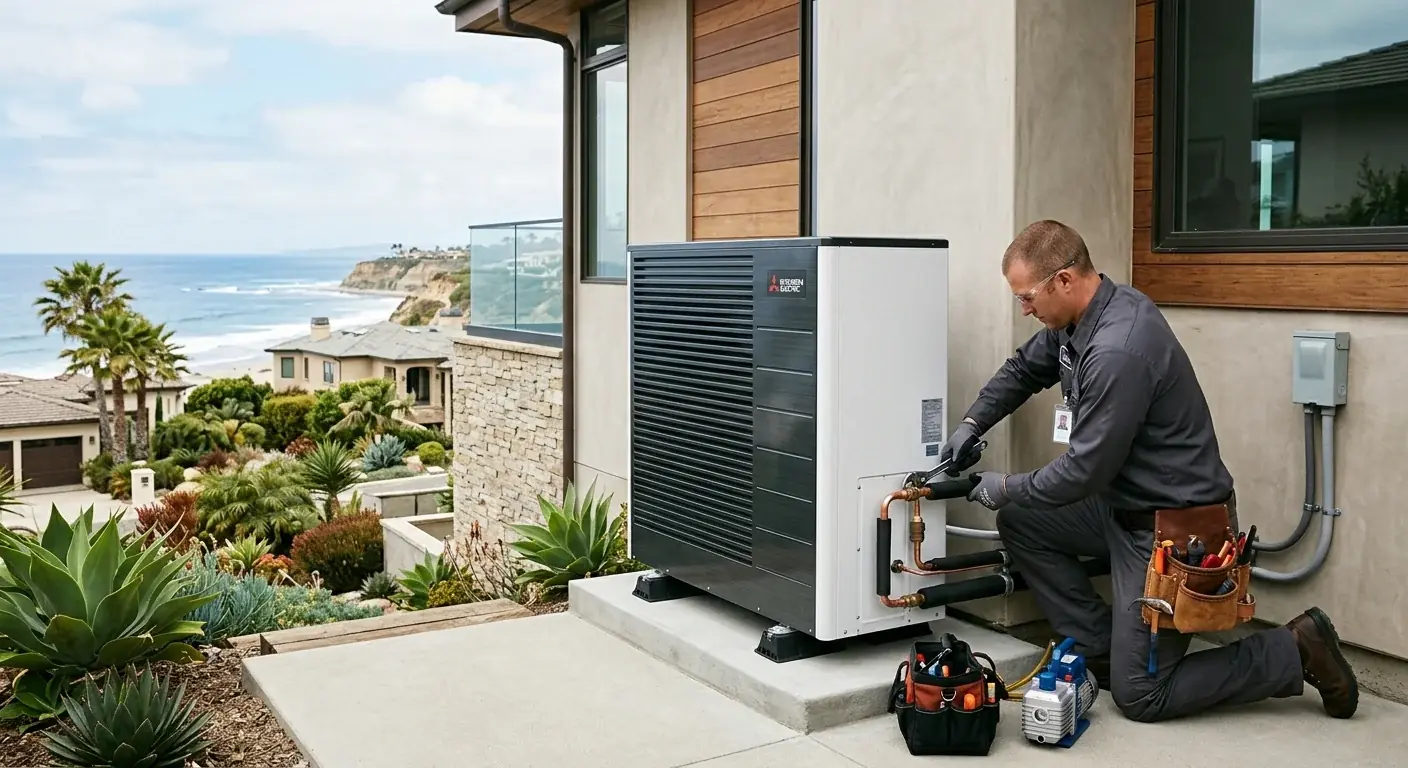
What are the six causes, in order?
| Cause | Homeowner check? |
|---|---|
| Thermostat set to Cool or Emergency Heat | Yes |
| Reversing valve stuck in cooling | No (mode test only) |
| Low refrigerant from a leak | No |
| Defrost cycle stuck on | Sometimes wait-and-see |
| Outdoor coil iced over | Partial (thaw, then retest) |
| Failed auxiliary heat strip | No |
Match what you see. Stop at the first row that fits.
| What you’re seeing | Most likely cause | Next step |
|---|---|---|
| Air feels lukewarm but the house is warming | Normal heat-pump air | Wait a cycle |
| Fan runs, air is cold, thermostat says Cool or Em Heat | Wrong mode | Switch to Heat |
| Fan runs, air stays cold, Cool still gives cold air | Reversing valve stuck in cooling | See reversing valve |
| Fan runs, air is room temperature in both modes | Low refrigerant | Call a tech |
| System blows cool briefly, then warms, repeats | Normal defrost | Wait it out |
| System blows cool for a long stretch and never warms | Defrost stuck | Tech |
| Outdoor unit is a visible block of ice | Iced coil | Off, thaw, then retest |
| Worked last winter, no heat only on cold mornings | Failed aux strips | Tech |
| Nothing runs at all | Power, breaker, or control | Check breakers and disconnect |
| Filter visibly clogged, weak airflow | Blocked airflow | Replace filter, retest |
1. Is the thermostat in the wrong mode?
Heat pump thermostats have more modes than a simple furnace thermostat.
- Cool. Compressor runs and produces cold air.
- Heat. Normal heating. Refrigerant flow reverses.
- Emergency Heat. Bypasses the heat pump and runs electric strips if you have them. That mode costs more to run. Some people set it during a cold snap and forget to switch back.
- Auto. Switches between heat and cool based on temperature.
Fix. Set Heat. Raise the set point a few degrees. Listen for the outdoor unit. Check a register after several minutes. If it warms, you were in the wrong mode.
2. Is the reversing valve stuck in cooling?
The reversing valve is what makes a heat pump different from an air conditioner. When it sticks in cooling, you get cold air at the registers in heat mode.
Tell. Outdoor unit runs. Indoor blower runs. Supply air is outdoor-temperature or colder. Set Cool and feel the register. If it gets cold, the valve is a strong suspect. If it stays room-temperature, look at refrigerant instead.
Fix. Tech job. Sometimes cycling modes frees a sticky valve. A truly stuck valve needs a solenoid or a full valve. See heat pump reversing valve.
3. Is refrigerant low from a leak?
A heat pump needs the right charge to move heat. A slow leak can look like a reversing-valve problem: outdoor unit running, blower running, no useful heat.
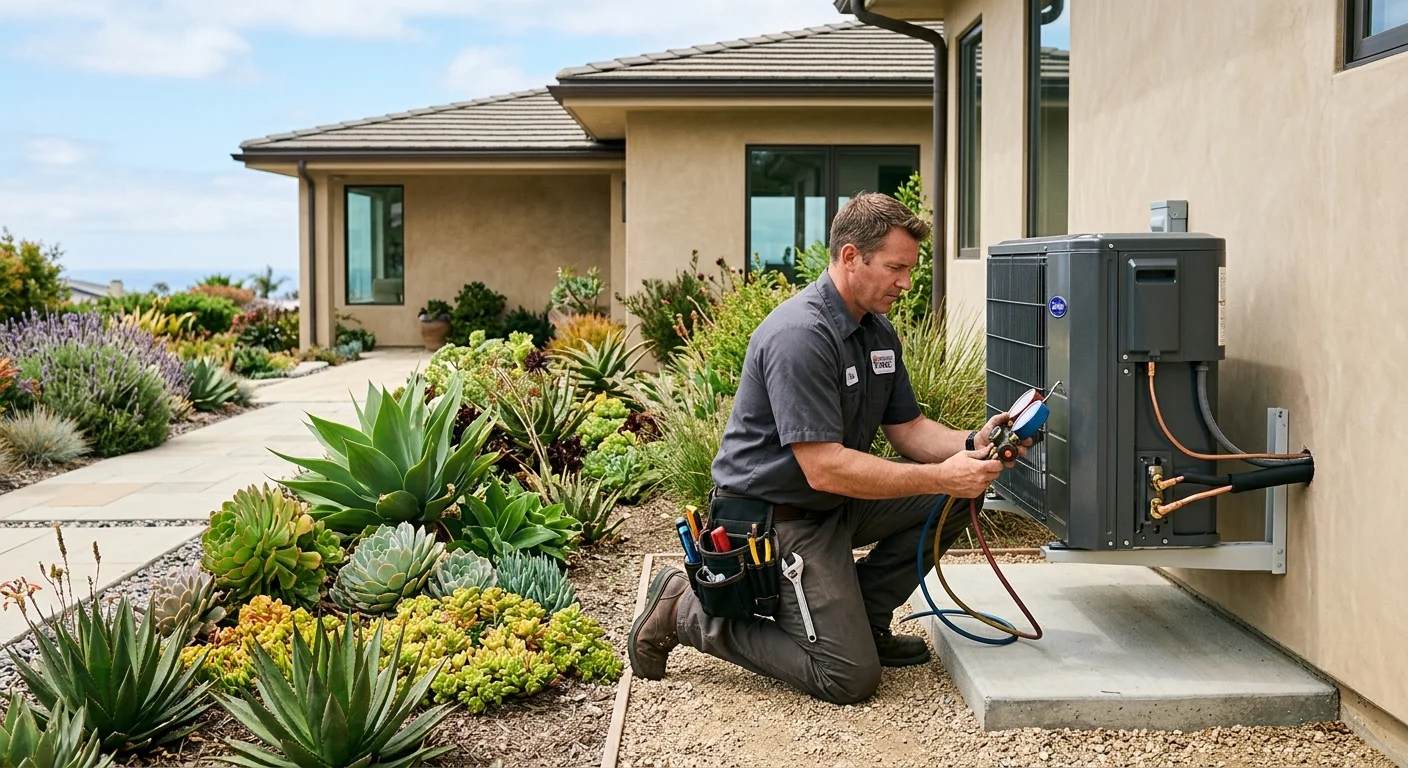
Tell. Coastal homes see coil and line-set corrosion from salt air more often than inland yards. Partial ice on the outdoor coil. Hissing or bubbling at the lines. Lines that stay ambient instead of warming on a heat call.
Fix. Tech-only. Leak find, repair, then recharge. Do not add charge without finding the leak. Older R-22 systems can still be serviced with recycled or previously produced refrigerant after the January 1, 2020 production and import ban. See the EPA Class II ODS phaseout.
Coastal examples: Coronado, La Jolla, Carlsbad, Oceanside. Related: AC repair in Coronado.
4. Is the defrost cycle stuck on?
In heat mode the outdoor coil can drop below freezing. Moisture freezes on the coil. The system reverses briefly to melt ice, then returns to heat. Steam off the outdoor unit and a short stretch of cooler indoor air can be normal.
When defrost stays on, the system never returns to heat. The board or sensor has failed.
Tell. Outdoor unit runs. Indoor air stays cool. The system never seems to kick back into heat.
Fix. Tech replaces the board or outdoor sensor after they prove which one failed.
5. Is the outdoor coil a block of ice?
Not the same as a stuck defrost, but related. Blocked airflow or a defrost problem can ice the whole cabinet. Heat transfer drops toward zero.
Tell. Visible ice or frost wrapping the coil. Indoor air at room temperature or cooler.
Fix. Turn the system Off at the thermostat. Let ice melt. Do not chip fins. Once clear, restart and watch. If it ices again quickly, you have defrost or refrigerant trouble.
NWS San Diego describes ocean moderation near the coast and warmer summer days in nearby valleys. That is a qualitative regional distinction. It does not prove how many nights your yard drops below freezing. When a coastal coil freezes hard, treat it as a component or charge problem until a tech says otherwise.
6. Have the auxiliary heat strips failed?
Many heat pumps have electric resistance strips for backup or for Emergency Heat. In much of the county they run rarely. If the heat pump is weak and the strips are dead, cold mornings feel like no heat at all.
Tell. Fine last winter. This winter, cold mornings produce no heat. Or you hear a strip contactor click with no warmth after.
Fix. Tech job. Strip replacement is quoted after they confirm the elements and the air handler model.
What diagnostic sequence should you run?
- Set Heat a few degrees above room temperature. Does the outdoor unit start?
- If nothing runs, check the 240-volt outdoor breaker, the indoor air handler breaker, the outdoor disconnect, and the air handler switch.
- Check the filter. Replace it if it’s dirty, then retest.
- Walk to a supply register. Air moving? Warm, cool, or room temperature?
- If air is cold: flip to Cool. Cold in Cool plus cold in Heat points at a stuck reversing valve. Room temperature in both points at charge.
- If air is room temperature: look at the outdoor unit. Ice? Steam that never stops? Lines warm or cold?
- If the outdoor unit is silent and breakers are fine: thermostat wiring, control board, or contactor. Tech needed.
What is San Diego-specific about no-heat calls?
A heat pump that cannot pull heat from mild outdoor air is usually a failed part, not “San Diego is too cold for heat pumps.” Inland mornings in Escondido, San Marcos, Vista, El Cajon, and Santee exercise defrost more than the immediate coast.
If you are weighing replacement, do not treat 2026 as a rebate year by default. Section 25C does not apply to property placed in service after December 31, 2025. TECH single-family heat pump HVAC reservations stopped November 14, 2025. HEEHRA single-family was fully reserved February 24, 2026. Recheck IRS 25C, TECH, and HEEHRA. See also SDG&E heat pump rebates.
What will a repair cost?
This site does not publish part or labor prices. Ask the matched company for a written diagnostic, then a repair number, and a replacement number if the unit is old or the leak is in the coil. You hear the price before any work starts.
FAQs
Why is my heat pump running but not heating?
The six common causes: thermostat in the wrong mode, reversing valve stuck in cooling, low refrigerant, defrost stuck on, outdoor coil iced over, or failed backup strips. The sequence above narrows it.
How can I tell if my reversing valve is bad?
Set Heat, wait until it runs, then set Cool. If Cool is cold and Heat is room-temperature or cold, the valve is likely stuck in cooling.
Is it normal for my heat pump to blow cool air sometimes?
Yes, briefly during defrost. If cool air lasts through a long stretch of the cycle, the defrost path is stuck.
Why is my heat pump iced over?
Defrost failure, low refrigerant, or blocked outdoor airflow. Climate-only ice is less common on the immediate coast than inland cold mornings.
Should I turn my heat pump off if it’s iced over?
Yes. Set Off and let ice melt. Restart and watch. If it ices again quickly, call a tech.
My heat pump won’t turn on at all. What should I check first?
Breakers, outdoor disconnect, and the indoor air handler switch. If breakers keep tripping, stop resetting them and call a tech.
Does running Emergency Heat all winter damage the heat pump?
It does not usually damage the outdoor unit. It does run expensive resistance heat. If the heat pump itself is fine, switch back to Heat.
How long does a heat pump last in San Diego?
There is no single countywide life. Coastal salt air and inland heat both stress outdoor parts. Maintenance and coil condition matter more than a blog average.
Related services: heat pump service, AC repair, and AC installation.
Not sure this is your symptom? Our HVAC symptom finder matches what the system is doing to the likely cause.
When to call us
If the sequence points to refrigerant, the reversing valve, or the defrost system, those are tech jobs. Call (442) 777-6440. Ask whether a tech is available today, yes or no. The pro sets the diagnostic fee and confirms it with you before the visit.