Your furnace turns on, the blower runs, but the air coming through the registers is cold. That’s not a single failure. It’s five different failures that all look the same from your couch. Here’s how to tell which one is yours.
Climate Pros SD matches you with licensed HVAC companies. We do not repair equipment, own trucks, or publish repair prices.
The fast answer
| Cause | How often it shows up | DIY-fixable? |
|---|---|---|
| Thermostat set to “Fan On” instead of “Auto” | Very common | Yes |
| Furnace short-cycling on overheat (clogged filter or closed vents) | Very common | Yes |
| Ignition failure, burners not lighting at all | Most common mechanical cause | Sometimes |
| Pilot light out (older furnaces only) | Common on pre-1995 units | Yes |
| Flame sensor or limit switch fault | Common | Partial |
Most of these are short checks. Two of them cost nothing but a setting change or a filter.
1. Thermostat is set to “On” instead of “Auto”
This is the first thing to check, every time. It accounts for a large share of “my furnace is blowing cold air” calls.
Your thermostat has a fan setting independent of the heat/cool mode. “Auto” means the blower only runs when the burners are actively heating. “On” means the blower runs continuously, including the long minutes between heating cycles when there’s no heat to push. Air pulled across a cold heat exchanger and blown into the room feels uncomfortably cool, especially in San Diego where winter indoor temps already sit in the low 60s in many homes.
Fix. Set the fan switch to “Auto.” If the air still feels cold while the heat is supposedly running, move to the next cause.
2. Furnace short-cycling on overheat
The burners light, run for 1-3 minutes, then the high-limit safety trips and kills the gas. The blower keeps running to cool the heat exchanger and pushes a few minutes of cold air through the registers. By the time you stand at the vent, the burners are off.
The most common reason for this in San Diego is a clogged filter starving the system of return air. Less common: too many supply vents closed, a blocked return grille, or a slipping blower belt on the few older units that still use one.
Tell. Furnace runs briefly, blower keeps going, no consistent heat. Repeats every 10-20 minutes. Possibly an error code on newer units.
Fix. Replace the filter. Open all supply vents and check that no furniture or rugs are blocking returns. Try again. If short-cycling continues, call a licensed tech; the high-limit switch itself may be failing, or the heat exchanger may be partially blocked.
3. Ignition failure (burners aren’t lighting)
If the blower runs but the burners never ignite, you’ll get cold air for the entire run cycle, not just briefly. This is the same problem family as our furnace won’t ignite guide, and the diagnostic sequence is identical.
Common causes in San Diego order:
- Dirty flame sensor (most common). Burners light for 5-10 seconds then quit; blower keeps running.
- Failed hot surface igniter (wear part).
- Tripped pressure switch (often a spider web in the inducer port after the long off-season here).
- Closed gas valve at the furnace.
Fix. Watch through the burner inspection port during a heat call. If you see the igniter glow but no flame ever ignites, it’s a gas supply or igniter issue. If you see flame light then disappear within seconds, it’s the flame sensor. We walk through cleaning the flame sensor in the ignition guide.
4. Pilot light is out (standing-pilot furnaces only)
If your furnace was installed before about 1995 and you’ve never had to deal with a hot surface igniter, you have a standing pilot. The pilot is a small flame that burns continuously to light the main burners when there’s a heat call. Drafts, dust, and weak thermocouples can put the pilot out.
Tell. Older furnace. Blower runs but no burner ignition. You can see through the inspection port that there’s no small blue pilot flame in front of the main burner.
Fix. Most older furnaces have a relight procedure printed on a sticker inside the access panel. Generally: turn the gas valve to “Off,” wait 5 minutes for any residual gas to clear, turn it to “Pilot,” press and hold while lighting the pilot with a long match or BBQ lighter, hold for 30-60 seconds after the pilot lights, then release and turn the valve to “On.”
If the pilot won’t stay lit after release, your thermocouple is failing. That’s a small part. A licensed tech quotes it after they confirm it. Only attempt it yourself if you’ve worked on gas appliances before.
5. Flame sensor or limit switch fault
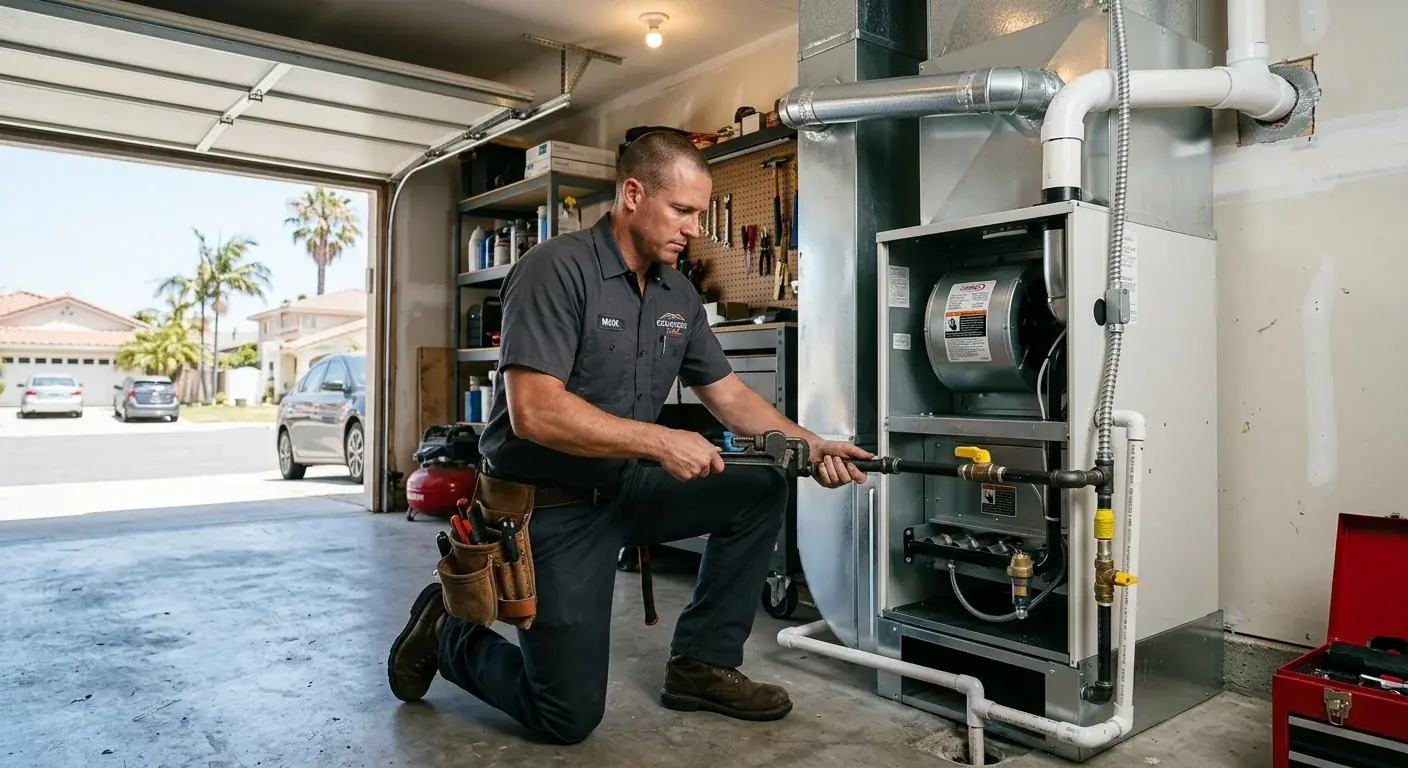
The flame sensor and limit switches are the two main safety devices. The flame sensor confirms that gas is actually burning; the limit switch confirms the heat exchanger isn’t overheating. Either one can fail open and prevent normal heating.
Flame sensor failure. Already covered above. Furnace ignites briefly, then quits. Repeat 2-3 times, then lockout. Clean or replace.
Limit switch failure. Less common but more serious. A bad limit switch can either prevent ignition (always-tripped) or fail to protect the furnace from real overheating (always-closed). Modern furnaces will throw an error code; older ones just behave erratically. A licensed tech quotes the part and labor after they test it.
The diagnostic sequence (run this in order)
- Check the thermostat fan setting. Move it to “Auto.”
- Check the filter. If it’s clogged, replace it. Wait 15 minutes for the system to reset, try again.
- Watch a full heat cycle. Stand at the furnace during a heat call. What do you hear?
- Just the blower, no whoosh of burners igniting: ignition failure (cause #3 or #4 above)
- Burners ignite then quit within 10 seconds: flame sensor (cause #5)
- Burners ignite, run for 1-3 minutes, then quit while blower keeps going: limit switch overheat (cause #2 or #5)
- Check the gas valve and supply. Are other gas appliances working?
- Check the inspection port. Pilot light visible (older units)? Igniter glowing orange-white during a heat call (newer units)?
San Diego-specific patterns
This complaint shows up most often in coastal homes where the furnace runs irregularly. The thermostat gets set to “On” so the family can hear airflow at night for the white noise. The blower runs constantly. The heat call only comes a handful of times overnight. The long stretches between heat cycles push cold-feeling air through the house, and by morning everyone is convinced the heater is broken.
The other regional pattern: inland homes (Escondido, El Cajon, Santee) where the dry summers load filters with fine dust over six idle months. The first November heat call short-cycles on overheat almost immediately. A new filter solves it, and an October maintenance visit prevents it. We cover what’s in a maintenance visit on the HVAC maintenance page. The matched pro confirms what they will actually do.
What a cold-air visit should include (not a price list)
A blog cannot publish a county-wide repair menu. Ask the matched company for:
| Line to insist on | Why it matters |
|---|---|
| Diagnostic fee, in dollars | Each company sets it. Ask if it applies toward repair if you approve the work. |
| Failed part, named | Flame sensor, igniter, thermocouple, limit switch, pressure switch, not “parts” |
| Labor scope | Access, panel time, and a second visit change the quote |
| Warranty, in writing | Part versus labor, and who honors it if a different company returns |
A thermostat reset and a filter swap are homeowner jobs. Everything that touches gas, combustion, or the control board belongs with a licensed C-20 contractor.
FAQs
Why is my furnace blowing cold air when I turn the heat on?
Five things, in order: thermostat fan set to “On” instead of “Auto,” clogged filter causing overheat shutoff, ignition failure where burners never light, pilot light out on older units, or a flame sensor failure where burners ignite briefly then quit.
How do I know if my flame sensor is bad?
Watch through the burner inspection port during a heat call. If burners ignite, run for 5-10 seconds, then shut off (while the blower keeps running), it’s almost certainly a dirty or failed flame sensor.
Why does my furnace blow cold air sometimes and hot other times?
Either short-cycling on a high-limit shutoff (most often from a clogged filter) or the thermostat fan is set to “On,” so the blower runs through the long off-cycles between heat calls. Both push cold-feeling air between actual heating cycles.
Should the air from my furnace feel really hot?
At the supply register closest to the furnace, supply air should feel clearly hot, not room-temperature. If it only feels lukewarm, the system isn’t fully heating, which usually means short-cycling or a sizing problem. The matched tech measures actual supply temperature; this page does not publish a guaranteed number.
Can a dirty filter really cause my furnace to blow cold air?
Yes, and it’s one of the most common causes. A clogged filter starves the system of return air. Without enough airflow across the heat exchanger, the high-limit switch trips and kills the gas as a safety measure. The blower keeps running to cool the unit, pushing cold air through your house.
Is this an emergency?
Not in the safety sense. A furnace blowing cold air isn’t dangerous; it’s just uncomfortable. The exception is if you smell gas, hear hissing, or your CO detectors go off. In any of those cases, call SDG&E at 800-411-7343 first, then call us to get matched with a licensed HVAC pro.
Related services: furnace repair and AC repair.
Not sure this is your symptom? Our HVAC symptom finder matches what the system is actually doing to the likely cause.
When to call us
If you’ve worked through the thermostat fan setting, the filter, and watched a full ignition cycle without identifying the cause, the next step needs a tech with a multimeter and combustion analyzer. Call (442) 777-6440. Climate Pros SD matches you with a licensed pro. Ask for the diagnostic fee in dollars, what they found, and what the repair includes before you authorize work.