Do the maintenance in October, and do it on a warm day. A coastal furnace that only runs a few weeks a year needs a deliberate wake-up before the first cold night, not a service call during it.
Nothing here is urgent. That’s the point. Everything below is easier, cheaper, and less disruptive when the house is 72 degrees and you have all afternoon.
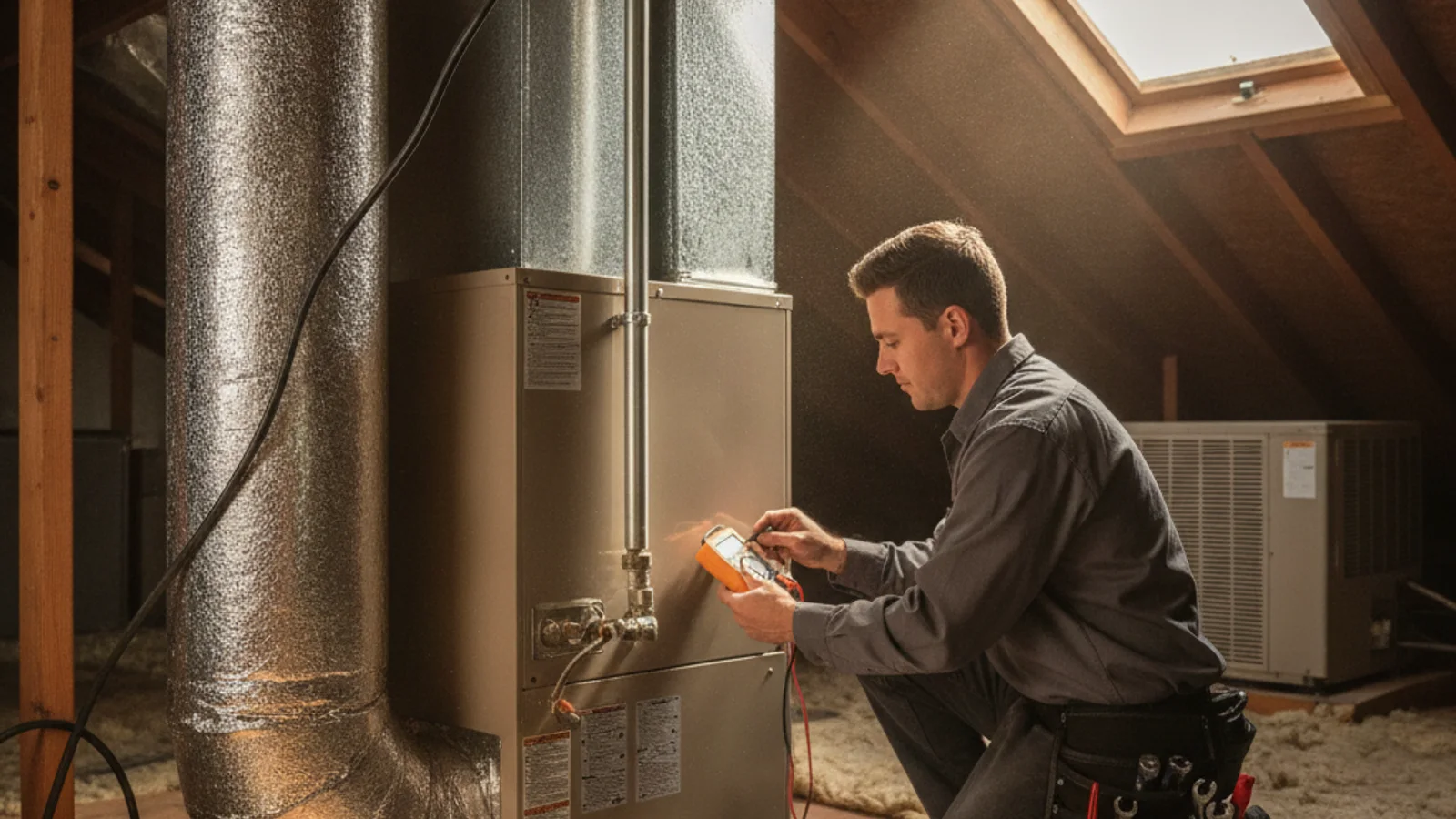
Encinitas furnace maintenance belongs on a warm October day
Run a heat cycle before the first cold night. Coastal furnaces sit idle for months. That idle stretch, not winter runtime, is when ignitors, condensate, and animals cause no-heat calls. Encinitas heating loads are short. A failed heat call in December is often a unit that was never proven in October.
Checklist
- Set heat and listen for inducer, ignition, and blower.
- Replace the filter before the test.
- Look for rust at the condensate or vent termination.
- See furnace repair in Encinitas.
- Use HVAC maintenance.
Related: Encinitas HVAC and furnace repair.
Start with a test run on a warm day
The single most useful thing an Encinitas homeowner can do is turn the heat on in October, months before anyone actually wants it.
Set the thermostat about five degrees above room temperature, switch the system to heat, and stand where you can hear the furnace. Then pay attention to the startup sequence. First a click from the thermostat. Then the inducer motor spinning up, a small whirring sound. A pause while the igniter heats. Then the burners lighting with a soft whoomp. Then the main blower starting and warm air reaching the registers.
That whole sequence should complete without drama, and the furnace should keep running until the thermostat is satisfied. Let it run fifteen minutes. Then walk the house and put your hand at each register.
You’re listening for anything that breaks the pattern. Grinding or a metallic scrape means bearings. A furnace that lights, runs briefly, then shuts off and retries is telling you about airflow or flame sensing. A burnt dust smell may occur at startup and should fade. A smell that persists is not.
Note what happens and open a window. If the sequence stalls anywhere, you now have a diagnostic detail rather than a mystery, and you’ve found it in shirtsleeve weather. Our companion piece on furnace repair in Encinitas walks through what each stall point usually means.
What you can do yourself
Three tasks, no tools beyond a flashlight and a vacuum.
Replace the filter. Find the size printed on the frame, buy the same size, and note the arrow that shows airflow direction pointing toward the furnace. On a system that idles most of the year, once or twice a season is usually enough, but check it rather than assume. A filter that’s grey across its face is done.
Clear the space around the furnace. Garage installs in Encinitas collect surfboards, bikes, storage bins, and paint cans, and a furnace needs combustion air and service clearance. Anything flammable stored against the cabinet is a genuine hazard. Anything blocking the front panel becomes a labor charge when a technician has to move it.
Vacuum the return grille and open every supply register in the house. Closing registers in unused rooms feels efficient and does the opposite: it raises static pressure, strains the blower, and can trip the high limit.
Two more worth doing while you’re there. Change the thermostat batteries if it takes them, because a dying battery produces intermittent faults that look expensive. And look at the exposed sheet metal and screw terminals inside the cabinet with your flashlight. Rust and green or white powder on connections is the salt air signature, and it’s information for the tech even if you do nothing about it yourself.
What you don’t touch: the gas valve, the burners, the flame sensor, the igniter, and anything behind the upper access panel. Those are gas and combustion components, and the correct move is to leave them and write down what you saw.
What the pro’s visit should actually cover here
An annual maintenance visit is priced and scoped differently by every company, so ask what’s on the checklist before you book. On a coastal furnace, a few items matter more than the generic list.
Combustion analysis. A technician with a combustion analyzer reads oxygen, carbon monoxide, and flue temperature at the vent and can tell you whether the burn is clean. On an older furnace this is the check that catches problems before they become safety issues, and plenty of cut-rate tune-ups skip it.
Heat exchanger inspection with a camera or a mirror and a light, not a glance through the burner opening. Coastal humidity accelerates the corrosion that turns a hairline stress crack into a real one.
Vent and flue inspection from the cabinet to the roof termination. Salt fog attacks the joints and the roof jack, and that’s the part of the system most likely to be quietly failing on a house within a mile of the water.
Amp draw on the blower and inducer motors, and a capacitor test read against the rating printed on the can. These are the numbers that show a part drifting out of spec before it strands you.
Condensate trap and drain clearing on high-efficiency units, which sit full of water through the marine layer season.
Ask for the readings, not just a checkmark. A report with actual numbers on it lets you compare next year and see what’s moving. If your house runs a heat pump rather than a gas furnace, the checklist is different again and our guide to heat pump maintenance covers it.
Filters, humidity, and the marine layer
Encinitas has an unusual filtration situation, and the standard advice imported from elsewhere doesn’t fit.
The furnace runs so little that filter loading from heating is minimal. What loads the filter is the blower running in fan mode or during cooling, plus the ordinary dust of a house with the windows open most of the year. In Leucadia and Cardiff, where a lot of people leave windows open through the summer, filters pick up more outdoor particulate than the furnace’s own duty cycle would suggest.
Marine layer humidity is the other factor. Damp air sitting in an unused duct system encourages mold growth on filter media and inside the cabinet, particularly on a filter left in place for a year. If a filter smells musty when you pull it, that’s a reason to change filters more often, not a reason to buy a more expensive one.
Resist the urge to fit the highest MERV rating on the shelf. A dense filter in a system with undersized return ducts, which describes a lot of the older single-story homes here, restricts airflow enough to cause the exact overheating and short cycling you’re trying to prevent. Match the filter to what the system was designed for, and if you want better filtration, ask about adding return capacity instead.
What maintenance won’t fix
Being straight about the limits: a tune-up is not a repair, and it doesn’t reset the clock on age.
It won’t restore a heat exchanger. It won’t make an undersized or oversized furnace comfortable, since a furnace too large for the house short cycles no matter how clean it is. It won’t fix duct leakage in a crawl space, and it won’t correct a bad original installation. Those are all real problems with real fixes, but the fixes are duct work, load calculations, and equipment, not a seasonal service visit.
Maintenance also can’t buy back a part that’s already drifted. If the capacitor tests low or the inducer draws high amps, replacing it is a repair with its own cost, and a good tech will present it that way rather than folding it into the visit and surprising you on the invoice. Ask which line items are maintenance and which are repairs before anyone starts.
If the furnace’s age and condition are raising replacement questions, have that conversation instead of assuming another tune-up is the answer. It’s a much better conversation in October than in December. ENERGY STAR’s heating and cooling guidance is a reasonable neutral reference while you’re weighing that.
When to call us
Book the annual visit before the first cold snap, and call sooner if the October test run turned up a smell, a noise, or a furnace that won’t stay lit. Combustion and gas components are licensed-technician work every time. Call us at (442) 777-6440 and we will match you with a licensed local pro.