San Marcos sits far enough inland that winter nights actually get cold. NOAA 1991-2020 January normal low at Escondido #2 (the station used for San Marcos) is about 45F. Some nights dip colder. That’s enough to run a furnace hard. The problem is that many San Marcos homeowners go months without thinking about their heating system, then fire it up in November and discover something’s wrong.
Climate Pros SD matches you with licensed HVAC companies. We do not repair equipment, own trucks, or publish repair prices.
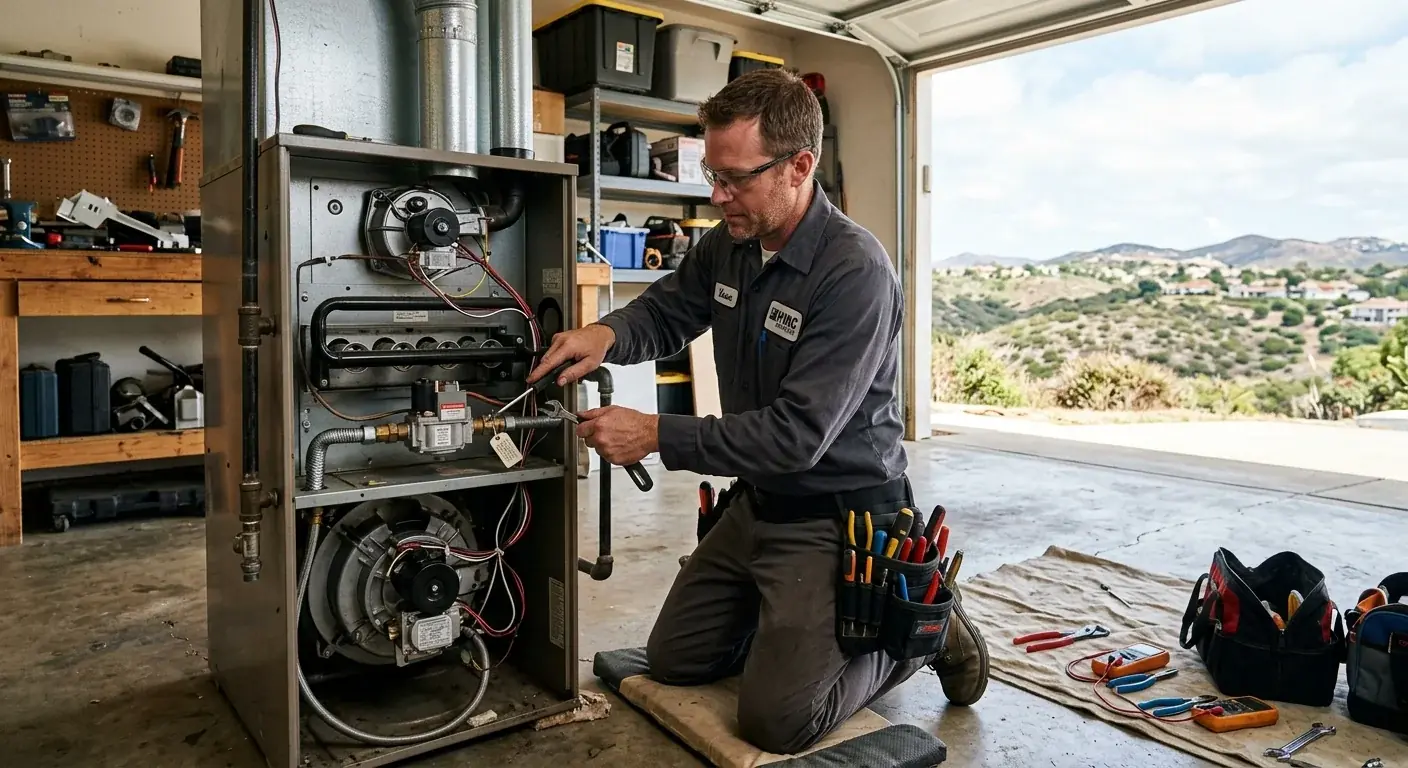
This guide covers what fails most often in San Marcos homes, how to read a 2026 quote, and how to decide whether a repair makes sense or a replacement is the smarter move.
How San Marcos furnace use patterns create specific failures
San Marcos has a shorter heating season than most people expect from Southern California. Furnaces sit idle through a long spring, summer, and fall, then get called into service when temperatures finally drop. That pattern creates predictable problems.
Dust, debris, and minor component degradation accumulate during the off-season. When the furnace fires up for the first time in October or November, those issues show up fast. The result is a late-fall call HVAC companies across San Marcos get constantly: “It worked fine last year.”
The city’s housing stock also varies considerably. San Elijo Hills, built primarily in the 2000s and 2010s, has newer high-efficiency systems with electronic controls and variable-speed blowers. Those units are more capable, but they have more components that can fail. Lake San Marcos has an older housing stock, much of it from the 1970s and early 1980s, with furnaces that have seen decades of service. Many of those units still run on standing pilots rather than electronic ignition. Twin Oaks Valley and the Cal State San Marcos corridor include a mix of newer apartments and older ranch homes, with rental-property maintenance gaps showing up regularly.
Common furnace failures in 92069, 92078, and 92096
Ignitor and flame sensor failures top the list across all San Marcos zip codes. The ignitor is what lights the gas when your furnace calls for heat. The flame sensor confirms a flame is present. When either fails or gets dirty, the furnace won’t start or shuts down within seconds as a safety measure. You’ll often hear the furnace attempt to start, then go quiet. This is the most common no-heat call in San Marcos.
Dirty filter-induced lockout is a close second. A clogged filter starves the furnace of airflow, which causes the heat exchanger to overheat. The furnace’s high-limit switch trips as a safety response and shuts the unit down. The fix is a new filter, but if the limit switch was tripped repeatedly, it may also need replacement. This happens most in homes where filters haven’t been changed in six months or more, which is common in San Marcos given the short heating season.
Cracked heat exchangers in older Lake San Marcos units are a serious concern. Furnaces from the 1970s and 1980s in the Lake San Marcos community are well past their designed service life. A cracked heat exchanger leaks carbon monoxide into the air supply. It’s a safety issue that can’t be patched. When a cracked heat exchanger is found, replacement of the furnace is the only responsible recommendation.
Blower motor wear shows up in both older and newer systems. The blower runs during cooling season too, so it accumulates far more hours than the heating components. Signs include unusual noise (grinding or squealing), weak airflow from vents, or a furnace that heats but doesn’t distribute the warm air through the house.
What a 2026 furnace quote in San Marcos should include
These are typical jobs for San Marcos residential systems. All assume a licensed technician. The pro sets the diagnostic fee and confirms it with you before the visit. Climate Pros SD does not publish dollar ranges.
- Ignitor replacement
- Flame sensor cleaning or replacement
- Filter replacement and limit switch reset
- Blower motor capacitor
- Blower motor replacement (variable-speed motors in newer San Elijo Hills systems are a different quote)
- Gas valve replacement (safety issue)
- Control board replacement (newer high-efficiency units in San Elijo Hills have more complex boards)
- Heat exchanger: a cracked heat exchanger is not a repair. Replacement of the full unit is almost always the right call.
Newer San Elijo Hills systems vs. older Lake San Marcos stock
The difference matters when you’re deciding between repair and replacement.
San Elijo Hills homes built after 2005 typically have high-efficiency furnaces with AFUE ratings of 80 to 96 percent. These units have electronic controls, variable-speed blowers, and pressure switches that older systems don’t have. They’re more efficient, but there are more parts to fail. A 10 to 15-year-old San Elijo Hills system that needs a control board or blower motor is still worth repairing in most cases because the unit has years of useful life remaining.
Lake San Marcos homes from the 1970s and 1980s are in a different situation. A 40-year-old furnace with a standing pilot and no electronic controls might still be running, but the heat exchanger, burners, and heat-distribution components have been cycling through thousands of heating seasons. Parts are hard to source. Efficiency is low, often 60 percent AFUE or less. A repair on one of these systems is rarely the right answer unless it’s a simple, inexpensive fix. Most of the time, replacement with a modern unit is the better investment. The matched licensed contractor installs it.
Repair vs. replace: how to think through it
The rule most HVAC professionals use is the 50 percent rule: if the cost of the repair is more than 50 percent of the cost of a new furnace, replace it. Use the actual new-system quote. Climate Pros SD does not publish a San Marcos install range.
Age matters too. A furnace under 10 years old is almost always worth repairing unless it has a cracked heat exchanger. A furnace over 20 years old is almost never worth a major repair. The sweet spot from 10 to 15 years requires judgment based on the specific repair and the overall condition of the system.
Older Lake San Marcos homes may also have R-22 refrigerant in the air conditioning system, a separate issue that signals an aging overall HVAC setup. EPA banned R-22 production and import as of January 1, 2020; existing systems may still be serviced with recycled refrigerant. If a major furnace repair coincides with an aging R-22 AC system, it often makes sense to plan both replacements together.
Related service: AC repair.
When to call us
If your San Marcos furnace isn’t starting, is cycling on and off, is making unusual noise, or you’re simply not getting heat, call (442) 777-6440. Climate Pros SD matches you with a licensed pro. Ask for the diagnostic fee in dollars, what they found, and what the repair includes before you authorize work.
Before hiring any HVAC company, verify their contractor licensing on the CSLB website.
For San Marcos neighborhood notes, see our furnace repair in San Marcos service page or the full San Marcos HVAC page.