A heat pump changeout in Vista involves the equipment, paperwork, and electrical panel, and the panel can change the plan. Getting the sequence right matters more than getting the brand right.
Homeowners tend to picture this as a swap: old box out, new box in. On the ground it’s four trades’ worth of work compressed into one project, and the parts people forget are the ones that hold up the final sign-off.
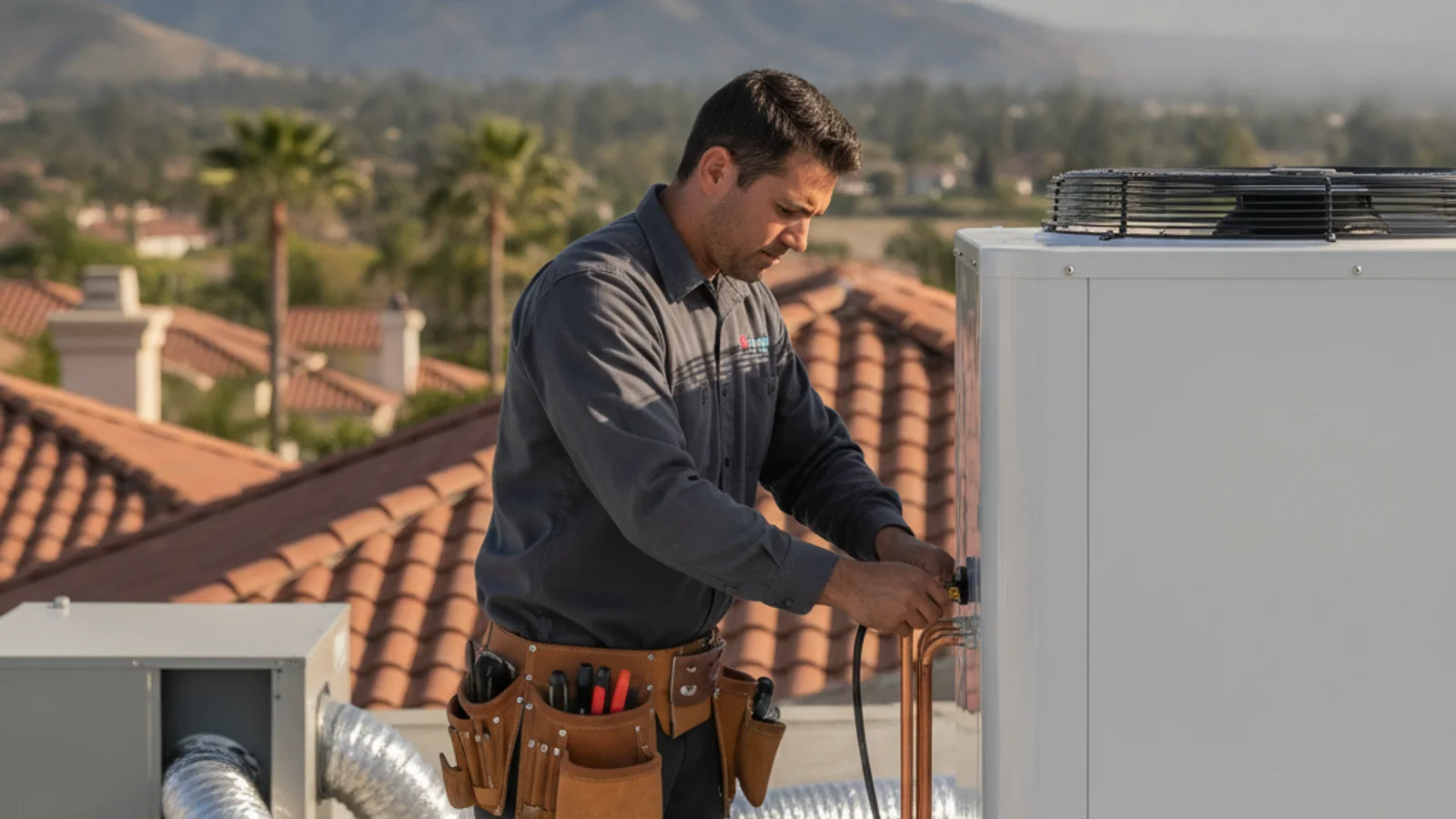
What the changeout actually involves
The visible work is the outdoor condenser and the indoor air handler or coil. Around that sits everything else: a new pad or bracket, a refrigerant line set either reused or replaced, a condensate drain and safety switch, a disconnect box at the unit, and a dedicated circuit back to the panel.
If the old equipment was a gas furnace, there’s demolition too. The furnace comes out, the gas line to it gets capped by whoever’s licensed to do that, and the flue penetration through the roof or wall gets sealed. Skipping the flue seal is a slow leak that shows up as a stain on a ceiling two winters later.
The refrigerant question deserves a beat. Equipment sold now uses low-global-warming refrigerant, because EPA rules under the AIM Act set a GWP limit of 700 for residential air conditioning and heat pump equipment starting January 1, 2025. An old R-410A line set can often be reused, but it has to be evaluated and properly cleaned or flushed for the new refrigerant, and sometimes the honest answer is that it gets replaced. Ask which one your quote assumes.
Then the system gets pulled into a vacuum, charged to the manufacturer’s spec for the actual line length, and commissioned. Commissioning is where a good install separates itself: airflow measured, charge verified, thermostat configured for the equipment rather than left on defaults.
All-electric or dual fuel
Vista sits inland enough to get real summer afternoons and mild enough that winter heating loads stay modest. That combination makes an all-electric heat pump a reasonable fit for most homes here. One system, both seasons, no combustion appliance in the house.
Dual fuel keeps the gas furnace as the heating backup and lets the heat pump handle cooling plus the mild heating hours, with a control that switches to gas below a set outdoor temperature. It’s a genuinely good answer in two situations: when the existing furnace is newer and still has years left, and when your electrical service can’t comfortably carry a full-electric heating load without an upgrade you’d rather not fund right now.
It’s a worse answer when the furnace is old anyway, because you’re paying to keep and eventually replace a second system. Our comparison of replacing an AC with a heat pump lays out how that tradeoff plays over the equipment’s life.
One thing that should not enter the decision as a given: rebates. The federal Section 25C credit expired December 31, 2025 per the IRS. The IRS $2,000 figure is the 2025 qualified heat-pump cap, not a 2026 bid. TECH Clean California stopped new single-family heat-pump HVAC reservations on November 14, 2025. HEEHRA single-family rebates were fully reserved statewide as of February 24, 2026. The $8,000 / $4,000 figures are design caps, not live money. If a proposal’s price depends on an incentive, ask for that program’s current status in writing.
The panel is where projects stall
A heat pump adds a dedicated 240 volt circuit, and an all-electric system with backup heat strips adds more load than most people expect. That’s the piece that turns a straightforward changeout into a two-permit project.
The right answer comes from a load calculation, not from the number stamped on the main breaker. Plenty of Vista homes on smaller services have room once the calculation accounts for actual demand instead of nameplate totals. Plenty of others don’t, particularly if a spa, an EV charger, or a converted garage has already been added. That calculation is covered in running a heat pump on a 100 amp panel.
Where the panel is genuinely full, the options are a service upgrade, a load-management device that prevents two large loads from running at once, or sizing the system so backup heat draws less. All three are legitimate. Which one fits is an electrician’s call on your specific panel, and the cost difference between them is large enough that it belongs in the quote before you sign, not after demolition starts.
Vista’s housing eras change the scope
Shadowridge and the planned tracts built from the 1980s into the 1990s generally have equipment in a garage or an interior closet, ducts that were designed with the house, and panels that can often take the load. Those are the cleanest changeouts in the city.
The older core around Vista Village and Escondido Avenue runs smaller and older. Mid-century homes here often have a furnace in a hall closet with just enough space for the furnace and nothing else. Fitting an air handler and coil into that footprint sometimes means relocating the equipment, which changes the duct connections and the drain routing.
Homes up Foothill Drive and the eastern hills add access and placement questions. A sloped side yard limits where a condenser pad can go, and the line-set run to the indoor unit gets longer. Longer runs need line sizing and charge matched to the measured distance.
Older homes across all three areas share one issue worth naming: the duct system. A heat pump delivers air at a milder supply temperature than a gas furnace does, so leaky ducts and undersized returns show up as rooms that never quite reach setpoint. If the ducts are original, get them evaluated as part of the project rather than after it. Our AC installation guide for Vista covers the sizing side of the same question.
Permits and HERS verification
The current permit authority and process for a Vista heat pump changeout could not be confirmed from the approved sources. Before work starts, ask the contractor to verify the property’s jurisdiction and confirm the current process and fee with the City of Vista or County of San Diego, whichever has authority.
California’s Title 24 energy code requires field verification and diagnostic testing when an HVAC system is altered or replaced, and that testing is performed by a certified third-party rater rather than the installing contractor. The California Energy Commission moved that verification scope into its Energy Code Compliance program as of January 1, 2026, and directs questions to its Standards Compliance Branch through the CEC program page.
Practically, that means your job isn’t finished when the unit runs. A rater visits, tests, and files, and the permit closes after that. Ask whether the verification is included in the quoted price and who schedules it. A project that never gets its final sign-off is a problem you inherit at resale.
What belongs in the quote
Model numbers for the outdoor and indoor units. The load calculation for your house. Whether the line set is reused or replaced. The electrical scope and who performs it. Duct work included or excluded, stated plainly. Permit fees. Title 24 verification. Commissioning, including measured airflow and verified charge.
Compare bids on that list rather than the total. Verify the license number on the CSLB lookup too. HVAC falls under the C-20 classification, and every HVAC pro in the network is licensed and insured. More local detail is on the Vista HVAC page and the heat pump service page.
When to call us
A heat pump changeout touches refrigerant, electrical, ducting, and permitting, which puts it squarely with a licensed C-20 contractor who will run a load calculation before quoting. Call us at (442) 777-6440 and we will match you with a licensed local pro.