When a heat pump stops heating or cooling, the useful move is to name the failed part family and get a written diagnostic. Heat pumps share a compressor, coils, and charge with air conditioners. They add a reversing valve and a defrost path. Those two extras are why a generic AC checklist can miss the actual fault.
Climate Pros SD matches homeowners with licensed, independent HVAC companies. We do not repair equipment, employ techs, or set prices. Ask the matched pro what their diagnostic fee is and whether it applies toward the repair.
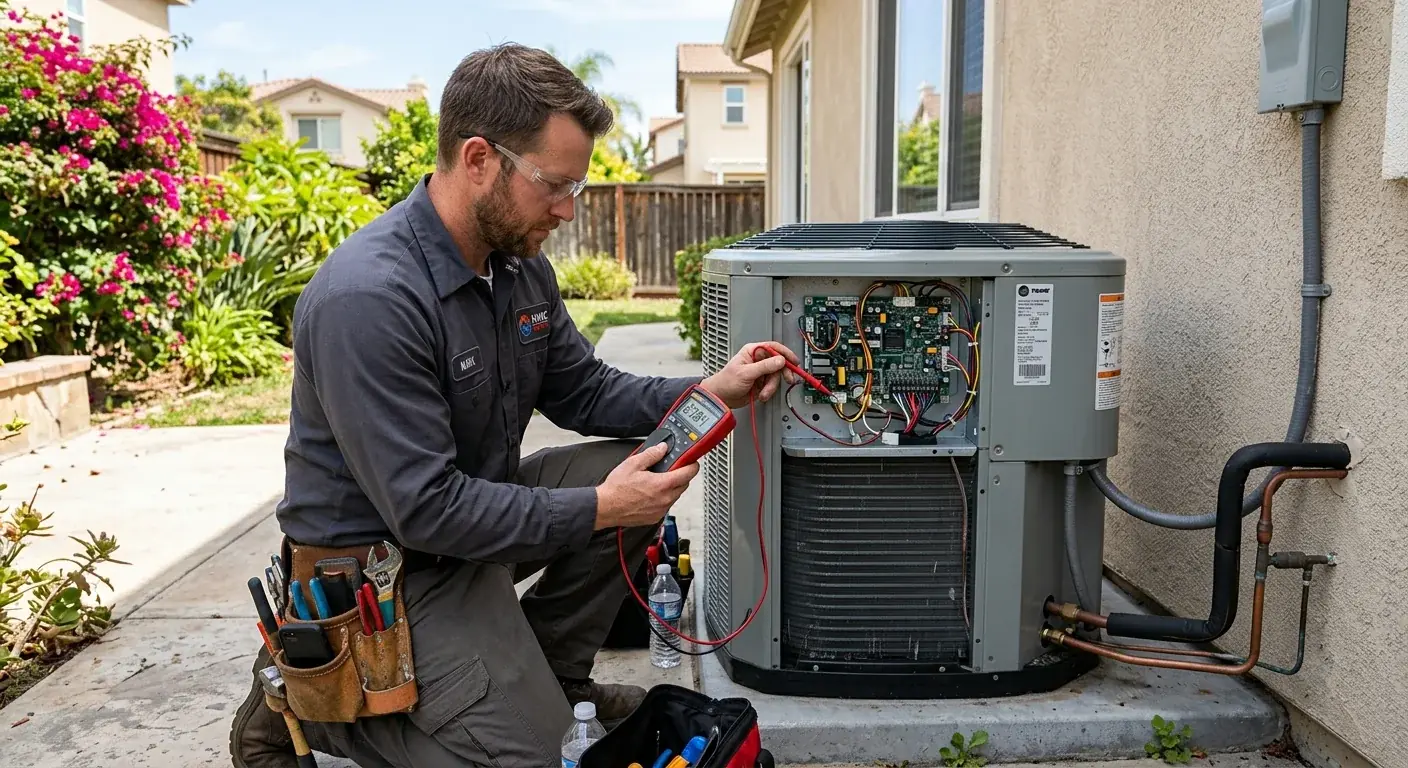
What are the most common heat pump problems in San Diego?
A stuck or failed reversing valve. That valve switches refrigerant flow between heat and cool. Stuck in one position, you lose the other mode. Details: heat pump reversing valve.
A failed defrost board or sensor. In heat mode the outdoor coil can ice. Defrost is supposed to melt it. If it does not, you get a frozen outdoor unit and weak heat. See frozen outdoor unit.
Refrigerant leaks. Low charge makes the system run long and deliver lukewarm air. Coastal salt air is a common outdoor-coil story. Do not top off without a leak search.
Electrical: tripped breakers, weak capacitors, pitted contactors, wiring. A clogged filter can look like a “system problem” until airflow is restored.
Related: heat pump not heating and heat pump making noise. Service page: heat pump service.
How is heat pump repair different from AC repair?
An air conditioner only dumps heat outdoors. A heat pump also has to pull heat indoors. That reverse path is the reversing valve. An AC outdoor coil does not need a heating-mode defrost cycle. A heat pump does.
When a homeowner says the unit will not heat, a heat-pump-literate tech checks mode, charge, valve, and defrost, not only capacitors. They should run the system in both directions when it is safe to do so. Comparison background: heat pump vs AC in San Diego.
In California, HVAC work over the B&P §7048 threshold or work that needs a permit is C-20 contractor scope. Verify the company at CSLB. Climate Pros SD is a referral service, not the licensee.
City of San Diego: no part of heating, ventilating, air conditioning, or refrigeration systems shall be installed, altered, replaced, or repaired unless a Mechanical Permit has been obtained. That is city jurisdiction. See City of San Diego mechanical permits. The matched contractor pulls permits, not the brand.
What do reversing valves, defrost boards, and other parts cost?
This site does not publish part or labor prices. Those numbers belong on the contractor’s quote after they see the model, refrigerant type, and access.
Ask them to split:
- Diagnostic
- Solenoid-only versus full reversing valve (recovery, braze, vacuum, recharge)
- Defrost board versus sensor
- Leak find, repair, recharge
- Compressor or coil, if that is where the diagnosis landed
You hear the price before any work starts.
R-22 (HCFC-22) production and import have been banned in the US since January 1, 2020. Existing systems may still be serviced with recycled or previously produced refrigerant (EPA ODS phaseout). New residential heat pumps manufactured or imported after January 1, 2025 must meet EPA’s GWP 700 limit (EPA Technology Transitions). Do not invent future R-410A prices.
When does repair make sense versus replacement?
Age, leak location, coil condition, and whether this is the second major failure in a short span. A named trade heuristic is the 50% rule: compare a major repair to about half of replacement. It is a heuristic, not a guarantee.
Do not close the math with expired or closed incentives. Qualifying 2025 installs may still sit in the Section 25C window; property placed in service after December 31, 2025 does not. The IRS says the annual limit for qualified heat pumps and heat pump water heaters was $2,000 and the credit is nonrefundable. Direct tax questions to a tax professional (IRS 25C). TECH Clean California single-family heat pump HVAC incentives were fully reserved and stopped new reservations on November 14, 2025. HEEHRA single-family was fully reserved February 24, 2026. Recheck TECH and HEEHRA. SDG&E’s Golden State Rebates retail offerings have ended; do not generalize that to every SDG&E program (SDG&E rebates). More on this site: SDG&E heat pump rebates and California HVAC rebates.
How do you find a technician who knows heat pumps?
Look for companies that list heat pump service, not only AC. Ask how they test a reversing valve and how they force a defrost. Verify C-20 status at CSLB. Do not treat Climate Pros SD as the licensed installer.
Skip testimonials on this site. We do not publish reviews. You can still read public CSLB complaint history.
Related: AC repair, AC installation, HVAC maintenance. Cities: San Diego County locations.
FAQs
Why does my heat pump blow warm air when I want cooling?
The reversing valve may be stuck in heating, or the thermostat may be in Heat. Confirm the mode first, then call if both modes are wrong.
Can I add refrigerant myself?
No. Charge work is licensed HVAC work, and a leak that is not found will dump the new charge.
Should I keep running a noisy or iced heat pump?
If it bangs, grinds, hisses, or is a block of ice, shut it off and call. See the noise and ice guides.
When to call us
If the unit will not heat, will not cool, ices over, or makes a new mechanical noise, call (442) 777-6440. Ask whether a tech is available today, yes or no. The matched company diagnoses and quotes. We do not.