“Heat pump service” in Escondido covers four different jobs: diagnosing a system that isn’t working, routine upkeep, replacing a failed unit, and converting a gas-furnace home to a heat pump. Knowing which one you actually need keeps you from paying for the wrong visit.
The phrase gets used loosely, and that costs homeowners money. Somebody books a tune-up when the reversing valve has already stuck, or gets quoted a full replacement when a capacitor was the whole story. Here’s what each category involves in this valley.
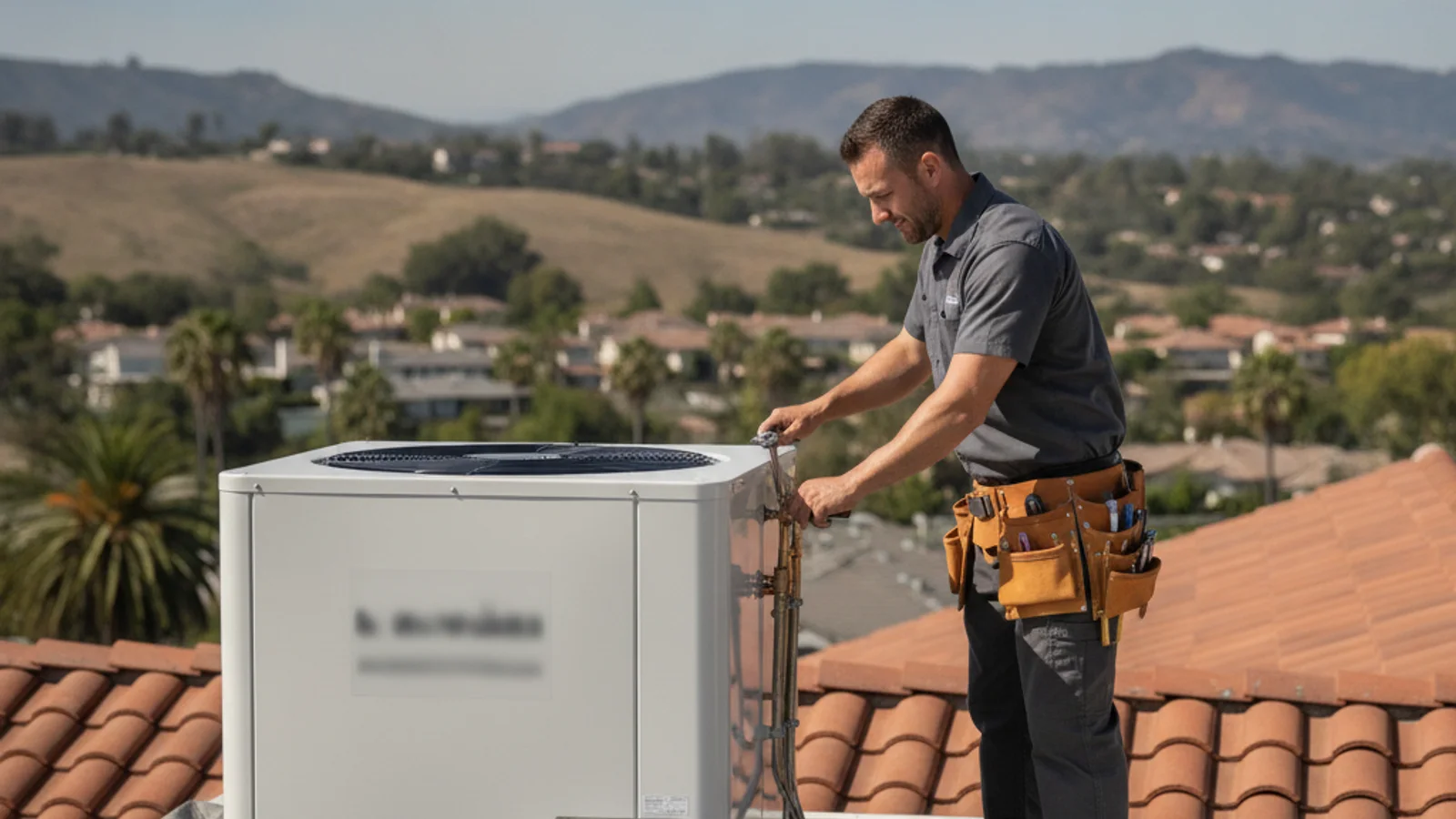
The four things “heat pump service” can mean
Diagnosis and repair is what you need when the system runs but doesn’t heat or cool, makes a new noise, trips a breaker, or short cycles. It’s a paid visit with gauges and a meter, and it ends with a named fault and a price to fix it.
Maintenance is preventive, scheduled, and priced per visit or as a plan. Nothing is broken. The point is to catch drift before it becomes a failure.
Replacement is a changeout of the existing heat pump, usually because a major component failed on an old system or efficiency has fallen far enough that repairs stop making sense.
Conversion is a different animal: pulling a gas furnace and an air conditioner and putting a single heat pump in their place. That one touches electrical and permitting in ways a straight changeout doesn’t, and it’s covered in our guide to replacing an AC with a heat pump.
When you call anyone, say which of the four you think you’re in. If you’re not sure, describe the symptom instead of guessing at the category. A good dispatcher will sort it out from the symptom faster than from your diagnosis. Note when the trouble started, what the thermostat is set to, and whether it happens in heating, cooling, or both.
Why the Escondido valley changes the equipment’s job
Escondido sits in a bowl. The hills that make the drive in on Highway 78 scenic also trap afternoon heat, and the valley floor holds it longer into the evening than the coastal cities to the west. A heat pump in 92025 or 92027 spends far more hours in cooling mode at a high outdoor temperature than the same model in Encinitas would.
That matters because a heat pump’s capacity drops as the outdoor temperature climbs. The rated number on the label is measured at a standard test condition. On a genuinely hot Escondido afternoon, the unit is delivering less than that rating while the house is demanding more. A system sized off a coastal assumption runs continuously on the days you most need it, which feels like a broken unit but is really a sizing decision made months earlier.
The heat also shortens the life of the parts that don’t like heat. Capacitors, contactors, and the compressor’s start components run hotter on a pad in direct sun than the same parts in a shaded coastal yard. That’s why failures cluster in late summer here rather than spreading evenly through the year.
Then there’s what the air carries. Dust off the dry hillsides, agricultural debris from the surrounding valleys, and pollen through spring all end up in the outdoor coil’s fins. A fouled coil raises head pressure, which raises energy use and puts load on the compressor. It’s the single most common thing found on an inland unit that’s underperforming.
Repair: what actually fails on an Escondido heat pump
A heat pump has everything an air conditioner has, plus two things it doesn’t: a reversing valve that flips the refrigerant flow between heating and cooling, and a defrost control that keeps the outdoor coil clear on cold mornings. Both are heat pump specific failure points, and both are the parts a generic AC technician is least practiced on.
A stuck reversing valve typically shows up as a system that works in one direction only. The house cools fine in July and won’t heat in December, or the reverse. A defrost board that stops triggering shows up as ice on the outdoor unit on a cold inland morning, and then as weak heating because the iced coil can’t move air.
The more ordinary failures are the same ones that hit air conditioners. A failed run capacitor leaves the compressor humming without starting. A pitted contactor cuts power intermittently. A low refrigerant charge means there’s a leak somewhere, and topping it off without finding the leak is money spent to repeat the visit next season.
For the full failure list and how each one is diagnosed, see our heat pump repair guide. If you aren’t sure the fault is even in the heat pump, start from the symptom instead: a thermostat that lost power and a compressor that won’t start look identical from the hallway. Sizing for this valley’s cooling load is its own topic, and it belongs in the replacement conversation below rather than the repair one.
Upkeep: what to ask before you book a plan
Maintenance plans are sold hard in this trade, and the useful question isn’t the price, it’s the scope. A heat pump plan should be different from an air conditioner plan, because a heat pump has parts an air conditioner doesn’t.
Ask three things. Does the visit check the reversing valve’s operation in both directions? Does it verify the defrost control actually triggers? Is refrigerant charge measured in both modes, since a system can be correct in cooling and off in heating? If the answer to all three is vague, you’re being quoted an AC tune-up with a heat pump’s name on it.
Ask how many visits the plan includes, what the price is per visit if you don’t sign a plan, and whether a diagnostic fee applies toward a repair. Each company sets its own policy on that, so get the answer from the company you’re hiring rather than from an article.
There’s a general twice-a-year rhythm to heat pump upkeep in San Diego County, and our heat pump maintenance guide explains why a system that runs in both modes needs a different cadence than an AC-only house.
Replacement, and how to check who you’re hiring
The replacement conversation usually starts with one expensive part. A failed compressor or a leaking coil on a system past its warranty is the classic moment. Age, the cost of the repair against the cost of new equipment, and how much the system has been costing you to run all belong in that decision.
Two program facts worth knowing before anyone quotes you a rebate: the federal Section 25C tax credit expired December 31, 2025 according to the IRS. The IRS $2,000 figure is the 2025 qualified heat-pump cap, not a 2026 bid. TECH Clean California stopped new single-family heat-pump HVAC reservations on November 14, 2025. HEEHRA single-family rebates were fully reserved statewide as of February 24, 2026. Confirm current status in writing rather than counting on a number in a brochure.
For efficiency comparison, ENERGY STAR certifies air-source heat pumps at SEER2 15.2 and HSPF2 7.8 or better. That’s a floor for comparing bids, not a legal minimum.
Whoever you hire, run their license number through the CSLB lookup. HVAC work falls under the C-20 classification, and the lookup shows status, bond, and complaint history. Every HVAC pro in the network is licensed and insured, and checking still costs you nothing.
More local detail lives on the Escondido HVAC page and the heat pump service page.
When to call us
If your heat pump works in one mode and not the other, ices up, or you’re staring at a repair quote large enough to raise the replacement question, that’s a licensed C-20 contractor’s call, not a weekend project. Call us at (442) 777-6440 and we will match you with a licensed local pro.