A ductless mini split is usually the practical answer in Oceanside because so much of the older beach housing stock has no ductwork and nowhere sensible to put any. The install decisions that matter here are corrosion protection, where the outdoor unit can legally sit, and who has to approve it.
Oceanside stretches from the sand toward the inland edge near Bonsall, and the right install looks different across the city. A cottage two blocks off The Strand and a tract house out past Rancho Del Oro are two separate projects that happen to share a product category.
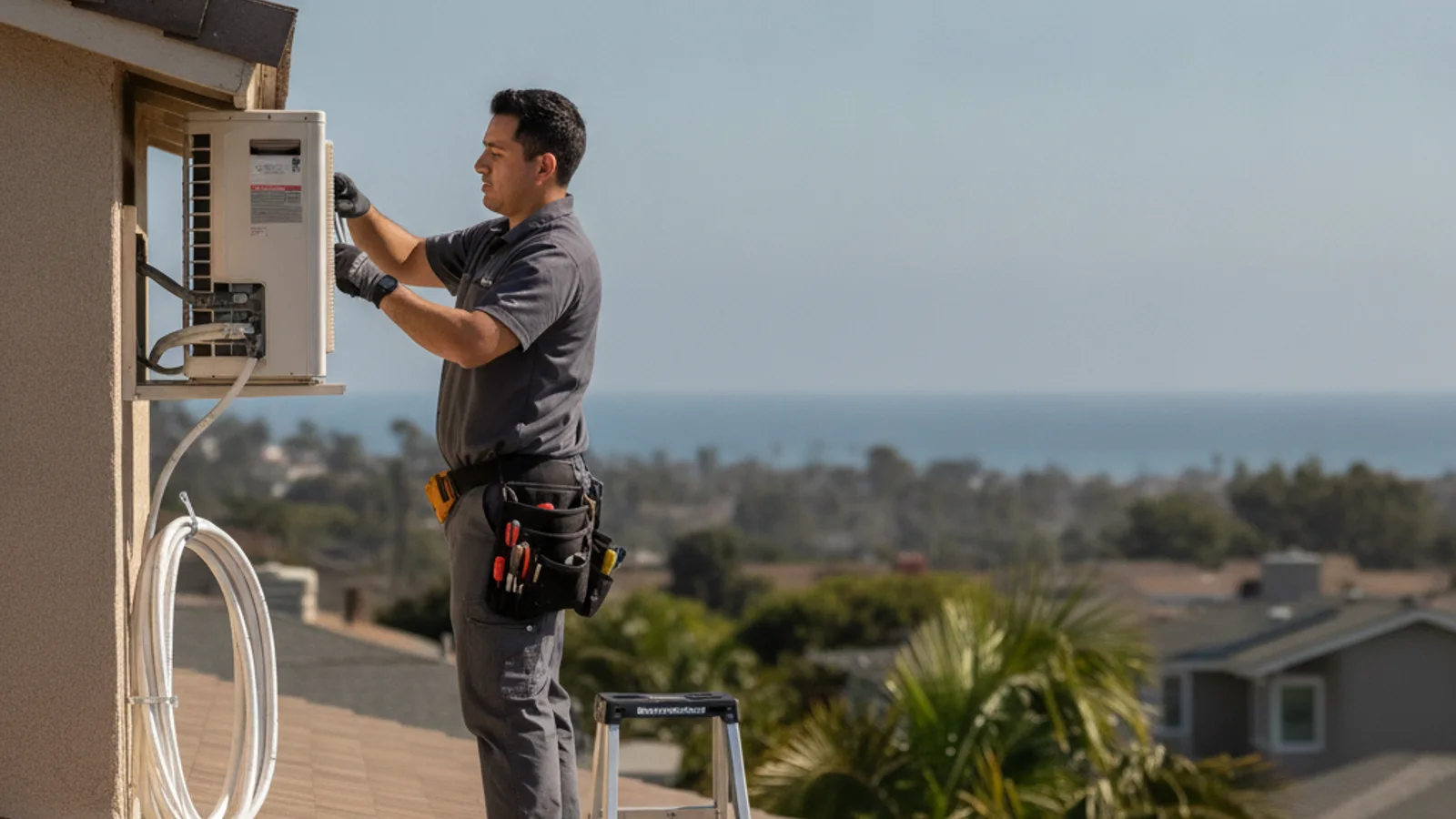
Oceanside mini splits exist because many houses have no ducts
Coastal protection, legal condenser placement, and HOA or city sightlines matter more than indoor head style. Ask for a corrosion package and a condensate route that will not stain stucco. Salt air at Oceanside shortens outdoor coil life if the unit sits unsheltered and uncoated.
Checklist
- Get architectural rules in writing.
- Ask who registers the manufacturer warranty.
- See hide mini split lines.
- See thermostat install Oceanside if you are also replacing controls.
- Do not assume 25C applies to a 2026 install.
Related: Mini split installation and Oceanside HVAC.
Why so many Oceanside homes end up ductless
The beach blocks along Pacific Street and North Cleveland Street are full of small older cottages built before central forced air was standard. There’s no attic worth crawling, no basement, and often no chase to run a supply trunk. Retrofitting ducts into a house like that means dropping soffits through finished rooms, and you lose ceiling height in the only rooms anyone uses.
A ductless system skips that entirely. One outdoor condenser feeds one or more indoor heads, and the only thing crossing the wall is a refrigerant line set, a control wire, and a condensate drain. Nothing structural moves.
The same logic applies to the accessory dwelling units and garage conversions that have been going in across Fire Mountain and the streets east of Coast Highway. A converted garage rarely has capacity left in the main system, and tapping the existing ducts for one more room usually starves the rest of the house. If you’re weighing that specific project, our ADU and granny flat mini split guide walks through the sizing side in more detail.
Downtown around Mission Avenue is a third case. Condo and mixed-use units there often have shared walls, limited exterior frontage, and a building that already decided where mechanical equipment lives. Ductless still works, but the constraint is the building, not the house.
What salt air changes about the equipment spec
Oceanside’s western blocks sit in genuinely severe marine exposure. Salt aerosol settles on the outdoor coil, works into the fin pack, and attacks the aluminum and the copper joints from the outside in. Standard inland-spec equipment can face different conditions there than equipment farther east, and corrosion may contribute to refrigerant leaks.
Coastal-rated packages exist for exactly this. Ask the contractor you’re matched with for equipment with a coated condenser coil, corrosion-resistant cabinet fasteners, and a stand or bracket that keeps the unit off wet ground. Stainless fasteners cost almost nothing extra at install and save a seized bolt later.
Maintenance matters as much as the spec. A freshwater rinse of the outdoor coil on a schedule is the single cheapest thing a coastal owner can do, and it’s the step most people skip. Manufacturers publish their own coastal installation guidance and their own warranty conditions, so read what the manufacturer requires before assuming a rinse is optional.
None of this applies with the same force east of I-5. Rancho Del Oro, Ocean Hills, and Whelan Ranch run a normal inland spec, and paying for a marine package out there buys you very little. Ask where the line falls for your specific address rather than assuming the whole city is coastal.
Where the outdoor unit can actually go
This is the question that stalls more Oceanside installs than any other. The condenser needs clearance for airflow, a service path, a mounting surface that can carry it, and a spot where the noise doesn’t land in a neighbor’s bedroom window. On a narrow beach lot, that list eliminates most of the side yard.
Wall brackets solve some of it by lifting the unit off a side yard that floods or fills with sand. Ground pads work when there’s real setback. On the tighter downtown lots, a roof or upper-deck location sometimes ends up being the only option, and that brings structural and access questions the installer has to answer before the equipment is ordered.
Line-set length is the other constraint. Every manufacturer publishes a maximum run and a maximum vertical rise between the condenser and each head, and pushing near those limits changes refrigerant charge and can cost capacity. If the only legal condenser location is far from the room you want cooled, say so early. That’s a design problem, not an install-day surprise.
Line-set covers matter too. On stucco, a bare copper run stapled up the wall looks exactly as rough as it sounds, and it corrodes faster. A properly sleeved run in a paintable channel is standard work.
HOA and condo rules along the coast
Oceanside has plenty of associations, and the coastal and downtown buildings tend to be the strictest about anything visible from the street or from a shared walkway. Common restrictions cover condenser placement, whether equipment can appear on a balcony or roof, allowable sound ratings, and the color and routing of exterior line-set covers.
Some buildings prohibit exterior units on the street elevation entirely. That doesn’t kill the project, but it may push you toward a rear or roof location and a longer line set, which loops back to the design question above.
Get the architectural rules in writing before anyone quotes the job. The company you are matched with can supply equipment cut sheets, sound-rating documentation, and a placement drawing for the committee packet, but only the association can tell you what it will approve, and review takes as long as it takes.
Permits and the state verification step
Oceanside is its own jurisdiction with its own building department, so confirm Oceanside’s current requirements and fees directly with the City of Oceanside. We could not verify Oceanside’s specific fee schedule from a primary source, and a number that looks about right is worse than no number.
On the state side, California Title 24, Part 6 requires field verification testing when HVAC systems are altered or replaced, performed by a certified rater. As of January 1, 2026, the field verification and diagnostic testing scope moved from the HERS Program to the Energy Code Compliance Program at the California Energy Commission. Ask the contractor which tests apply to your scope and who schedules them.
New equipment also reflects the EPA refrigerant transition. Residential air conditioning and heat pump systems must meet a global warming potential limit of 700 for equipment manufactured or imported on or after January 1, 2025, so a new mini split will use a low-GWP refrigerant rather than R-410A.
What to ask before you sign
Ask for a load calculation per zone, not a guess from square footage. Oversizing a ductless head is the classic mistake, and it shows up as short cycling and a room that feels clammy rather than cool.
Ask whether the quote includes a coastal-protection package, line-set covers, the condensate route, any electrical work, permits, and the Title 24 verification. Ask who holds the manufacturer warranty and what registration it requires. Then verify the contractor’s license and classification on the CSLB license check. California requires a C-20 license for warm-air heating, ventilating, and air-conditioning work above the Business and Professions Code section 7048 threshold of $1,000, and a permitted install clears that bar comfortably.
If you’re still comparing ductless against a conventional system, read our ductless versus central AC breakdown first. Local coverage details for the city sit on the Oceanside HVAC service page, and the scope of the work itself is on our mini split installation page.
When to call us
Mini split installation is licensed work: it involves refrigerant handling, electrical connections, a permit, and a state verification step. Get the placement, the corrosion spec, and the HOA approval settled before equipment gets ordered. Call us at (442) 777-6440 and we will match you with a licensed local pro.