Almost every thermostat question in Oceanside comes down to what’s behind the old one. Pull the faceplate off, count the conductors, and write down which terminal each color lands on. That five-minute step decides whether this is a simple swap or a job that needs someone at the air handler.
Oceanside’s housing runs from prewar cottages near the pier to master-plan tracts out at Rancho Del Oro, and the wiring behind the wall follows that spread. The same thermostat is a straightforward change in one house and a rewire in the other.
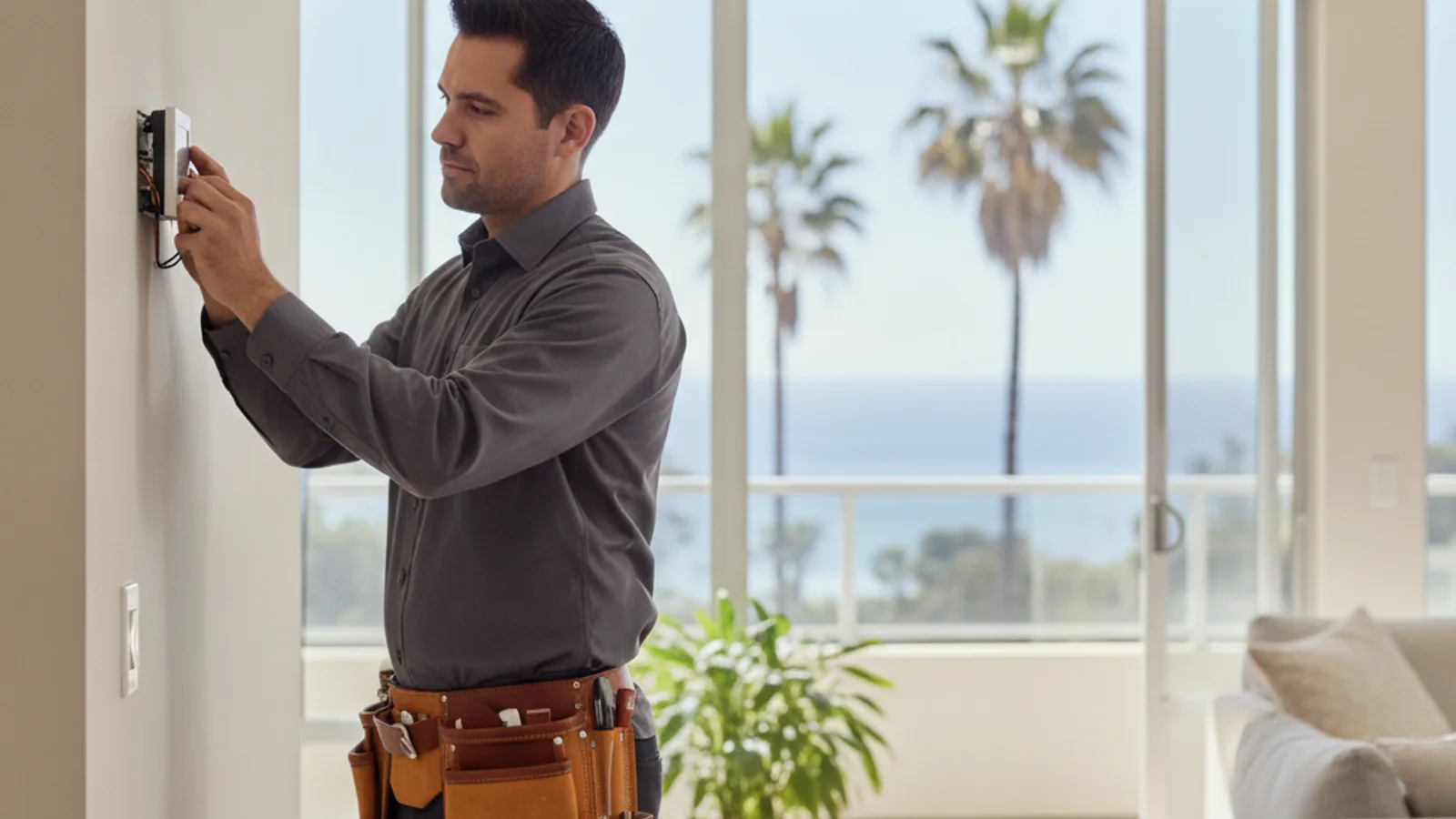
Oceanside thermostat jobs are decided by the wires behind the plate
Count conductors and photograph terminals before you buy a Wi-Fi model. Missing C-wire is the usual reason a store thermostat will not hold cooling. Salt air is hard on outdoor equipment, not usually on the wall control. The indoor issue is wiring vintage in older beach houses.
Checklist
- Label each wire as you remove the old face.
- See Honeywell troubleshooting.
- See mini split Oceanside if the house is going ductless instead.
- Use thermostat installation.
- Climate Pros SD refers. The matched contractor pulls permits if required.
Related: Oceanside HVAC and Energy Star thermostats.
Take the faceplate off and count the wires
Kill power to the HVAC system at the breaker first. Then pull the thermostat body off its baseplate and photograph the terminal block before you touch anything. The photo is your reference if a wire slips out.
What you’re recording is which colored conductor sits in which lettered terminal. R or Rh and Rc carry power. W calls for heat. Y calls for cooling. G runs the indoor fan. C is the common, the return leg that lets a device draw continuous power. O or B controls a heat pump’s reversing valve.
Do not trust wire color as a guide. Color conventions are conventions, not code, and plenty of older Oceanside houses were rewired at some point by someone who used whatever was on the truck. The terminal letters are the truth, the colors are a hint.
Also count the unused conductors tucked back into the wall. A cable with a spare wire that was never landed is the single most common way a no-C-wire problem turns out not to be one. If there’s an unconnected blue or brown pushed into the hole, that spare may be usable at both ends, and checking the other end at the air handler is the next step.
Finally, note the equipment. A gas furnace with a separate condenser wires differently than a heat pump, and buying the wrong thermostat is a real and avoidable mistake.
Heat pump wiring is not furnace wiring
This trips up more Oceanside homeowners every year as heat pump conversions replace aging gas furnaces along the coast. A conventional system has a heat source and a cooling source that the thermostat calls independently. A heat pump has one piece of equipment that runs in both directions, and the thermostat has to tell it which way to point.
That’s the O or B terminal driving the reversing valve. Most manufacturers energize O in cooling, some energize B in heating, and the thermostat has to be configured to match the equipment. A thermostat set up as conventional on a heat pump will heat when you ask for cooling, which is exactly as confusing as it sounds.
Heat pumps also add auxiliary and emergency heat terminals, usually labeled AUX and E, and a lockout setting that decides when the backup is allowed to run. On the coast that backup rarely runs at all, but a misconfigured system can bring it on unnecessarily, and electric resistance heat is the most expensive way to warm a house.
Any thermostat you buy has to list heat pump support and multi-stage support matching your equipment. Check the compatibility tool for the specific model against your terminal list, not against a generic “works with most systems” claim. If you’re comparing specific units, our Nest versus Ecobee comparison for San Diego goes model by model.
When there’s genuinely no C-wire
Older Oceanside homes, especially the downtown-adjacent stock around Mission Avenue and the beach cottages west of Coast Highway, frequently ran four-conductor cable and nothing more. No spare, no common. A basic battery thermostat never needed one. A smart thermostat generally does.
There are three honest paths. First, pull new thermostat cable from the air handler to the wall. That’s the cleanest result and it’s the one to prefer when the run is accessible, which in a single-story cottage with attic access often it is. Second, install an add-a-wire adapter at the air handler, which uses the existing conductors to carry the extra signal. It works, it’s a legitimate product, and it adds a component in the equipment cabinet. Third, choose a thermostat that supplies its own power, whether by battery with a documented service interval or by an included power adapter.
What to avoid is a thermostat that steals power through the heat or fan circuit without a common. On some older equipment that trickle is enough to make a control board chatter or the blower kick briefly, and the resulting short cycling is hard on the system. If a device’s own documentation warns about operating without a C-wire, believe it.
Which path fits depends on the house. A slab-on-grade cottage with a wall furnace and no attic is a different job than a two-story tract home with a garage air handler and an open attic run.
What SDG&E time-of-use pricing means for your schedule
The point of programming a thermostat in San Diego County isn’t only comfort. SDG&E uses time-of-use pricing, so the same kilowatt-hour costs different amounts depending on when you use it, with the higher-priced periods generally in the evening when demand peaks.
The practical move is precooling. Let the system work harder earlier in the day, then ease the setpoint during the expensive window rather than fighting a hot house at the worst possible hour. A house with decent insulation coasts a long way on that. In coastal Oceanside, where afternoons are moderated by the marine layer, the coasting period can cover most of the peak window on many days.
Rates and period definitions change, and some county residents get generation service through San Diego Community Power or Clean Energy Alliance rather than SDG&E, which changes the numbers. Check your own current plan and its actual periods at sdge.com or with your community choice provider before setting a schedule. We are not going to publish a cents-per-kilowatt-hour figure or a peak window here, because those move and a stale number costs you money.
Efficiency background on the equipment side is worth a look too, from ENERGY STAR heating and cooling and the US Department of Energy.
Rentals, condos, and coastal considerations
Oceanside carries a lot of rental stock, including the military-tenant housing near the Camp Pendleton perimeter and along Vista Way and Mission Avenue. For a rental, a locking cover or a thermostat with a passcode and remote access saves a lot of turnover friction, and the owner keeps the schedule sane between tenants.
Condos and HOA buildings downtown sometimes run shared or central systems where the in-unit control is not a standard residential thermostat at all. Check with the association before ordering anything.
Salt air does not attack a thermostat directly, but it does shorten the life of the outdoor equipment the thermostat controls. If your system is old enough that you’re replacing the control to squeeze more life out of it, get the condenser looked at in the same visit. Scope for the control work is on our thermostat installation page, and local coverage is on the Oceanside HVAC service page.
After the swap, verify every mode
A thermostat that powers up and shows a room temperature is not a finished install. Run the system through each mode and confirm the equipment does what the display says.
Call for cooling and check that cold air arrives at a register and that the outdoor unit is running. Call for heat and confirm the heat source engages, not just the fan. On a heat pump, verify that heating and cooling are actually reversed correctly, which is the failure a mis-set O and B configuration produces. Run the fan alone and confirm it starts and stops on command.
Then leave it a day and watch the cycle behavior. Short bursts every few minutes point to a configuration problem, a power-stealing issue, or a cycles-per-hour setting that doesn’t match the equipment. If the room temperature reading sits several degrees off a separate thermometer on the same wall, the location may be catching sun or a draft from the wall cavity behind it.
When to call us
A like-for-like swap with a C-wire already present is within reach of a careful homeowner. A heat pump, a multi-stage system, a missing common, or a thermostat that behaves oddly after installation needs someone who can meter the board at the air handler. Call us at (442) 777-6440 and we will match you with a licensed local pro.