In Rancho Bernardo, the architectural committee decides your mini split project before the contractor does. Almost every neighborhood here sits under an association that reviews visible exterior equipment, so the approval packet comes first and the install schedule bends around it.
That’s the part homeowners here get blindsided by. The equipment is the easy decision. Bernardo Heights, High Country East and West, Seven Oaks, Oaks North, and the Heritage all have their own standards, and a condenser bolted to a side wall without approval is a letter you do not want.
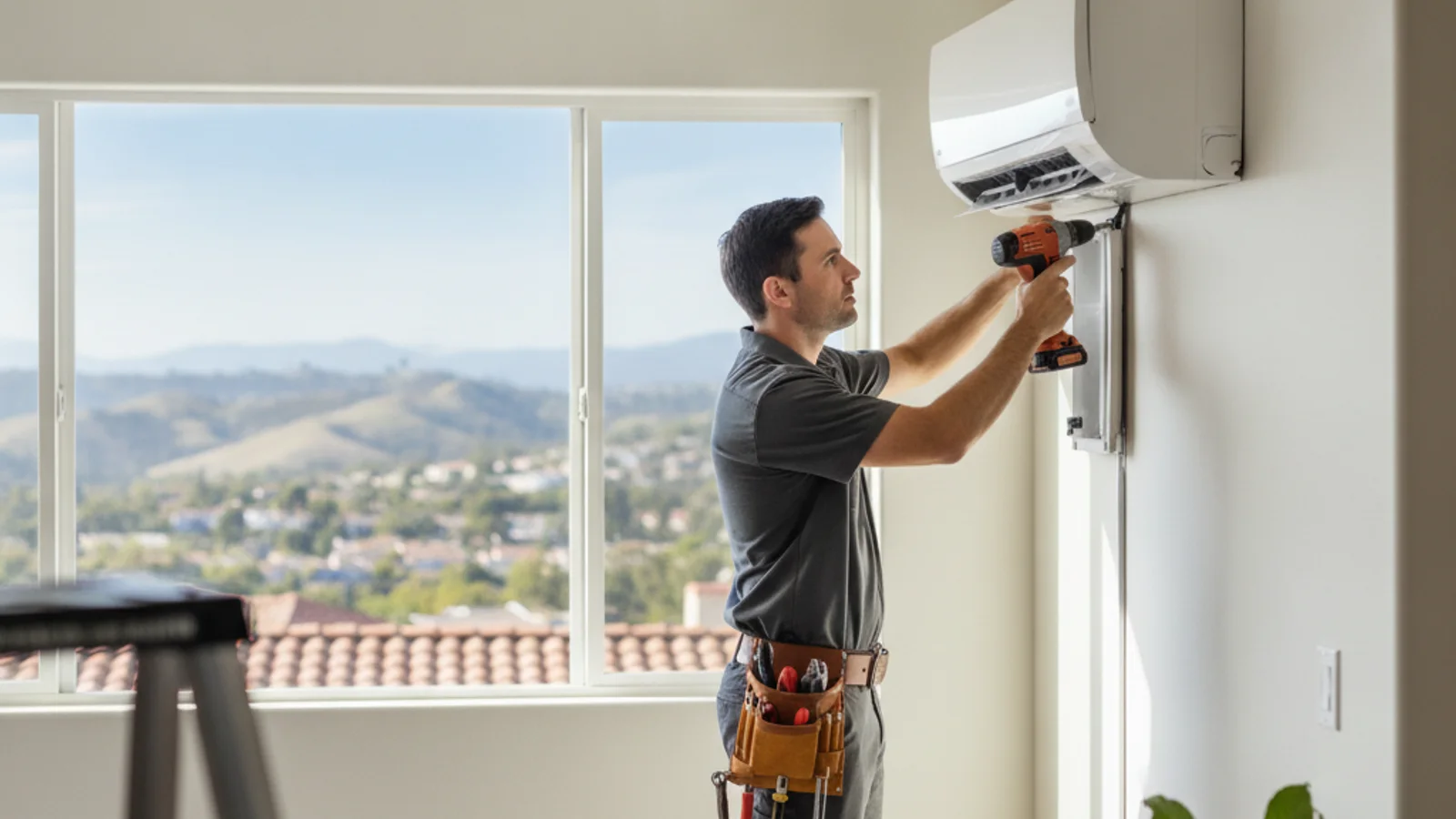
Rancho Bernardo mini splits start at the architectural committee
Submit cut sheets, sound ratings, and a site plan before copper is ordered. The association timeline is not the contractor’s timeline. Almost every RB neighborhood reviews visible condensers. A backyard install that ignores setbacks gets a stop-work.
Checklist
- Ask the HOA for current packet requirements.
- Photograph neighbor sightlines.
- See concealed mini splits.
- See Rancho Bernardo HVAC.
- The company you are matched with can prepare documents. Only the association approves.
Related: Mini split installation and AC installation.
Start with the architectural committee, not the equipment
Pull your association’s architectural guidelines before you take a single quote. What you’re looking for: whether exterior mechanical equipment is allowed on the elevation you had in mind, whether screening is required, what sound rating the association will accept, and whether line-set covers have to be painted to match the stucco.
The committee packet usually wants equipment cut sheets, a site plan showing the condenser location and setbacks, the manufacturer’s sound rating, and a description of any screening. The company you are matched with can produce the technical documents. The submission and the timeline belong to you and the association. A typical review time could not be confirmed, so ask your association for its current schedule.
Do not let anyone order equipment against an unapproved location. If the committee moves the condenser to the rear yard, the line-set run changes, the refrigerant charge changes, and sometimes the model changes. Approve first, then order.
The 55-plus communities work slightly differently. Seven Oaks, Oaks North, and the Heritage carry a lot of patio homes and attached stock where the association also controls access, shared walls, and common-area conditions. In those cases the association may want to coordinate the work window itself.
The rooms Rancho Bernardo homeowners actually retrofit
Very few people here ductless a whole house. Most of Rancho Bernardo already has central forced air, and the mini split shows up as a targeted fix for one room the central system never solved.
The recurring candidates are the upstairs bedroom over the garage, the west-facing room that bakes through a long inland afternoon, and the primary suite at the end of a long duct run. The age of Rancho Bernardo’s two-story tract housing could not be confirmed from the approved sources. Ask the pro to check whether the upstairs supply runs and trunk are sized for the second floor before relying on damper adjustments.
A single-zone head in that one room is often cheaper and less disruptive than reworking the duct system, and it lets the room run on its own schedule. That last part matters more than people expect. A home office that needs cooling from nine to five does not need the whole upstairs conditioned with it.
The second common case is a room that gets used differently than the rest of the house: a converted den, a guest suite occupied a few weekends a year, or a bedroom that a light sleeper wants a few degrees cooler at night. Zone control is the whole point of ductless, and buying it for one problem room is a legitimate use, not a compromise. Our how a mini split works explainer covers the mechanics if you want the background first.
Converted garages and detached offices
Garage conversions are the other big driver in Rancho Bernardo, and they’re a different design problem than a bedroom retrofit. A converted garage typically has an uninsulated or lightly insulated slab, a large door opening that was framed and filled, and often a west or south exposure with no shade.
Tapping the house’s existing ducts for that space is usually the wrong move. The central system was sized for the original conditioned area, and adding a room with a hard load pulls capacity from everywhere else. A dedicated single-zone system keeps the two loads separate.
Insulation work comes first, though. Conditioning a poorly insulated converted garage with a correctly sized head still produces a room that swings hard between morning and late afternoon. Ask the pro to look at the envelope before sizing the equipment, and expect the recommendation to include sealing the old door header and improving the slab-edge and ceiling insulation where it’s accessible.
Detached offices and casitas at the back of the larger High Country and Bernardo Heights lots add a distance problem on top. The condenser can’t always sit at the main house, and the electrical feed to a detached structure may need its own attention.
Routing a line set on a two-story stucco home
On a single-story home, the line set is a short horizontal penetration and a wall cover. On the two-story stock that dominates Bernardo Heights and High Country, an upstairs head means a vertical run down an exterior stucco wall, and that’s where install quality shows.
Good work looks like this: a cored penetration sleeved and sealed, the line set insulated continuously with no crushed sections, a paintable channel down the wall in a line that follows an existing architectural edge, and a condensate route that actually drains somewhere sensible instead of onto the walkway.
Interior routing through a closet stack or an existing chase is sometimes possible and usually looks better, but it costs more labor and it depends on what’s actually inside the wall. Ask for both options and the price difference.
Condensate is the detail people skip. An upstairs head that drains by gravity is simple. One that needs a small condensate pump adds a component that can fail and flood drywall, so ask where the pump goes and how it’s serviced.
Sizing for inland heat, not coastal averages
Rancho Bernardo is genuinely hot in summer, and equipment sized off a coastal rule of thumb underperforms on the afternoons you bought it for. Ask for a room-level load calculation that accounts for glazing area, orientation, insulation, and ceiling height.
Oversizing is the more common error with ductless. An oversized head satisfies the thermostat fast, shuts down, and leaves the room humid and unevenly cooled, and the short cycling is hard on the compressor. Inverter-driven systems tolerate part-load operation well, so a correctly sized unit running long and slow beats a bigger one hunting.
Check efficiency ratings against the ENERGY STAR heating and cooling listings rather than a salesperson’s shorthand. Then verify the contractor’s C-20 classification on the CSLB license check before work starts.
One more item: electrical. A new outdoor unit needs its own circuit and a disconnect, and older panels in this housing era are sometimes full. Have the panel looked at during the quote, not on install day. Scope and coverage for the work itself sit on our mini split installation page, and local service detail is on the Rancho Bernardo HVAC service page.
Ductless or fix the ducts
Worth asking honestly, because in Rancho Bernardo the answer isn’t automatic. If the central system is near end of life and the ductwork is leaking through a hot attic, the money may be better spent on a properly sized replacement with sealed and re-insulated ducts. That fixes every room at once instead of one.
The case for ductless is strongest when the central system still has real life left, when only one or two rooms misbehave, or when the space in question was never part of the original conditioned area. It’s also the right call when the duct fix would mean opening finished ceilings.
Our ductless mini split cost breakdown for San Diego is useful background before either conversation. Ask for both scopes priced separately. A contractor willing to quote the duct-side repair alongside the ductless option is giving you a real comparison. One who only quotes the product they prefer to install is not.
When to call us
Ductless work involves refrigerant, a dedicated circuit, a permit, and in most of Rancho Bernardo an association approval on top. Line up the architectural review and the load calculation before anyone orders equipment. Call us at (442) 777-6440 and we will match you with a licensed local pro.