In most of Kearny Mesa the hard part of AC maintenance isn’t the work, it’s the access. The equipment tends to sit on a roof or inside a closet you share with a building, and getting to it involves someone other than you.
Sort out where your unit is and who controls the space around it. Every other decision follows from those two answers.
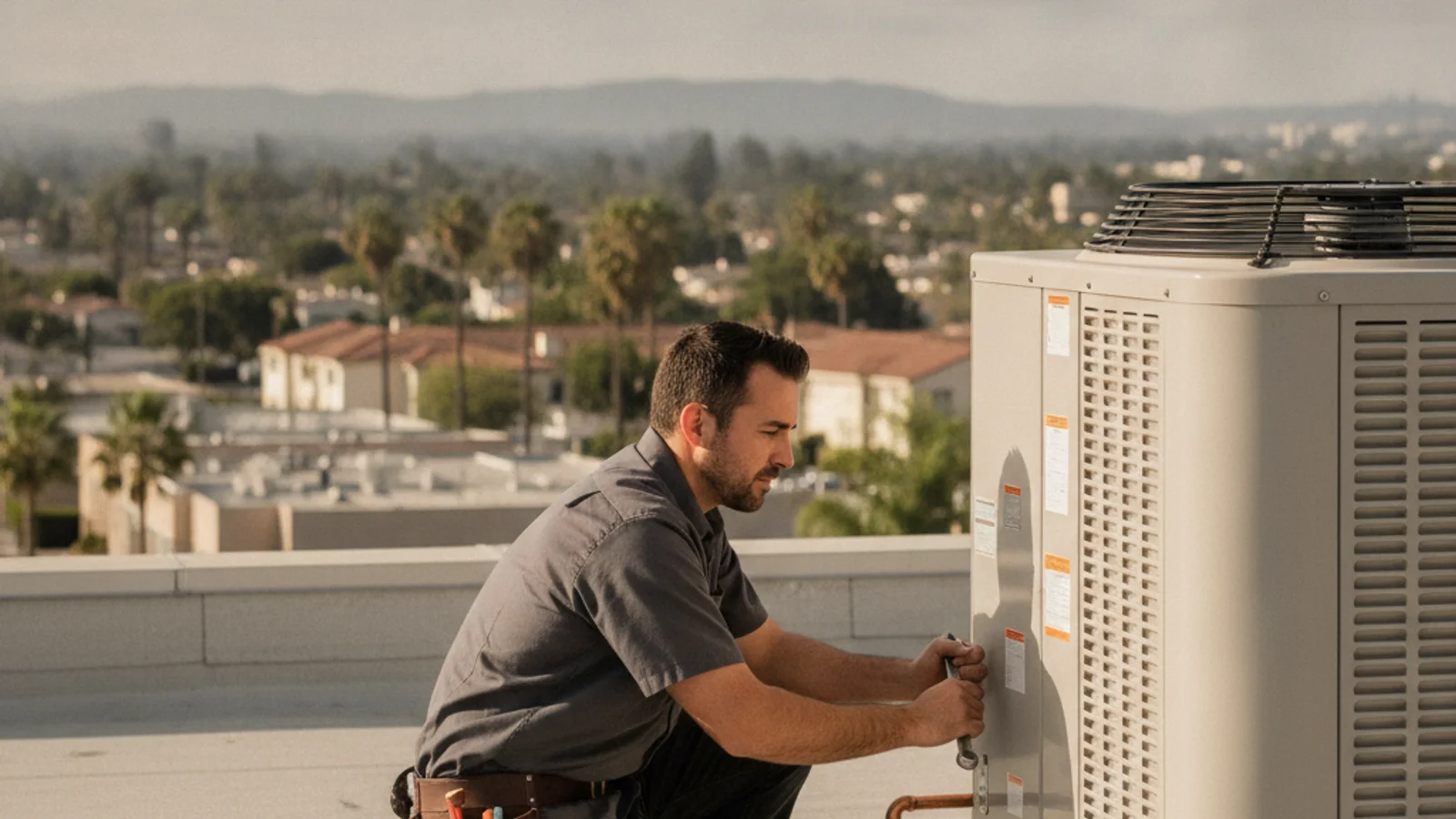
Kearny Mesa AC access before anyone quotes maintenance
Get roof, closet, or HOA access in writing, then ask for a visit that covers the rooftop condenser and the indoor equipment you cannot see from the parking lot. Many Kearny Mesa units sit on commercial-style roofs or in shared mechanical closets. A driveway inspection is not a maintenance visit.
Checklist
- Name who holds the roof hatch key or HOA vendor list.
- Photograph the outdoor unit tag and indoor air-handler tag.
- Note whether tenants share one condenser.
- Record any rooftop grease, construction dust, or nearby Convoy traffic film.
- Ask what the visit includes if a ladder or lift is required.
Related: Kearny Mesa HVAC and commercial HVAC.
Find out where your equipment actually lives
Kearny Mesa sits on a mesa top bounded by SR-163, SR-52, and I-805, and it’s built out as a mix of commercial and industrial along Convoy Street, Kearny Villa Road, Clairemont Mesa Boulevard, and the Aero Drive corridor, with pockets of mid-century condos and apartments filling the streets between.
That mix means three very different equipment situations exist within a few blocks of each other.
The first is the rooftop package unit: one cabinet on the roof holding the compressor, coils, and blower, with ducts dropping into the space below. Nearly every commercial building here uses them, and so do a number of the older apartment and condo buildings.
The second is the split system with an air handler or furnace in an interior closet, a hallway platform, or a garage, paired with a condenser on a small pad or a roof curb. That’s typical of the mid-century residential stock off Clairemont Mesa Boulevard and Mesa College Drive.
The third is a wall or window unit in an older apartment, where maintenance is mostly filter and coil cleaning.
Go look before you book anything. A homeowner who says “my AC” and means a rooftop package unit needs a different visit, different equipment, and different building access than one with a closet furnace. The Kearny Mesa service page describes the area’s building stock in more detail.
Rooftop package units and what a visit involves up there
A package unit does everything in one cabinet outdoors, which means the whole system is exposed to weather, roof heat, and whatever the air carries. It also means the entire maintenance visit happens on the roof.
The items that matter most are the coil faces, the condensate drain and its pan, the belt and blower on units that use one, and the economizer if there is one. Economizers are the quiet failure on Kearny Mesa rooftops: dampers seize, linkages break, and the unit either stops using free outside air when it should or draws in hot outside air when it shouldn’t. Neither condition throws an error. Both cost money every month.
Condensate is the other one worth naming. A package unit’s drain pan sits above occupied space, so a clogged drain doesn’t just shut the unit down, it can put water into a ceiling. Ask for the drain and pan to be cleared and inspected at every visit rather than only when something backs up.
Roof access is the logistics piece. Getting on the roof usually needs building management, a key, and sometimes a scheduled window. Arrange that before the appointment, not on the day.
If a package unit needs replacing rather than servicing, that’s crane work and a bigger job. It’s also permitted work: the City of San Diego states that no part of a heating, ventilating, air conditioning, or refrigeration system may be installed, altered, replaced, or repaired without a mechanical permit. Ask the contractor to confirm the permit path for your specific scope.
Closet air handlers in the mid-century residential stock
Interior closet equipment has the opposite problem from a rooftop unit. It’s easy to reach and it’s surrounded by things it shouldn’t be surrounded by.
The first thing to check is clearance. Closets get used for storage, and boxes stacked against a furnace or air handler block the return path and, on gas equipment, interfere with combustion air. Clear a working space around the unit and keep it clear.
Second, find the return and its filter. In a lot of these buildings the return grille sits in a hallway ceiling or wall, and the filter lives behind it rather than at the equipment. People service the unit for years without ever finding the actual filter.
Third, the condensate line. A closet air handler drains to somewhere, often a laundry standpipe or a line running through a wall, and those lines clog. In a stacked condo or apartment, an overflow lands in the unit below yours, which turns a maintenance item into a neighbor problem. Clogged AC drain lines covers how to spot one before it overflows.
Fourth, ductwork. Mid-century buildings often have original duct runs, and leaks in a duct that passes through an unconditioned chase waste a meaningful share of the cooling you paid for. A pro can pressure test rather than guess, and duct leak repair explains what that involves.
Work out who is responsible before you book
This is the question that stalls more Kearny Mesa maintenance than any technical issue. In a condo or apartment, the equipment serving your unit may be your responsibility, the association’s, or split between the two, and the roof it sits on almost never belongs to you.
Read the governing documents rather than asking a neighbor. Typical arrangements assign the interior equipment to the owner and anything on common area, including roof-mounted equipment and shared risers, to the association. Typical is not universal, and getting this wrong means either paying for work that wasn’t yours or waiting for approval that was never needed.
Renters have a simpler path but a slower one: report the issue in writing to the landlord or property manager and keep the record. Don’t arrange your own contractor for building equipment.
For owners, ask the association three specific things. Who authorizes roof access and how much notice they need. Whether there’s an approved vendor list. Whether exterior equipment changes need architectural review. Answers in writing prevent a scheduled visit from turning into a wasted trip.
Our condo HVAC guide works through the ownership split in more depth, including what to do when the documents are ambiguous.
Freeway air and what filtration can and can’t fix
Kearny Mesa is wrapped in freeway. Buildings close to SR-163, SR-52, and I-805 pull road dust, brake and tire particulate, and exhaust into whatever their return air path happens to be.
You’ll see it on the filter. Filters in buildings near a freeway corridor load faster and darker than the same filter a mile away, and the honest response is to check them monthly during the cooling season rather than trusting a printed interval.
A higher-MERV filter captures more fine particulate, and that’s a real improvement for anyone sensitive to it. The limit is airflow: older equipment and undersized returns can’t always tolerate the added resistance, and starving a system for air causes its own failures. Ask the pro what your specific equipment and duct sizing will support.
Filtration also can’t fix an uncontrolled infiltration path. If a closet return is pulling air from a garage, a chase, or a corridor rather than from the conditioned space, sealing that path does more than any filter upgrade. Ask for the return path to be verified during the visit.
Small commercial along Convoy and Aero Drive
If you run a business here rather than living here, the maintenance picture changes again. Restaurant kitchens along the Convoy District corridor add exhaust hoods and makeup air to the equation, and makeup air balance affects the dining room comfort that customers actually notice.
Warehouse and flex space along Aero Drive and the Sky Park area typically runs larger tonnage package units where a single failure takes out a whole zone. Retail and office suites often share rooftop equipment with neighboring tenants, which makes the lease language about HVAC responsibility worth reading before anything breaks.
Our guide to HVAC for small businesses in San Diego covers the tenant side, including what to ask before signing. For scope on the residential side, the maintenance service page lists what a professional visit covers.
California requires a C-20 contractor for HVAC work above the Business and Professions Code section 7048 threshold of $1,000 or where a permit is required. Any license can be checked at the CSLB license lookup. Every HVAC pro in the network is licensed and insured.
When to call us
Rooftop work, refrigerant charge, and anything involving shared building equipment need a licensed HVAC pro with the right access and the right insurance. Call us at (442) 777-6440 and we will match you with a licensed local pro.