If your San Diego AC won’t shut off even after you turn the thermostat to OFF or raise the set point above the room temperature, something downstream of the thermostat is stuck in the ON position. The most common cause is a stuck contactor (the relay that physically completes the high-voltage circuit to the compressor and fan). Less common but possible: a welded indoor blower relay, a shorted thermostat wire, or a faulty thermostat itself.
This one matters more than most homeowners realize. A stuck contactor that’s welded closed cannot be turned off from the thermostat, the breaker on the air handler, or even by pulling the disconnect handle in some cases. The compressor will run until it overheats, the windings short, or you cut power at the main panel. Here’s how to handle it safely.
Climate Pros SD matches you with licensed HVAC companies. We do not publish a contactor, relay, or thermostat repair price list.
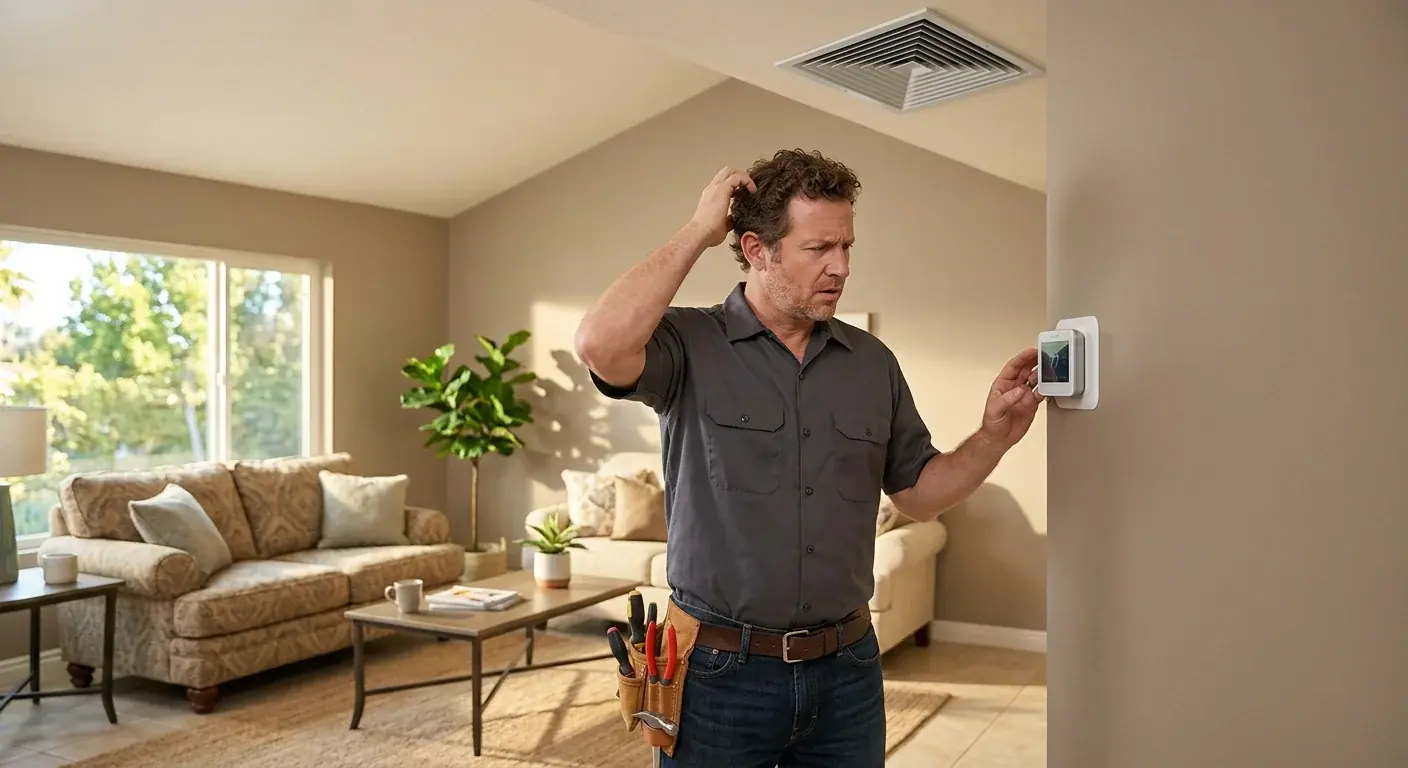
Safety first: turn the breaker off
Before troubleshooting anything else, do this:
- Go to the thermostat. Set to OFF. Wait 60 seconds.
- If the outdoor unit is still running, walk to the electrical panel.
- Find the breaker labeled AC, condenser, or compressor. Flip it to OFF.
- Confirm the outdoor unit stopped.
- Leave it off until a tech diagnoses the cause.
If killing the breaker stops the unit, you’ve confirmed it’s a control problem (stuck contactor, bad relay, or wiring), not a runaway compressor. That’s the better scenario. If the unit somehow keeps running with the breaker off (it shouldn’t, but if you have a generator, battery backup, or wiring fault) cut power at the main service disconnect and call an electrician immediately.
Do not just keep raising the thermostat hoping it’ll stop. Do not leave a stuck AC running overnight. A compressor running with no thermostat control and no safety call typically destroys itself within 4 to 12 hours, and the failure mode is often expensive (burnt compressor, melted contactor, scorched disconnect).
The four real causes, ranked by likelihood
1. Stuck contactor (welded contacts), by far the most common
The contactor is a small relay inside the outdoor unit’s access panel. When the thermostat calls for cool, 24V from the low-voltage circuit pulls the contactor’s plunger down, connecting two high-voltage contacts that send 240V to the compressor and fan. When the call ends, the plunger releases, the contacts separate, the unit shuts off.
Over time (typically 7 to 12 years in San Diego, faster near the coast due to salt corrosion) the contact surfaces pit, arc, and can eventually weld themselves closed. Once welded, the unit stays on regardless of what the thermostat is doing.
How to tell: thermostat is OFF or set well above room temp, but outdoor unit keeps running. Killing the breaker stops it. Turning the breaker back on, it starts immediately without any thermostat input.
Ask the matched contractor for a written contactor quote. The part is small; labor is short. Many techs recommend replacing the capacitor at the same time since they’re a few feet apart and similar age. Get both lines on the same ticket so you can say yes or no.
2. Welded indoor blower relay or sequencer
Less common, but in heat-pump systems or some packaged units the indoor air handler has its own relay or sequencer that controls the blower. If it welds closed, the blower runs constantly even with the thermostat OFF. The compressor may or may not be running depending on the system design.
How to tell: indoor blower runs constantly, even with thermostat OFF. Outdoor unit may cycle normally or may also be stuck. Killing the air handler breaker (often a separate breaker from the condenser) stops the blower.
The quote depends on whether it’s a simple relay or an integrated control board. Climate Pros SD does not publish that range.
3. Thermostat wire shorted to itself
The 24V control wire bundle that runs from the thermostat to the air handler is usually a 5- to 8-conductor cable, often stapled along framing in the attic or behind walls. If a staple cuts insulation or a rodent chews through it (real problem in older San Diego homes, especially East County and rural North County), the Y wire (cooling call) can short to the R wire (24V hot) and create a permanent cool call. The contactor sees voltage continuously. The unit runs continuously.
How to tell: outdoor unit runs nonstop. Disconnecting the Y wire at the air handler stops it. The contactor itself tests fine on a meter. Often shows up after recent attic work, a roofing project, or a rodent issue.
Labor scales with how much of the thermostat cable has to be traced and replaced. Ask for that in writing after diagnosis.
4. Failing thermostat
The thermostat itself can fail with the cool-call output stuck on. Cheap mechanical thermostats are more prone to this; modern smart thermostats fail differently (usually they go dark or stop calling for anything at all). On an older mercury-bulb or basic digital thermostat, a stuck output is a known failure mode after 10 to 15 years.
How to tell: physically remove the thermostat from the wall plate. If the unit shuts off, the thermostat is the problem. If it keeps running, the issue is downstream (contactor, relay, or wiring).
A replacement can be a basic programmable or a full smart thermostat. Going from a non-C-wire setup to a smart thermostat sometimes requires running a new wire. That is extra labor, not a number from this page.
A 30-second diagnostic sequence
Run these in order. Stop when one of them shuts the unit off.
- Set thermostat to OFF. Wait 60 seconds. Still running? Go to step 2.
- Pull the thermostat off the wall plate. If unit stops, it’s the thermostat (cause 4). If still running, go to step 3.
- Open the air handler access panel. Disconnect the Y wire from the control board. If unit stops, it’s a wire short upstream of that point (cause 3). If still running, go to step 4.
- Kill power at the condenser breaker. Unit stops. The contactor is welded (cause 1) or a relay is stuck (cause 2). Leave breaker off and call for service.
Step 3 involves opening an electrical panel and should only be done if you’re comfortable doing it safely. If you’re not, skip straight to step 4 (kill the breaker) and let a tech walk through 1 through 3.
What this can cost you if ignored
A compressor running with no thermostat control has no safety call, no off cycle to let the motor cool, and no head-pressure relief. Typical outcomes when this gets left for 24 to 48 hours:
- Burnt compressor windings, often triggering full system replacement
- Welded disconnect contacts that arc and scorch the disconnect box
- Extra SDG&E charges. A system running 24/7 instead of normal cycles on a summer TOU peak window burns kWh all day. Check current TOU prices on sdge.com. That is not a Climate Pros SD daily-bill estimate.
- Insurance issues if a scorch becomes a fire
The common cause (stuck contactor) is a short, parts-and-labor repair. Letting it run can become a compressor or system event. This is the one repair we tell people not to wait on.
Frequently asked questions
Can I run my AC if I can’t get it to shut off?
No. Cut the breaker and leave it off until a tech diagnoses it. Running an AC with no control puts the compressor at serious risk and creates a real electrical fire hazard if the contactor is arcing.
Will my AC eventually shut off on its own?
The compressor has an internal high-temperature thermal cutout that may trip if the unit truly overheats, but that’s a last-resort safety. It does not work reliably and isn’t a substitute for cutting power at the breaker. Don’t rely on it.
Why does my outdoor fan keep running even when the AC isn’t cooling?
On most residential split systems the outdoor fan and compressor share one contactor. If the fan runs, the compressor is running too, even if the indoor blower stopped. You’re still pulling 240V and stressing the system. Cut the breaker.
How long does it take to fix a stuck contactor?
The actual repair is 20 to 45 minutes once a tech is on site. Most San Diego HVAC techs carry common contactor sizes (30 amp, 40 amp) on the truck, so a second trip for parts is rare. A stuck contactor is a no-off safety issue.
Can a power surge cause a contactor to stick?
Yes. SDG&E grid surges from heat-related demand events or wildfire shutoffs can weld contactor contacts in a single event. If your contactor failed right after a known power event, that’s almost certainly why. A whole-home surge protector can reduce future risk. Ask the matched electrician or HVAC company for a written surge-protection quote. It is not a Climate Pros SD parts table.
Should I replace the capacitor when replacing the contactor?
Yes, on any unit over 6 years old. The capacitor and contactor are inches apart inside the same access panel, experience the same heat and humidity, and have similar lifespans in San Diego. Replacing both together adds a parts line and avoids a repeat service call within 12 to 18 months.
What to do next
If your AC is running right now and won’t shut off, kill the breaker first. Then call (442) 777-6440 to get matched with a vetted San Diego HVAC pro from our network. A stuck-on unit is a safety issue. The matched companies cover every ZIP code in the county, and most stuck-contactor calls are resolved in a single visit.
Related reading: AC capacitor replacement in San Diego · AC short cycling causes and fixes · AC won’t turn on troubleshooting
Related services: AC repair and AC installation. Local coverage: all 67 cities we cover in San Diego County. Not sure this is your symptom? Our HVAC symptom finder matches what the system is actually doing to the likely cause.