Put the two heat pump visits on a Vista calendar rather than a generic one: one in early spring before the nursery and grove bloom loads the air, one in late fall after the first Santa Ana events have blown through. The timing is what makes the visits worth paying for.
Twice a year is standard advice for a system that runs in both modes. What nobody tells you is when, and in Vista the when is driven by what’s blowing around outside rather than by the calendar month.
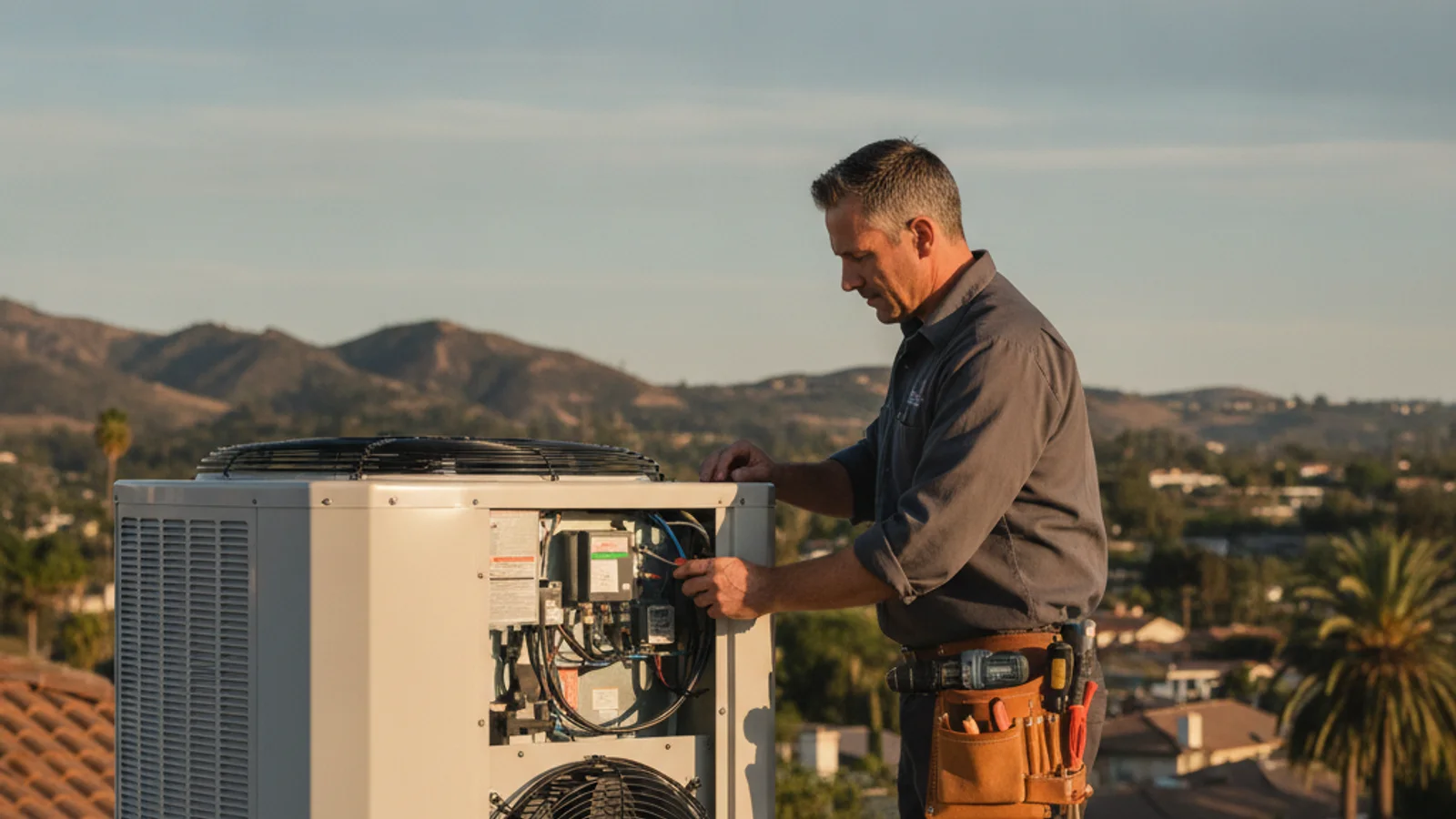
Vista heat pump visits: after bloom and after Santa Ana dust
Schedule one visit before spring pollen from nurseries and groves, and one after the first Santa Ana wind event. Those two loads pack coils in North County. A heat pump is the heating and cooling machine. Skipping the heating-season check leaves defrost and reversing-valve issues for the first cold night.
Checklist
- Note outdoor coil cleanliness after winds.
- Ask the contractor to observe a defrost cycle if the unit ices.
- Record filter dates.
- See heat pump vs AC.
- Use Vista HVAC.
Related: Heat pump service and HVAC maintenance.
Why the timing is local
Vista sits a few miles back from the coast, close enough to get marine-layer mornings and far enough inland that afternoons run hot from June into October. A heat pump here works both sides of the year: cooling hard through those afternoons, then handling mild heating through the winter nights when the valley cools off faster than the beach cities do.
That means neither season is a rest period. The compressor and the outdoor fan accumulate run hours nearly year round, and there’s no long idle stretch where you’d naturally notice something has gone wrong before you need the system.
The other local factor is airborne. Vista’s surrounding nurseries and remaining groves, the dry hillsides east of town, and the dirt shoulders along the older roads all put material into the air that ends up in the outdoor coil. Coastal homes deal with salt corrosion. Vista deals with loading, which is a different problem with a different fix.
So the spring visit goes early, before bloom and before the first heat wave finds a weak capacitor. The fall visit goes after the first offshore wind events, not before, so the technician is cleaning the debris that just arrived rather than the debris from last year.
What loading does to an outdoor coil
The outdoor coil is a dense grid of aluminum fins wrapped around refrigerant tubing. Air has to pass through it freely for the system to reject heat. Pack those fins with pollen, dust, and organic debris and the airflow drops.
What follows is quiet and expensive. The system doesn’t stop. It just runs at higher pressure, draws more current, and takes longer to reach setpoint. Your SDG&E bill climbs before anything visibly breaks, and the compressor takes the strain the whole time. SDG&E’s time-of-use pricing means those extra run hours land partly in the more expensive evening window too, though the actual rates change and are worth checking on sdge.com rather than assuming.
Loading also has a seasonal signature here. Spring puts fine pollen into the fins, which mats when the morning marine layer wets it down. Late summer puts dry dust in. Fall puts leaves and twigs against the base and into the fan guard. Each one needs a slightly different cleaning approach, which is part of why a visit at the right moment beats two visits at arbitrary ones.
Indoors, the same air is loading the filter. A filter that lasted three months last year may not this year, and a starved blower produces the same symptoms as a refrigerant problem. Check it more often than the box says during bloom.
The week after a Santa Ana
Offshore wind events do more to an outdoor unit in three days than a month of ordinary weather. Dry air, high wind, and everything loose in the neighborhood moving sideways at once.
The morning after, walk out and look at the unit. Clear anything stacked against the sides or drawn into the fan guard: palm fronds, bougainvillea, eucalyptus litter, plastic bags. Debris pressed against the coil blocks airflow in exactly the spot that needs it most.
Look at the top too. A unit with the fan discharging upward will collect leaves on the grille, and they sit there until someone lifts them off. Look at the condensate line and the pad for anything that’s shifted.
Then listen to it run. A new rattle after a wind event is often just debris inside the cabinet, and it’s worth reporting rather than living with, because something loose against a fan blade gets worse quickly. This is the moment a homeowner can genuinely prevent a repair, and it takes about five minutes.
If your system runs in heating that same week, which is common when a Santa Ana breaks and the nights turn cold, pay attention to whether it heats normally. Problems on the heating side hide all summer and reveal themselves the first time you ask for warm air.
What you can do between visits, and what you can’t
Yours to handle: changing the filter on the schedule your house actually needs, keeping two to three feet of clear space around the outdoor unit, hosing loose surface debris off the fins gently with the power off at the disconnect, keeping planting beds and irrigation spray back from the cabinet, and clearing the condensate line’s exit point.
Not yours to handle: anything involving refrigerant, the reversing valve, the defrost control, or the electrical compartment. Refrigerant work requires EPA certification, and a charge adjusted by guess strains the compressor rather than helping it. The capacitor inside the electrical compartment holds a charge after the power is off. The US Department of Energy’s heating and cooling guidance draws the same line between homeowner upkeep and technician work.
One habit worth building: write down what you notice. A date, the outdoor temperature, what the thermostat was set to, and what the system did. A pattern noted across three weeks tells a technician more than a description given from memory on the phone.
For the full picture of what a professional visit should include on a heat pump specifically, including the reversing valve and defrost checks that separate it from an AC tune-up, see our heat pump maintenance guide for San Diego.
When upkeep turns into a repair conversation
Some findings end a maintenance visit and start a different one. Refrigerant measurably low means there’s a leak, and a leak needs to be found rather than topped off. A capacitor reading out of tolerance is a cheap part now and a compressor call later. Burnt or pitted contacts in the electrical compartment are the same story.
On the heat pump specific side, a reversing valve that hesitates or doesn’t fully switch, and a defrost control that doesn’t trigger when it should, both belong in a repair conversation while the weather is still mild. Neither gets better with time, and both are easier to schedule in October than in the middle of a cold snap.
Ask the technician for findings in writing, with the part named and a price for the fix, and ask what happens if you wait. A pro who can explain the consequence of waiting is giving you real information. For what those failures look like from the homeowner’s side, our heat pump repair guide covers the symptoms, and our Vista AC repair guide covers the failures Vista’s inland run hours produce most often.
Before you book
Ask what the visit covers, item by item, and confirm it’s a heat pump scope rather than an air conditioner scope. Ask the price for a single visit and for any plan, and ask whether a diagnostic fee applies toward a repair, since each company sets its own policy. Ask whether both visits in a plan are heat pump visits or whether the second one is a furnace check you don’t need.
Local service coverage is on the Vista HVAC page, and the HVAC maintenance service page covers what routine upkeep includes across system types.
When to call us
Refrigerant checks, reversing valve testing, and defrost diagnostics need a licensed C-20 pro with the right gauges, and the best time to book one is before the season turns rather than during it. Call us at (442) 777-6440 and we will match you with a licensed local pro.