The standard single-zone, single-thermostat central AC that most San Diego two-story tract homes were built with often cannot keep both floors even. By late afternoon the upstairs runs much hotter than the downstairs. There are three real solutions: add zoning to the existing system, install a second dedicated system for the upstairs, or add a supplemental mini-split for the worst rooms. The right answer depends on the condition of your ductwork, the size of your home, and how you use SDG&E peak hours.
Climate Pros SD matches you with licensed HVAC companies. We do not install equipment, set prices, or promise arrival windows.
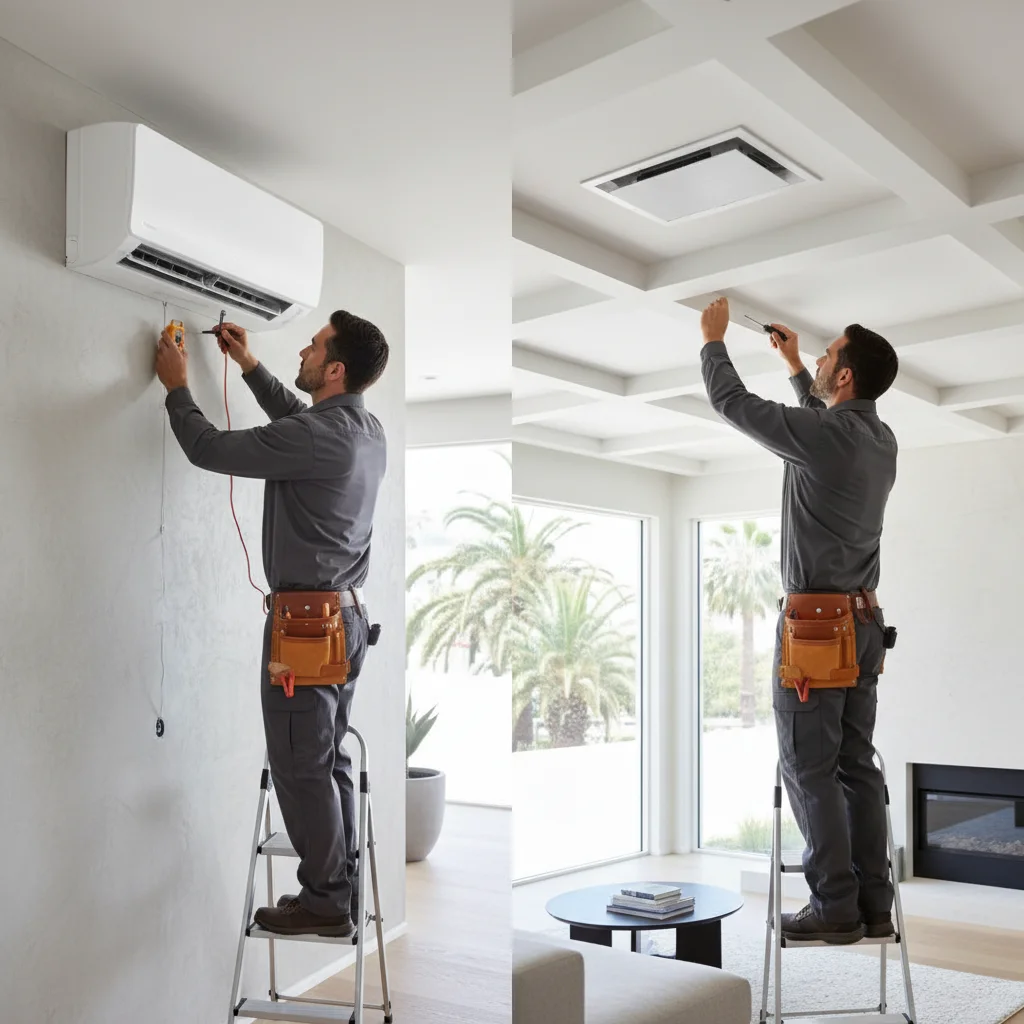
Why does standard single-zone HVAC fail in San Diego two-story homes?
Almost every two-story home built in San Diego from the mid-1990s through the mid-2010s shipped with one central AC, one thermostat, and ductwork sized to a downstairs-biased load calculation. That was the cheap way for the builder to hit the Title 24 minimum. The problem shows up the first hot afternoon you live there.
The single-thermostat dilemma
One thermostat, almost always in a downstairs hallway, controls a system that is serving two floors with completely different heat loads. The thermostat reads the downstairs temperature, the system runs until that setpoint is satisfied, then it shuts off. The upstairs never catches up. The thermostat does not know and does not care.
Bumping the downstairs setpoint colder to force the AC to keep running just freezes everyone out on the first floor while the upstairs is still warm. Smart-thermostat scheduling helps a little but does not solve the underlying problem: one zone cannot serve two floors with different loads in San Diego’s climate.
Why is upstairs so much hotter by late afternoon?
In an inland or East County two-story (Escondido, Poway, Rancho Bernardo, Scripps Ranch, Santee, El Cajon, Alpine), the gap between downstairs and upstairs by late afternoon on a hot day is often large. Coastal two-stories in Carlsbad, Encinitas, La Jolla, and Coronado usually see a smaller gap because of the marine layer. Either way, it is outside the range that any single-zone system can manage well.
The drivers compound:
- Convection. Hot air rises, and an open stairwell is a heat highway.
- Attic heat radiating downward. A San Diego attic gets very hot by mid-afternoon. That heat radiates through the upstairs ceiling drywall.
- West-facing wall and window solar gain. San Diego sun bakes the second floor from about 2 p.m. into the evening.
- Undersized upstairs ducts. Builder-grade duct sizing often favored the downstairs.
- Inadequate upstairs returns. Many San Diego two-stories have one downstairs return and zero upstairs returns. Closed bedroom doors choke airflow.
ENERGY STAR says a typical forced-air house can lose about 20% to 30% of the air moving through ducts because of leaks, holes, and poorly connected ducts. That is a national typical-house statement, not a measured leakage rate for your upstairs attic.
A real fix has to address the control problem (one thermostat) plus the airflow problem (ducts and returns). Picking the right solution starts with diagnosing which of those is worse in your specific home.
What are the three real solutions?
Solution 1: HVAC zoning
Retrofit the existing central system with motorized dampers in the trunk ducts, a zone control panel near the air handler, and a second thermostat upstairs. The upstairs can now call for cooling independently. When the upstairs hits the setpoint, the upstairs damper closes and the downstairs damper opens.
Pros:
- Often the leanest path when the ductwork is in good shape.
- Reuses your existing AC and ducts.
- Pairs with SDG&E time-of-use plans that currently list 4 p.m. to 9 p.m. on-peak. Pre-cool the upstairs earlier in the day, then let it coast through peak while the downstairs holds. That is operating strategy, not a guaranteed kWh cut.
- One outdoor condenser, one indoor air handler, two zones of comfort.
Cons:
- Only works if the existing ductwork is sized correctly and in good shape. If the upstairs ducts are undersized or leaky, zoning will not deliver the comfort gain.
- Requires a bypass damper or a variable-speed air handler to handle the airflow restriction when only one zone is open.
- Cannot serve a large number of true zones before a second system may be cleaner.
Ask for a written two-zone versus three-or-four-zone scope, including whether ducts need rework. At the point ducts must be rebuilt, evaluate Solution 2 instead.
For the full breakdown, see HVAC zoning in San Diego.
Solution 2: A dedicated second HVAC system
Install a second complete HVAC system (outdoor condenser plus indoor air handler or furnace, with its own ductwork and its own thermostat) dedicated to the upstairs. The downstairs keeps its original system. The two systems run independently and never compromise.
Pros:
- Each floor has its own dedicated equipment sized for its specific load.
- Allows different temperature setpoints, schedules, and even fuel types per floor.
- Often the better path for larger homes, where zoning starts to strain.
Cons:
- Highest upfront cost of the three solutions. Climate Pros SD does not publish that bid.
- Requires space for a second outdoor condenser and a second indoor unit (usually in the attic).
- A second 240-volt circuit and panel capacity. If the electrical panel is already maxed out, panel work is a separate line item.
- Two systems means two maintenance schedules and two pieces of equipment to replace eventually.
If you are at this scope, see AC installation in San Diego. Do not subtract Section 25C from a 2026 heat pump. That credit does not apply to property placed in service after December 31, 2025. TECH single-family reservations stopped November 14, 2025. HEEHRA single-family was fully reserved February 24, 2026. Confirm SDG&E at sdge.com/rebates.
Solution 3: A supplemental mini-split for the worst rooms
Leave the existing central system alone. Add one or more ductless mini-split heads in the upstairs rooms that run hottest (usually the master bedroom and a west-facing bonus room). One outdoor condenser can run two or three indoor heads on a multi-zone setup.
Pros:
- Useful when the existing ductwork is fundamentally broken or unreachable. Bypasses the duct problem entirely.
- Surgical. Solves the worst rooms without touching the rest of the house.
- Heat-pump heating included in the same equipment, useful for the few cold mornings San Diego does have.
Cons:
- Visible indoor wall heads. Some homeowners do not like the look.
- Does not solve the whole upstairs, just the rooms with heads.
- Line sets have to route between the indoor heads and the outdoor condenser.
Ask for single-zone versus multi-zone as separate written scopes. For more, see mini-split installation, how a mini-split works, and ductless mini-split cost in San Diego.

Which solution fits your home?
The three solutions overlap in fit, not in a published price ladder. The right answer is determined by ductwork condition, home size, and how surgical the fix needs to be.
Pick zoning if:
- Your ductwork is in good shape (no major leaks, sized correctly for both floors).
- The whole upstairs runs hot, not just one or two rooms.
- You want to use SDG&E 4-9 p.m. peak strategy with pre-cooling.
- The existing AC still has useful life.
Pick a dedicated second system if:
- The home is large enough that one air handler is straining.
- The existing ductwork is unreachable, undersized beyond repair, or has to be replaced anyway.
- You have attic space and side-yard space for a second indoor and outdoor unit.
- You want fully independent control of each floor.
- The existing AC is at or near end-of-life. Replacing both at once can share mobilization, which is a contractor scheduling question.
Pick a supplemental mini-split if:
- Only one or two upstairs rooms are the problem.
- The existing ductwork is broken or unreachable.
- You do not want to touch the existing central AC.
- You are considering an ADU or finished bonus room and want a separate system for that space anyway.
Do not pick:
- Do not pick a portable AC as a long-term plan. Loud, inefficient, vents heat back into the conditioned space.
- Do not pick window units in a two-story home you plan to stay in. They are a band-aid.
- Do not pick “just upgrade to a bigger central AC.” A bigger single-zone system will short-cycle, fail to dehumidify, and will not solve the control problem. The issue is zoning, not capacity.
Run a Manual J load calculation first. Any HVAC contractor in San Diego can produce one. It tells you the actual cooling load of each floor (not a guess based on square footage). Climate Pros SD does not sell Manual J. If your existing AC is undersized for the downstairs (common in inland and East County homes that were spec’d for coastal conditions), no zoning or supplemental system will save it.
FAQs
What’s the best HVAC system for a two-story home in San Diego?
Two-zone HVAC zoning if the ductwork is in good shape, a dedicated second system if the home is larger or the ducts need to be replaced anyway, and a supplemental mini-split if only one or two upstairs rooms are the problem. Single-zone central AC is a poor fit for most two-story homes in San Diego.
How much does it cost to install two HVAC systems in a two-story house?
Climate Pros SD does not publish installed prices. Adding a second system dedicated to the upstairs includes the outdoor unit, indoor unit, new attic ducts, electrical, and start-up. Panel upgrades are extra if the panel cannot carry a second 240-volt circuit. Ask for those lines in writing.
Is zoning cheaper than a second AC system?
Usually yes, when the ductwork is sound. If the ducts are broken or undersized, those have to be fixed first or zoning will not deliver, and at that point the second-system quote often makes more sense. Compare written scopes.
Can I just add a mini-split to my upstairs bedroom and call it done?
Yes, if only one or two rooms are the problem. The rest of the upstairs (hallway, guest rooms) will still be served by the central AC, with whatever limitations that has. If most upstairs rooms are unbearable, a zoning retrofit or a second system usually fits better.
What size HVAC do I need for a 2,000 square foot two-story home in San Diego?
Do not size from square footage alone. Inland homes need more cooling than coastal homes of the same size. A Manual J load calculation gives the exact number. Splitting capacity across two zones is a design choice the contractor documents.
Should I get a heat pump for my two-story San Diego home?
For many two-story homes in San Diego, a heat pump is a good climate fit because winters are mild. Do not budget the federal Section 25C credit for a 2026 install. TECH and HEEHRA single-family paths are closed to new reservations as noted above. Confirm sdge.com/rebates. Modern variable-speed heat pumps pair well with zoning because they can modulate capacity instead of cycling on and off.
How do you get a two-story comfort assessment?
Picking between zoning, a second system, and a supplemental mini-split takes a real look at your ductwork, your home’s load profile, and your specific comfort complaints. Call (442) 777-6440. Climate Pros SD matches you with a licensed pro for a written estimate. This brand does not offer a free assessment promise.
Related service: AC repair.