Sunrooms are among the hardest rooms in a San Diego home to condition. Glass on three sides, a glazed roof in many cases, and a slab or floor that was not insulated like the rest of the house. Many homeowners try to extend the main HVAC system into the sunroom and still end up with a room that runs much warmer or colder than the rest of the house.
Climate Pros SD is a referral service. It does not install equipment or set prices. The matched licensed company quotes after they measure glass, orientation, and electrical capacity.
Why central AC almost never works in a sunroom
The thermostat in the main house usually lives in a hallway or living room with ordinary walls and a few windows. The sunroom is a glass box. Solar heat gain through single-pane or low-grade dual-pane glass can exceed what a single duct branch can remove.
Even if you add a duct run from the central air handler, the blower still has to serve the rest of the house. Pushing harder just steals airflow from other rooms. The sunroom stays hot, other rooms go cold, and the SDG&E bill climbs because the system overruns. SDG&E residential plans can price electricity by time of use. Current listed plans have a 4 p.m. to 9 p.m. on-peak period. Confirm your plan on sdge.com. This page does not publish a monthly bill.
Two paths actually work: dedicated equipment sized for the load, or reducing the load itself. The right project usually does both.
Address the glass first
Before you spend on equipment, look at the glass. Many San Diego sunrooms built before 2005 have single-pane glass or early dual-pane with no low-E coating. Modern dual-pane low-E glass for this climate has a much lower U-factor and solar heat gain coefficient. Ask a glazing contractor for the SHGC of what you have versus what they would install.
Options to discuss, ranked by typical homeowner sequence, not by a published dollar-per-square-foot table:
- Exterior solar film on structurally sound dual-pane glass
- Cellular shades with side rails, useful when the room is used at night
- Replacement low-E glass in existing frames
- Full window replacement
- Replacing a glazed roof with an insulated solid roof, which needs permit and structural review
Ask each trade for the price in dollars. Cutting solar gain often lets the HVAC contractor size a smaller, quieter mini-split. Skipping glass work and oversizing the head can work, but you will feel it on every cooling bill.
Why a dedicated mini-split is usually the equipment answer
After you reduce the load, the right equipment is almost always a single-zone ductless mini-split:
- Sized for the room, not the house. A head matched to post-glass-upgrade load beats a small duct branch off a central system.
- Inverter-driven. It can modulate on a mild San Diego morning instead of slamming on and off.
- Heat pump. Sunrooms get cold in winter because glass is a poor insulator. The same unit heats.
- Independent control. You can stop conditioning the room when it is empty.
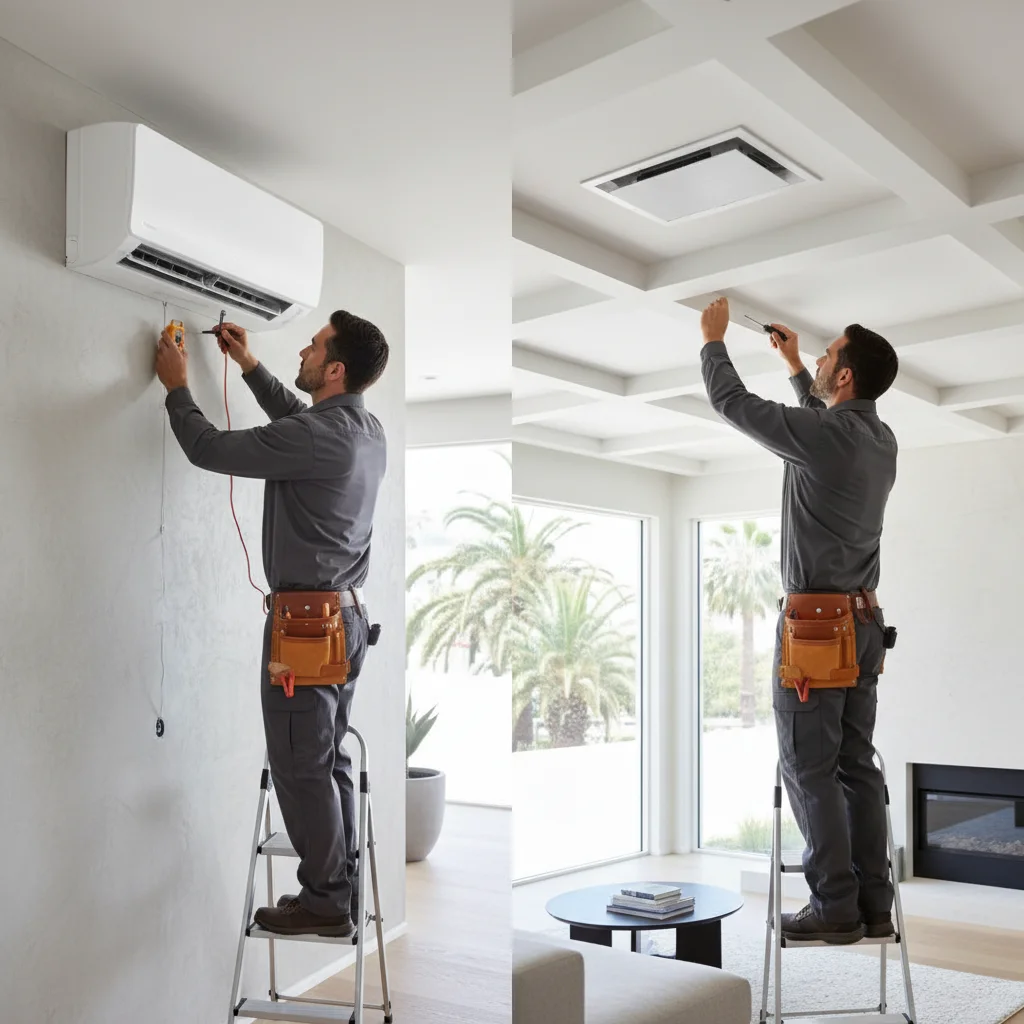
The install is simpler when the sunroom shares a wall with the main house. The indoor head mounts high on an interior wall, the line set goes through that wall to a side-yard condenser, and electrical comes off the main panel. Detached or roof-only attachments may need a longer electrical run.
DOE describes SEER2 as a seasonal cooling-efficiency rating in Btu per watt-hour. Actual savings vary with usage. A high SEER2 rating is not a guaranteed bill cut.
What a 2026 sunroom quote should list
Climate Pros SD does not publish 9,000, 12,000, 18,000, or 24,000 BTU installed bands. Ask for:
- Manual J load after glass upgrades (or with untreated glass if you refuse that work)
- Equipment, line set length, electrical, stucco patching, HOA review, permit
- Who pulls the permit (the licensed contractor, not this brand)
- Condensate routing
In the City of San Diego, a mechanical permit is required to install, alter, replace, or repair HVAC. Electrical permits apply to a new circuit. Other jurisdictions differ.
Do not budget Section 25C for a 2026 install. TECH single-family reservations stopped November 14, 2025. HEEHRA single-family applications were not being accepted as of February 24, 2026. SDG&E Golden State retail rebate offerings have ended.

When extending the main system actually works
A few cases where extending the home’s central system can be reasonable:
- The main system is being replaced anyway and the new system is sized to include the sunroom load
- The sunroom is small, already partly conditioned, and used only briefly during peak hours
- The sunroom has been retrofitted with insulated walls, roof, and high-performance glass, so it behaves like a normal room
- Immediate coastal sites where the glass load is naturally lower (Coronado, La Jolla shores, Cardiff). NWS describes ocean moderation near San Diego. That is qualitative, not a BTU table.
If none of those apply, extending the central system is usually the wrong move. Get a second licensed opinion if you have been told to “just add a duct.”
Decision framework
If the glass is single-pane or old dual-pane: upgrade glass or add film first, then size the mini-split.
If the glass is modern low-E and the room is modest: skip glass upgrades only after a load calc says the head can handle it.
If the room is large, glass-roofed, or west-facing and untreated: budget for both glass work and a larger head. Ask for the combined project in dollars.
If the sunroom is rarely used: insulated blinds and a buffer space may be enough. Do not condition it.
Frequently asked questions
Can I extend my central AC into my sunroom?
Almost never the right answer in San Diego. Sunroom solar gain through glass usually exceeds what a central system can deliver through a single duct branch. A dedicated mini-split sized for the room is the usual fix.
What size mini-split do I need for my sunroom?
Require a Manual J load calc. Typical starting conversation is a small head for a treated 150 to 200 square foot room, larger for untreated west glass or a glazed roof. Do not size from this article.
Should I upgrade the glass before installing HVAC?
Yes, if the existing glass is single-pane or pre-2005 dual-pane without low-E. Cutting solar heat gain lets you install smaller equipment and keeps the SDG&E bill more reasonable. DOE says actual energy results vary with use.
Do I need a permit for sunroom HVAC?
In the City of San Diego, yes for the mechanical work. Electrical permits apply to a new circuit. Glass or roof work may need building permits.
Will a portable or window AC work for a sunroom?
Short-term yes, long-term no. Portables dump heat through the exhaust hose, drainage is constant, and sunroom glass often blocks window-unit installs.
Do sunroom mini-splits qualify for rebates?
Not Section 25C for a 2026 install. Confirm TECH, HEEHRA, and SDG&E status on the live pages. Do not treat closed programs as cash.
Call (442) 777-6440 to be matched with a local licensed pro. Related reading: ductless mini-split vs central AC, ductless mini-split cost in San Diego, and how does a mini-split work. See mini-split installation.
Related services: AC repair and AC installation.