The first question on any Fallbrook furnace repair is what fuel the thing burns. Propane and natural gas furnaces look nearly identical from three feet away, and they fail in genuinely different ways.
Get that wrong and the diagnosis goes sideways. A propane-specific fault gets chased as an ignition problem, parts get swapped, and the furnace still won’t hold a flame.
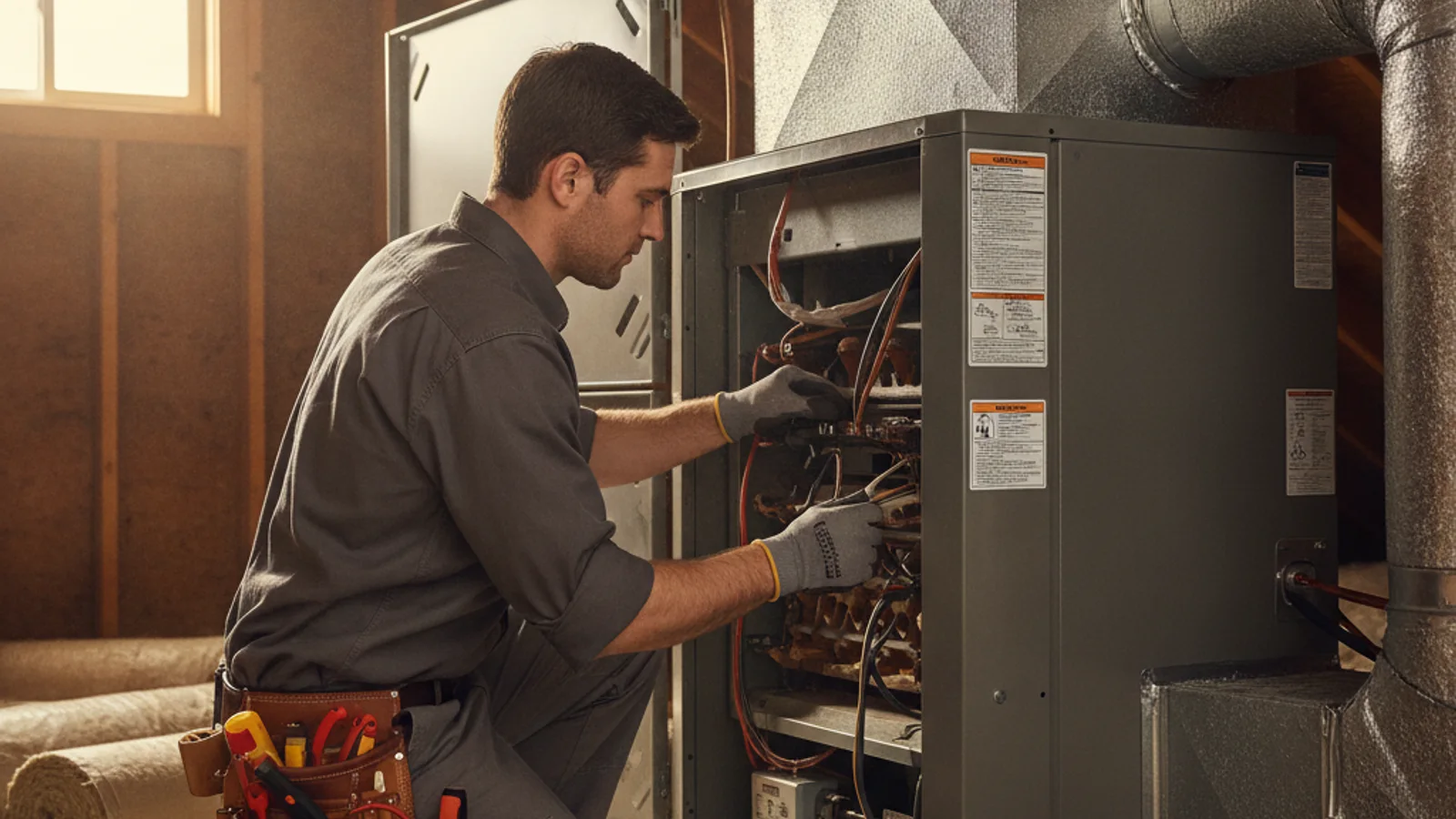
Fallbrook: name the fuel before the repair
Propane and natural gas furnaces fail differently. Read the rating plate or the tank. Do not assume city gas on a De Luz or grove parcel. Unincorporated Fallbrook often sits on propane. Orifice, regulator, and ignition symptoms are not interchangeable with natural-gas procedures.
Checklist
- Photograph the fuel type on the rating plate.
- If you smell gas or propane, leave and call from outside.
- Note tank level if you are on propane.
- See AC maintenance in Fallbrook for the cooling side.
- Use Fallbrook HVAC.
Related: Furnace repair and heating repair in Vista.
Start with the fuel, because Fallbrook is split
Natural gas service in Fallbrook follows the road network. Properties in and near the village, along Mission Road and the older grid streets, generally have a gas meter. Head out toward De Luz, Sandia Creek, Gird Valley or the Live Oak Park side and pipeline service thins out fast. Those homes run on a propane tank, either a horizontal tank on a pad or an underground tank with only the dome showing.
You can settle this in under a minute. Walk the exterior. A gas meter with a shutoff and a regulator on the wall means natural gas. A white or silver tank on the property means propane. Check the furnace data plate too, because it will be stamped either NAT or LP.
Why it matters: propane burns at a much higher pressure and delivers considerably more heat per cubic foot than natural gas. So a propane furnace uses smaller burner orifices and a different manifold pressure setting. A conversion done properly swaps the orifices and re-sets the gas valve. A conversion done casually swaps neither, and the furnace either soots up or short cycles for the rest of its life.
If a previous owner moved a natural gas furnace onto propane without the conversion kit, the tells are yellow lazy flames instead of crisp blue ones, black soot on the burner faces, and a heat exchanger that fails inspection years early. That’s the sort of thing a homeowner can spot with a flashlight and should never try to correct alone.
How a propane furnace fails differently
Once you know it’s propane, a whole category of problems opens up that natural gas homes never see.
Tank pressure is the first. Propane is stored as a liquid and has to boil off into vapor to reach the furnace. On a cold morning, with the tank down below a quarter full, vaporization slows and delivery pressure sags. The furnace lights, runs briefly, then drops out. Homeowners read that as a furnace problem. It’s a supply problem, and the fix is a delivery, not a part. Check the tank gauge before you call anyone.
Regulators are the second category. Propane systems use a two-stage regulator setup, one at the tank and one closer to the appliance. Regulators are outdoor components exposed to changing weather, and they age. A failing regulator produces intermittent, weather-correlated symptoms that vanish by the time anyone shows up.
Third, the orifices themselves. Propane orifices are small enough that a fleck of scale from inside the line will partly block one. The result is one burner that lights late or not at all, uneven heating across the burner rack, and a flame sensor that intermittently loses sight of the flame.
Whoever works on the system needs to be carrying a manometer and be willing to read manifold pressure against the data plate. If a quote arrives without anyone having measured gas pressure on a propane furnace, that quote is a guess. Some of the broader service context for the area is covered in our Fallbrook HVAC overview.
Grove dust, fire season, and fouled burners
Fallbrook sits in avocado and citrus country, and the air carries a load that coastal furnaces never deal with. Grove work kicks up fine soil. Summer and fall bring dry-season dust down the canyons on the Santa Ana pattern. Homes near unpaved driveways and access roads get an extra dose every time a vehicle comes up.
That dust settles in three places that matter. It cakes the burner faces, which distorts the flame pattern and makes a flame sensor unreliable. It coats the hot surface igniter, where it bakes into a hard glaze that insulates the element and lengthens the time to light. And it loads the filter far faster than any manufacturer’s schedule anticipates.
The filter part deserves emphasis. A one-inch filter in a Fallbrook home during a dusty September can be visibly grey in four weeks. A restricted filter starves the blower, the heat exchanger overheats, and the high-limit switch shuts the furnace down mid-cycle. That looks exactly like a serious failure and is often solved by a new filter off the shelf. Pull the filter and hold it up to a light before you do anything else. If light barely passes through it, replace it, run the system, and see whether the shutdowns stop before you book anything.
Wildfire smoke adds a layer during bad seasons. Fine ash is more abrasive and more conductive than ordinary dust, and it gets into the blower housing and onto the control board. After any smoke event close enough to leave ash on the cars, the furnace deserves an inspection before it’s asked to run all winter.
Older ranch houses and where the heat goes
A lot of Fallbrook housing is single-story ranch on acreage, built across the 1950s through the 1970s, plus a layer of 1980s and 1990s custom homes on larger lots. Those two groups behave differently when the heat isn’t working.
In the older ranch houses, the furnace is often a closet or hallway unit with short, undersized ductwork, sometimes still with original registers. Some of the smallest homes never had central heat at all and run on a wall furnace or a floor furnace. Those are a separate appliance class with their own safety issues, and an old floor furnace with a failed thermocouple is not a repair to attempt yourself.
In the newer custom homes, the furnace is usually in the attic or a garage mechanical closet, and the recurring problem is distribution rather than the furnace itself. Long duct runs across an unconditioned attic lose heat before it reaches the far bedrooms. Homeowners call it a weak furnace. Measured at the register, the far rooms may get cooler air than the rooms nearest the air handler.
Either way, if the complaint is uneven heat rather than no heat, the furnace may be fine. Ask for static pressure and register temperature readings, not just a burner inspection. Our list of signs a furnace is going out helps separate the two.
What a rural address changes about the work
None of this is about how quickly anyone reaches you. It’s about planning the visit so it only takes one.
Give the exact gate code, the cross street, and any note about a long or steep driveway when you book. Say on the phone that the home is on propane, and read the furnace’s brand, model, and serial number off the data plate. Rural parts runs are real, and a tech who knows the model beforehand has a much better chance of arriving with the igniter or the gas valve already on the truck.
If the furnace is older, ask directly whether furnace repair still makes sense or whether the money is better spent on replacement. The US Department of Energy’s home heating guidance is a neutral starting point for that comparison, since it isn’t written by anyone selling equipment.
When to call us
Gas pressure, propane regulators, heat exchangers, and any wall or floor furnace are licensed-technician work, and in Fallbrook that’s most of what actually breaks. Check the tank gauge and the filter first, then hand the rest over. Call us at (442) 777-6440 and we will match you with a licensed local pro.