Before you diagnose anything, find out whether your house is heated by a gas furnace, a heat pump, or both. Heat pump behavior can be mistaken for furnace behavior.
Vista has an unusually mixed housing stock for a city its size, and the heating equipment mix is just as split. The symptom that means a real fault on one system is completely normal on the other.
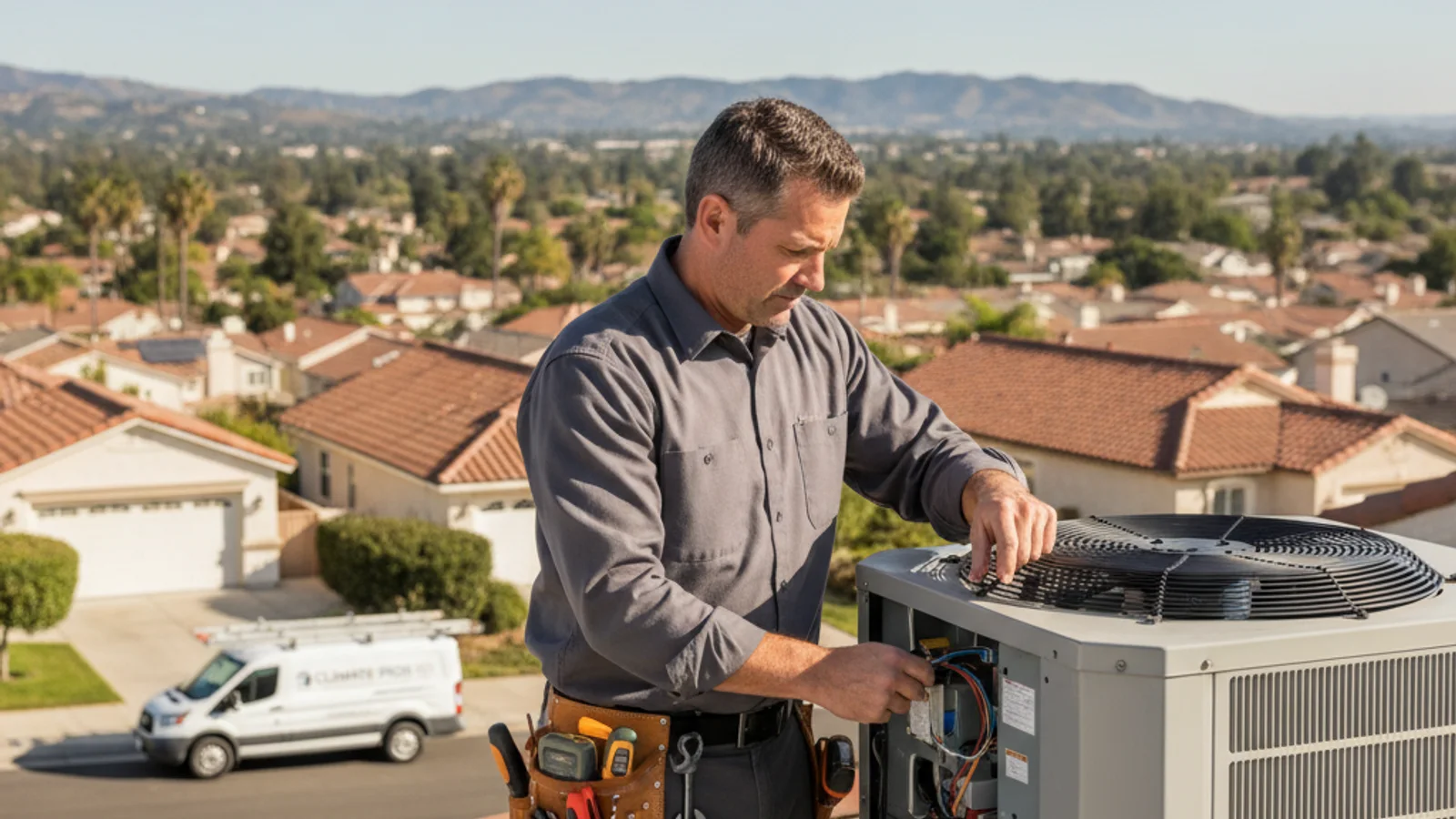
Vista heating repair starts with system identity
A no-heat call on a heat pump is a different diagnosis than a gas furnace lockout. Write the outdoor equipment type before you request a match. Vista has both tract furnaces and ductless heads. The wrong truck stock delays the visit.
Checklist
- Note gas smell. If present, leave.
- Write whether the outdoor unit is a condenser or a heat pump.
- See heat pump maintenance Vista.
- Use Vista HVAC.
- See furnace repair Fallbrook if you are on propane at the county edge.
Related: Furnace repair and emergency HVAC.
Start by identifying the system, not the symptom
Three checks settle it, and none takes more than a few minutes.
Go outside while the heat is running. If the outdoor unit is spinning, you have a heat pump. A gas furnace never runs the outdoor unit for heat, because in a furnace-plus-AC system the outdoor condenser sits idle all winter. This one check answers the question for most people.
Look at the thermostat. If the mode selector offers EM HEAT or AUX, or if the display ever shows AUX HEAT, that’s a heat pump control. A thermostat with only Heat, Cool, and Off is more likely paired with a furnace, though not always.
Find the indoor unit and read the data plate. A gas furnace has a flue pipe leaving the cabinet and a gas line entering it. An air handler paired with a heat pump has neither, just refrigerant lines and electrical, usually with a heat strip package inside.
The geography roughly tracks the era. The older neighborhoods around Vista Village and the streets off Bobier and Foothill Drive lean gas furnace, often the original ducted system with decades on it. Newer construction and the homes that have been through an equipment change in the last several years increasingly run heat pumps, since that’s what the market has shifted toward. Plenty of houses in between run something in the middle, which is the next section.
Write down which one you have. Every step below branches on it.
Heat pump air feels cool, and that’s usually normal
This can be mistaken for a fault during Vista heating calls, and it’s worth understanding before you spend money.
Air from a gas furnace feels hot at the register. Air from a heat pump can feel cooler even while it’s warming the room.
The test isn’t your hand. It’s the thermostat. If the house is reaching and holding the set temperature, the system is doing its job, and the air being less than scalding is the design working as intended. Heat pumps warm a house slowly and steadily rather than in hot bursts, which is also why using a large overnight setback and expecting a quick recovery in the morning doesn’t work well here.
When it is a real fault, the pattern is different: the house drifts further from setpoint over hours, the system runs continuously without gaining ground, or the air at the register is genuinely ambient. Our guide to a heat pump not heating breaks down what separates those cases.
One more Vista-specific note. Inland North County drops further overnight than the coast does, and a heat pump’s output falls as the outdoor temperature falls. A system that was sized for a mild coastal load and then installed in a Vista valley bottom will struggle on the coldest mornings without anything being broken.
Defrost cycles, steam, and the outdoor unit stopping
On a cold, damp Vista morning, especially in the low-lying stretches along Buena Vista Creek where cold air pools, you may walk outside and find the outdoor unit steaming, silent, or wrapped in frost. All three can be normal.
A heat pump pulls heat out of outdoor air, which chills the outdoor coil below the surrounding air temperature. When that coil drops below freezing and there’s moisture in the air, frost forms on it. The system then runs a defrost cycle: it briefly reverses into cooling mode to warm the coil, shuts the outdoor fan off, and melts the frost. You get steam, a change in sound, and a whoosh when it switches back. Most units also energize the backup heat during defrost so you aren’t blown with cold air.
A defrost cycle lasting several minutes and happening occasionally on a cold morning is the system working. What isn’t normal is ice that never clears, ice encasing the whole unit rather than the coil, defrost running constantly, or the unit staying frosted well after the morning warms up. Those point at a defrost sensor, a defrost board, a reversing valve, or a refrigerant charge problem, and there’s more detail in our piece on a frozen outdoor unit.
If ice is present, don’t chip at it or pour hot water on the coil. The fins bend, and the refrigerant line and sensor sit right there. Switch the system to emergency heat, which stops the outdoor unit, and let it thaw before anyone works on it.
Auxiliary heat and the switch marked EM HEAT
These two labels confuse a lot of homeowners, and running the wrong one for weeks gets expensive.
Auxiliary heat is the backup, usually electric resistance strips in the air handler. The thermostat brings it on automatically when the heat pump alone can’t keep up, typically on the coldest mornings or during a big setback recovery. A brief AUX indicator on a January morning in Vista is expected behavior.
Emergency heat is a manual mode that shuts the heat pump off entirely and heats the house with the strips alone. It exists for when the heat pump is genuinely broken. Electric resistance heat costs substantially more to run than the heat pump it’s replacing, so leaving a thermostat in EM HEAT is one of the more common causes of a shocking SDG&E bill.
Two things to watch. If AUX is showing constantly, in mild weather, something is wrong with the heat pump side and the strips are quietly carrying the whole load. And if you switched to EM HEAT during a problem months ago, check the thermostat now. That switch gets forgotten.
Dual fuel and gas packs, Vista’s third category
A fair number of Vista homes run neither a plain furnace nor a plain heat pump.
Dual fuel pairs a heat pump with a gas furnace in the same system. The heat pump handles most of the season, and the furnace takes over below a changeover temperature set in the thermostat. When these misbehave, it’s usually the changeover setting, not the equipment: set too high, the gas furnace runs when the heat pump should be handling it, and the gas bill climbs. Set too low, the house feels underheated on cold mornings.
Rooftop gas packs are the other one, common on single-story homes with limited indoor mechanical space. Heating and cooling live in one cabinet on the roof, which means every service call involves roof access and every failure is exposed to weather year round. Cabinet rust and rodent damage to the flexible duct connections under the curb are recurring issues on older units. If your registers are in the ceiling and there’s a large box on the roof, that’s what you have.
For the straight gas furnace side of the city, including what tends to fail on the older units, our Vista furnace repair guide covers that ground in more detail than there’s room for here.
What to check before you book
Run this short list first. It resolves a meaningful share of calls without anyone coming out.
Check the thermostat mode and setpoint, and replace the batteries. Check that the breaker for both the indoor and outdoor unit is on, since heat pumps use two. Check the filter. Check that the outdoor unit isn’t blocked by plants, a trash can, or a pile of yard debris, which matters more in the semi-rural eastern edge of the city than most people expect.
Then write down the specifics for whoever you call: the equipment brand and model from the data plate, whether the outdoor unit runs, whether AUX or EM shows on the thermostat, and how long the symptom has been happening. For anything on the refrigerant side, use heat pump service and leave the work to the pro. The US Department of Energy’s heating and cooling guidance is a useful neutral reference on how these systems are meant to behave.
When to call us
Refrigerant, gas, reversing valves, defrost boards, and anything on a rooftop unit are licensed-technician work, and every HVAC pro in the network is licensed and insured. Do the thermostat, breaker, and filter checks first, then hand it over. Call us at (442) 777-6440 and we will match you with a licensed local pro.