Stand next to the furnace and listen to a full startup. A gas furnace announces its own fault during startup, and knowing which step it fails at tells you more than any symptom described from another room.
Santee heating gets underestimated because the summers dominate the conversation. A furnace problem may not become obvious until someone calls for heat.
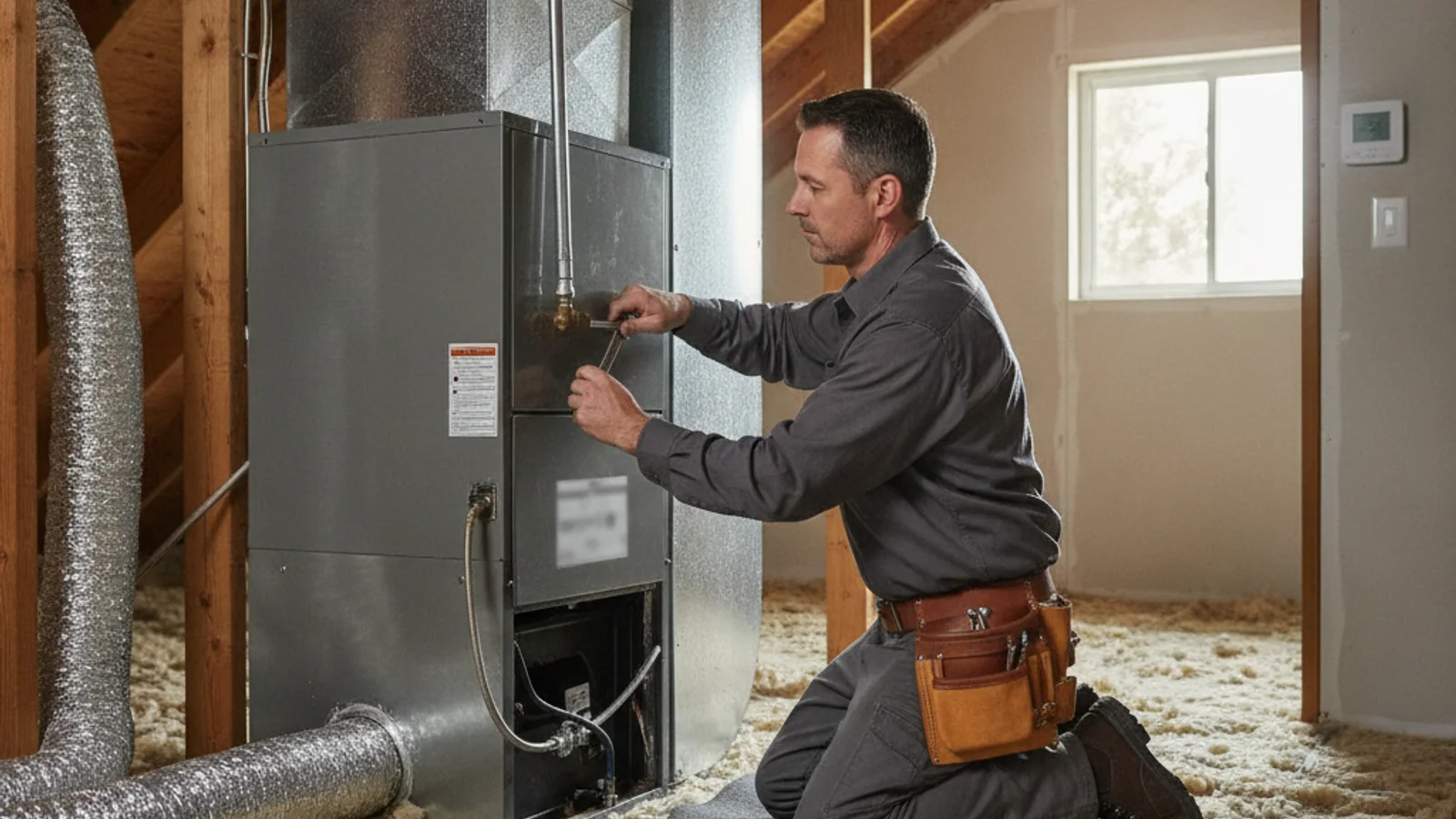
Santee furnace diagnosis starts at a full startup listen
Stand by the cabinet and note whether the inducer, ignitor, gas valve, and blower each start. The step that never happens is the report the contractor needs. East County nights get colder than the coast. Santee furnaces actually run. That makes ignition and airflow problems show up earlier than in Encinitas.
Checklist
- Time the trial-for-ignition.
- Write any lockout after several tries.
- Check the filter before blaming the inducer.
- See furnace repair in Tierrasanta.
- Use Santee HVAC.
Related: Furnace repair and HVAC maintenance.
What a healthy startup actually sounds like
Modern gas furnaces follow a fixed sequence, and every step has a sound. Learn the order once and you can locate a fault by ear.
The thermostat calls for heat. The inducer fan spins up first, a rising whine, and it runs alone to purge the heat exchanger and prove draft. A pressure switch senses that draft and closes. Only then does the igniter energize, either a hot surface igniter that draws current silently or a spark igniter that clicks. The gas valve opens, the burners light with a soft whoosh, and a flame sensor confirms the flame is really there. After the burners light, the blower starts and warm air reaches the registers.
Skip any step and the board shuts the gas down. That’s the safety design working, not the furnace being difficult.
Now match your symptom to the step. No inducer at all points at the thermostat call, the board, or power. Inducer runs and stops with no igniter means the pressure switch never proved. Igniter glows, burners light, then everything dies means the flame sensor did not confirm. Burners light and stay lit but no warm air arrives means the blower or its control.
Most furnaces also blink a diagnostic code through a small window on the control panel, with the legend printed inside the access door. Count that pattern and photograph the legend.
Three clicks and nothing: the ignition side
When the igniter tries repeatedly and the burners never light, the usual suspects are the igniter itself, the gas supply, or the pressure switch upstream.
Hot surface igniters are brittle silicon carbide or silicon nitride elements, and they fail from thermal cycling. A cracked one may still glow faintly or not at all. They are also easy to break by touching the element with bare fingers, so this is not a part to poke at.
The pressure switch is the other frequent stop. It closes only when the inducer pulls real draft, so anything blocking the flue or the condensate path can hold it open. With furnaces in a garage or a hall closet, the vent run can pick up a bird nest, a rodent nest, or debris, and after a windy Santa Ana stretch that’s worth ruling out. A cracked or disconnected rubber sensing tube does the same thing.
Then there’s gas supply. Confirm other gas appliances in the house work. If nothing gas fired is running, the problem is upstream of the furnace and belongs to the utility.
If your furnace fails specifically at this step, our why won’t my furnace ignite walkthrough goes deeper on the sequence and the parts involved.
It lights, runs a minute, then quits
This pattern can point to the flame sensor, but other faults can cause it too.
The sensor is a thin metal rod sitting in the burner flame. It works by flame rectification: a tiny current passes through the flame itself, and the control board reads that current as proof of ignition. Over years of firing, the rod accumulates a silica and carbon film. The film insulates the rod, the current drops below threshold, and the board concludes there’s no flame and closes the gas valve.
The result is a furnace that lights, runs briefly, shuts down, waits, and tries again until locking out. If your unit has been doing that on the first cold mornings each year and then working again after a lockout reset, this is very likely the cause.
Cleaning the rod is a routine part of a heating tune-up. Doing it means shutting off gas and power, removing the sensor, and cleaning it with an abrasive pad, and then confirming the microamp reading with a meter. That last part is why it’s technician work: cleaning it without measuring the signal afterward is guessing.
A short-cycling furnace can also be a dirty flame sensor’s neighbor: a plugged filter or closed registers causing a limit switch to trip on high temperature. Change the filter first, and open every supply register in the house before assuming a part failed.
Carbon monoxide is not something you troubleshoot
Everything above assumes the furnace is safe to operate. Some symptoms mean stop.
A cracked heat exchanger can allow combustion gases into the air the blower distributes. Warning signs include soot around the burner compartment, a yellow or lazy flame instead of a crisp blue one, visible rust streaking on the cabinet, a persistent sharp odor when the unit runs, and a carbon monoxide alarm sounding.
If a CO alarm goes off, or if anyone in the house has headaches, nausea, or dizziness that improve when they leave, get everyone outside and call 911. If you smell gas, do not operate switches, leave, and call SDG&E or 911 from outside. Those are the only phone numbers that belong in this situation.
Working CO alarms on every level of the home are not optional in a house with any fuel-burning appliance. A heat exchanger inspection is a normal part of a heating service visit, and it requires opening the unit.
Manufactured homes take a different furnace
If you own a manufactured home in Santee, tell the company before the visit. These units cannot take a standard residential furnace. Mobile and manufactured home furnaces are specifically listed for that use, typically sealed combustion drawing outside air, and they’re built for the home’s ducted-through-the-floor distribution and its dedicated closet.
Swapping in a conventional furnace is both unsafe and a listing violation. Tell whoever quotes the work that it’s a manufactured home before they arrive, and confirm the replacement part or unit is listed for manufactured home installation. Parts availability on older models is the usual constraint.
Ductwork under a manufactured home is its own recurring issue. Crossover ducts and belly board runs get damaged by rodents and by settling, and a furnace that fires perfectly still won’t heat the far end of the home if the crossover is torn.
Repair or replace on a decades-old system
Santee’s cooling season is long and the heating season is short, which changes the math. A furnace here accumulates fewer run hours per year than one in a cold climate, so age alone is a weaker argument for replacement than it would be elsewhere.
The honest triggers for replacement are a cracked heat exchanger, a failed part that costs a large fraction of a new unit, or repeated failures across different components. The other trigger is timing: if the air conditioning side is also original and near the end, ask a licensed pro whether a combined heat-pump project makes sense. Our heat pump versus furnace comparison lays out that decision for San Diego conditions.
Whoever you use, verify the license and classification on the CSLB license check. Repair scope is on our furnace repair page, and the local picture for the city sits on the Santee HVAC service page.
When to call us
Filters, registers, the breaker, and the thermostat batteries are yours. Anything involving the gas valve, the burners, the heat exchanger, or a repeating lockout code needs a licensed pro with a combustion analyzer. Call us at (442) 777-6440 and we will match you with a licensed local pro.