In a pre-1980 San Diego home, the equipment is rarely the hard part. The return air path, the electrical panel, and whether there’s anywhere to run a duct are what decide the scope and the price.
A 1948 bungalow in North Park and a 1972 tract house in El Cajon both count as older here, and they fail an HVAC install in completely different ways. Knowing which constraint you’re up against before you take bids is the difference between comparing quotes and guessing.
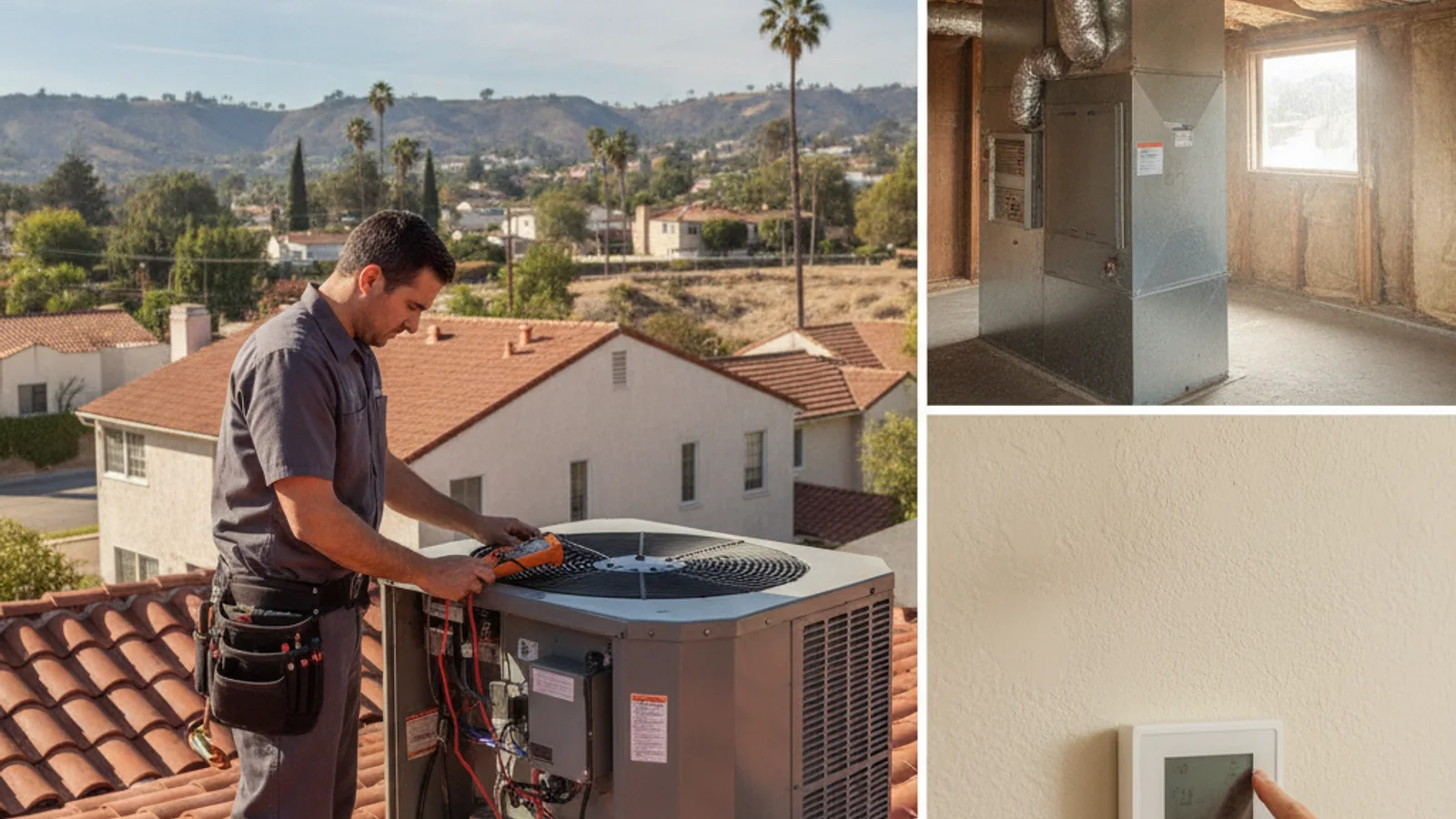
Pre-1980 San Diego HVAC is a return-air and panel problem
The condenser is rarely the hard part. Missing return paths, 100-amp panels, and nowhere to run ducts decide the scope. Craftsman and postwar bungalows in North Park, Golden Hill, and older Oceanside streets often never had ducts. Mini splits or a true duct redesign beat stuffing a coil in a tiny closet.
Checklist
- Photograph the panel door interior schedule.
- Measure the existing return grille.
- See heat pump 100 amp panel.
- See mini split Oceanside.
- Do not subtract closed 25C from a 2026 bid.
Related: AC installation and older-home contrast with Fallbrook.
Four eras, four different problems
San Diego’s older housing isn’t one category, and the era tells you most of what you need to know before anyone opens a wall.
Pre-war bungalows and craftsman stock. Golden Hill, South Park, North Park, Kensington, parts of La Mesa. These were built with no cooling and often with wall or floor furnaces for heat. There’s usually no duct system at all, low attic clearance at the eaves, and plaster-and-lath walls that don’t like being opened. Leucadia’s beach cottages are the coastal version of the same problem.
Post-war ranch tracts. Clairemont, Allied Gardens, San Carlos, Serra Mesa, big stretches of Chula Vista and El Cajon. Single story, shallow-pitch roofs, and an attic that’s generous over the middle of the house and unusable at the perimeter. Many of these have a gas furnace in a hall closet with a return grille in the ceiling above it, and that single return is the constraint on everything.
Seventies tract expansion. Vista’s South Vista and Buena Vista neighborhoods, Escondido, Santee, Poway. These usually do have ducts, and the ducts are usually the original flex with degraded insulation and separated joints at the boots.
Older small residential in the county’s central and inland cores. Vista Village, parts of National City and Lemon Grove. Small square footage, no attic clearance, and frequently no practical route for central ductwork, which is why ductless retrofits dominate here.
Identify which of these you own first. Everything below lands differently depending on the answer.
Undersized returns are the most common finding
If an older San Diego home has one complaint that survives every equipment upgrade, it’s this: the system can’t pull enough air back.
A single hallway return grille sized for a 1965 furnace does not have the free area a modern high-efficiency system wants. Put a new, larger unit on it and the blower fights a restriction it can’t overcome. What the homeowner experiences is noise from the return grille, rooms at the end of the run that never catch up, a coil that ices in cooling, and a furnace that short cycles on its high limit in heating.
Symptoms of a starved return are easy to mistake for undersized equipment. That’s how homes end up with a second oversize replacement that performs no better than the first.
The fixes, roughly in order of disruption: enlarge the existing return grille and the opening behind it, add a second return in a bedroom hallway or a large room, add transfer grilles or undercut doors so closed bedrooms can breathe, or in the worst cases rebuild the return trunk. Bedroom doors matter more than people expect. A closed door with no return path in the room turns that room into a pressurized dead end.
Ask any contractor bidding your job what the total return free area is, and what they intend to do about it. A bid that specifies equipment and says nothing about returns is a bid on half the job.
The electrical panel decides whether a heat pump fits
This is where older homes stop projects cold. A 1950s house on a 100-amp panel, sometimes with the original service and a full breaker bay, has to be looked at before anyone specs an all-electric system.
A heat pump changeout adds a 240-volt circuit and, on systems with backup heat strips, potentially a large one. Whether the existing service can carry it depends on a load calculation against the panel, not on a guess about the house’s size. Sometimes the answer is a simple subpanel or a circuit consolidation. Sometimes it’s a full service upgrade coordinated with SDG&E, which is its own timeline.
There are ways through that don’t require an upgrade, and they’re worth pricing before you assume the worst: inverter-driven equipment with lower running current, ductless systems that run on smaller circuits, or a dual-fuel setup that keeps the existing gas furnace for backup heat instead of electric strips. Our guide on heat pumps and 100-amp panels in San Diego works through the options.
Get the panel evaluated in the same visit as the load calculation. Discovering the panel problem after the equipment is ordered is how a one-week project becomes a two-month one.
Homes with no place to run a duct
Plenty of older San Diego homes simply have no duct chase and no attic clearance to build one. Retrofitting central forced air into a small craftsman or a 1,100 square foot cottage usually means soffits through living space, a furred-down hallway ceiling, or losing a closet.
Three alternatives are worth pricing side by side. Ductless mini-splits, with a head per zone and a small line set penetration per head, avoid the duct problem entirely and handle heating and cooling from one outdoor unit. Ducted mini-split air handlers hidden in a closet or a small attic pocket can serve two or three nearby rooms through very short duct runs, which reads more like central air at the register. High-static compact systems can push through smaller ducts where there’s a partial route available.
The tradeoff is visible indoor equipment versus construction. Our ductless versus ducted comparison for San Diego homes covers where each one wins. Historic districts add a wrinkle, because exterior line sets and condenser placement can be subject to review on designated properties.
Old duct insulation, permits, and Title 24 verification
Two things on an older-home changeout are not the contractor’s judgment call, and both need to come from the authority that sets them.
Unknown duct wrap. Older duct insulation and pipe wrap can contain materials that require specific handling, and nobody should tell you what’s in yours by looking at it. If the wrap is deteriorating and its age is unknown, testing by a qualified professional comes before demolition. Ask the contractor how they handle it rather than accepting an assurance.
Permits. For work in the City of San Diego, the city states that no part of a heating, ventilating, air conditioning, or refrigeration system may be installed, altered, replaced, or repaired without a mechanical permit. The city describes two paths: a simple no-plan permit for minor work on non-historic properties, including air conditioner installations and furnace replacements, and a plan permit for complex work or for historically designated properties. Other cities and the unincorporated county set their own requirements, so confirm with the jurisdiction the house sits in. Our San Diego HVAC permit guide covers the process.
Title 24 field verification. California requires field verification and diagnostic testing when HVAC systems are altered or replaced, performed by a state-certified rater. As of January 1, 2026, the California Energy Commission moved the scope of that testing from the HERS program into its Energy Code Compliance program, and the commission directs questions about current HVAC testing requirements to its Standards Compliance Branch. Do not accept a specific duct-leakage threshold from a salesperson as fact. Ask which tests apply to your scope and who performs them, and confirm current requirements with the California Energy Commission.
Verify any contractor’s C-20 license through the CSLB license check before signing. For scope and options across the county, see our AC installation page and the San Diego service area page.
When to call us
An older-home installation is worth a walkthrough before you collect bids, because the return path, the panel, and the duct route change the scope more than the equipment brand does. Anything involving refrigerant, gas piping, or the electrical service needs a licensed pro. Call us at (442) 777-6440 and we will match you with a licensed local pro.