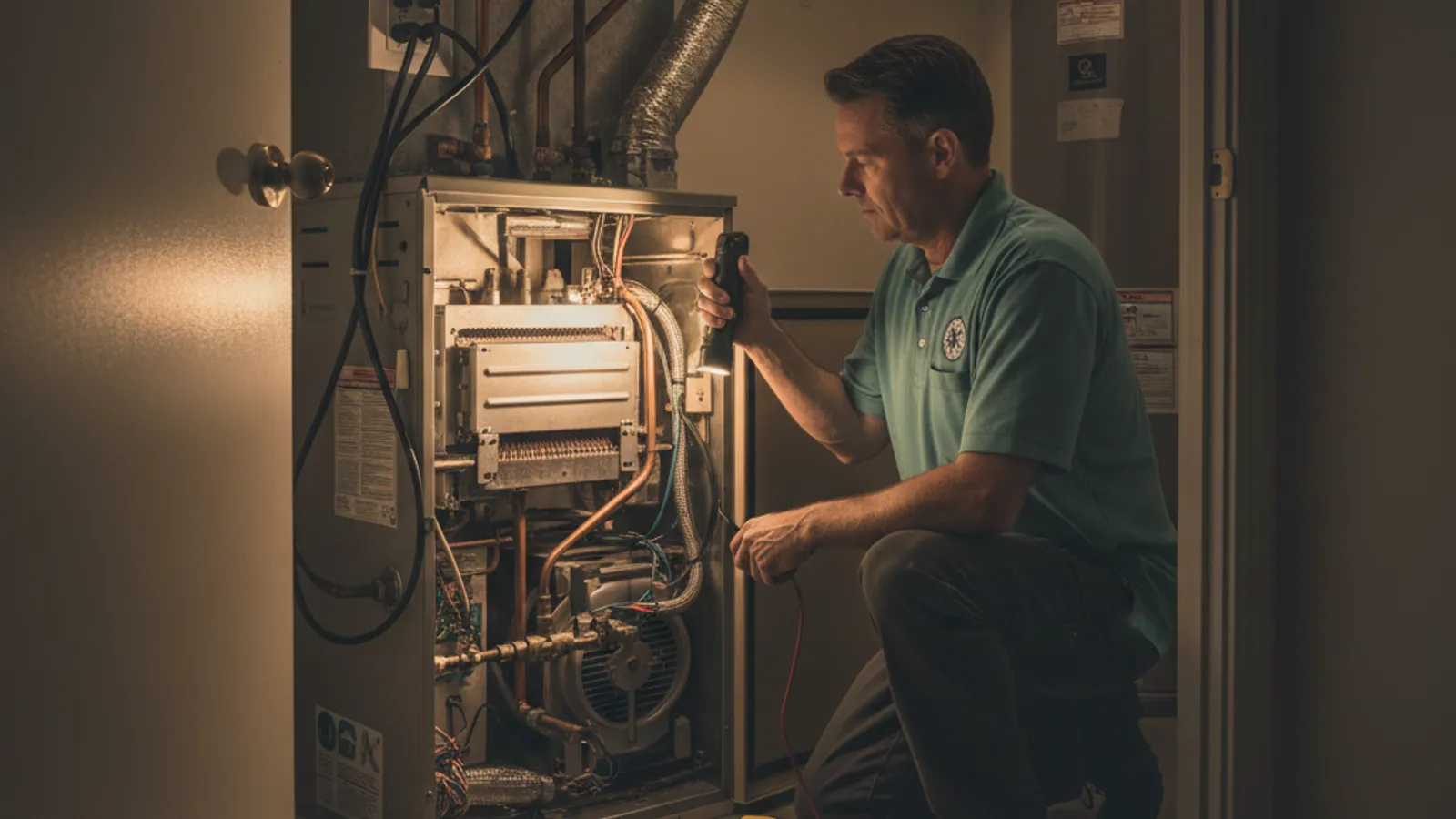
Furnace quit on a cold San Diego night and you need heat back. An after-hours heating company that actually runs trucks will send a licensed tech, not a call center that only books the next afternoon. Common no-heat causes are an igniter, a flame sensor, or a thermostat. A few safe checks can fix it before anyone drives out. If you smell gas or your carbon monoxide alarm is going off, skip the rest of this and get everyone outside, then call 911 and the gas company.
Climate Pros SD matches you with licensed HVAC companies. We do not repair furnaces, set after-hours rates, publish a parts-and-labor table, or promise that a tech arrives tonight. The matched company quotes the diagnostic fee and the repair in dollars, and it confirms its own timing.
San Diego winters are milder than inland-continent cold, so a lot of homeowners assume a dead furnace can wait. Inland valleys still get colder nights than the coast. A house with a newborn, an older parent, or anyone with a health condition should not wait out a no-heat night. Climate Pros SD does not publish a city-by-city overnight low.
What counts as a 24-hour furnace emergency
Not every heating problem needs a tech at midnight. Some do.
Gas smell or a CO alarm is a true emergency, every time. If you smell rotten eggs or sulfur near the furnace, or your carbon monoxide detector sounds, get everyone out of the house first. Do not flip switches. Do not relight anything. Call 911 from outside, then SDG&E at 1-800-411-7343. Carbon monoxide is colorless and odorless. A cracked heat exchanger can leak it while the furnace looks like it is running fine.
No heat with a vulnerable person in the home counts. A newborn, an elderly parent, someone immunocompromised, or anyone with a heart or lung condition should not ride out a cold inland night with no heat. Coastal homes in Carlsbad and Encinitas stay milder. Inland valleys run warmer summer days and colder nights than the immediate coast. That is qualitative climate context, not a published overnight low for your ZIP.
A furnace that short-cycles or trips the breaker repeatedly needs attention. If the system clicks on and shuts off every few minutes, or keeps tripping the breaker, stop running it. That pattern points to an overheating or electrical fault that can damage the unit or create a fire risk.
A furnace blowing cold air or running a little weak is usually not a tonight problem. That is often a furnace blowing cold air issue you can monitor until morning. Same with a thermostat that lost its schedule.
Safe checks to run before you call
Run these first. None of them involve opening the gas line or touching wiring. They do not replace a licensed diagnosis.
- Check the thermostat. Set it to Heat, not Auto-changeover or Cool, and push the target temp 5 degrees above the room. Dead screen? Replace the batteries. A surprising number of “broken furnace” calls are a thermostat with dead AAs.
- Check the furnace switch. There is a light-switch-looking toggle on or near the furnace, often at the top of the closet. Someone flips it cleaning and forgets. Make sure it is on.
- Check the breaker. Find the furnace breaker in your panel. If it is tripped, flip it fully off, then back on, once. If it trips again right away, stop. That is a real fault. Leave it off and call.
- Check the filter. A filter clogged solid can overheat the furnace and trip its safety limit, shutting it down. If yours is gray and packed, swap it and try again. Our furnace not igniting checklist walks through the next layer if it still will not fire.
- Check the furnace door. Most furnaces have a safety switch that will not let them run if the front panel is not seated. If someone pulled it to look inside, push it back until it clicks.
If you have run all five and you still have no heat, it is a real repair. The most common culprits are a failed igniter, a dirty flame sensor, a bad blower motor, or a control board. None of those are DIY on a gas furnace, and none are worth poking around a live gas appliance at night.
What belongs on an after-hours furnace quote
After-hours pricing is a company decision, not a blog menu. Overnight work costs more than a scheduled daytime visit because the tech is on call and parts come off the truck. Climate Pros SD does not publish daytime versus overnight bands.
| Line to insist on | Why it matters |
|---|---|
| Diagnostic or trip fee, in dollars | After-hours is often a different fee. Ask if it applies toward repair if you approve the work. |
| Failed part, named | Igniter, flame sensor, thermostat, blower motor, control board, or gas valve are different jobs |
| Labor window | After-hours work is not the same as a morning slot. The company names its own window. |
| What is excluded | Heat exchanger work, permit, and a second visit for parts |
| License | Gas work in California needs a licensed C-20 contractor. Verify at cslb.ca.gov |
| Warranty, in writing | Part versus labor, and who honors it if a different company returns |
Igniter and flame sensor jobs are often smaller than a blower motor or control board. Climate Pros SD does not publish those dollars. If a furnace is 15-plus years old and the repair quote is high, weigh it against replacement using the numbers on that written quote, not a blog formula.
Watch for outfits that advertise a low after-hours service fee, then load parts and labor on top. Ask whether the diagnostic fee rolls into the repair if you approve it, and get the full number before they start.
How to spot a real 24-hour service vs. an answering machine
“24-hour emergency furnace repair near me” pulls up a lot of listings. Plenty of them route to a call center that books you for tomorrow afternoon, which defeats the point.
Ask whether a licensed tech is on the call, not only a script reader. If the person cannot ask what your furnace is doing, you may be talking to an answering service. Climate Pros SD does not pick the phone script for the matched company.
Ask for that company’s own timing in writing if they offer one. “Sometime tonight” is not a number. Climate Pros SD does not publish ETAs or after-hours coverage maps.
The company doing the gas work needs a C-20 and pulls the permit in the right city. You can verify any license at cslb.ca.gov in under a minute. An emergency is no reason to skip that. Climate Pros SD does not pull permits. A botched gas repair is worse than no heat.
Ask whether they actually run after-hours work to your city. A company based in North County may not run an after-hours truck to Chula Vista or Imperial Beach, and the reverse is true. Ask before anyone is on the road. Climate Pros SD does not publish a night coverage map.
If your no-heat call is really a heat pump and not a gas furnace, the symptoms and fixes are different. See heat pump not heating for that path.
When your furnace is down and it is late, call Climate Pros SD at (442) 777-6440. We match you with licensed heating companies across San Diego County. You reach us to get matched. We do not send our own truck, and we do not promise that the matched company is on after-hours duty for your ZIP.
Frequently asked questions
How much does 24-hour emergency furnace repair cost in San Diego?
Ask the matched company. After-hours diagnostic and repair are separate lines. Climate Pros SD does not publish an igniter, flame sensor, blower, or control-board menu. An igniter or flame sensor job can be shorter than a blower motor or control board once a tech is on site. The company on the job names the part and the dollars.
Is a furnace not working really an emergency in San Diego?
It can be. Inland valleys get colder nights than the coast. With a newborn, an older parent, or anyone with a health condition in the home, no heat overnight is a real emergency. A gas smell or a carbon monoxide alarm is always an emergency. Get out and call 911.
What should I check before calling for emergency furnace repair?
Set the thermostat to Heat and 5 degrees above room temp, check its batteries, confirm the furnace switch is on, reset the furnace breaker once, swap a clogged filter, and make sure the front panel is seated. If none of that restores heat, it is a real repair.
Can I fix a furnace that won’t ignite myself?
You can rule out the easy causes: dead thermostat batteries, a tripped breaker, a clogged filter, or an unseated panel. A gas furnace that still will not ignite usually needs a new igniter, a cleaned flame sensor, or a control board. Those involve a live gas appliance. That is a job for a licensed tech, not a DIY at night.
Why does my furnace keep shutting off after a few minutes?
Short-cycling often means an overheating furnace tripping its safety limit, usually from a clogged filter or a failing component, or a flame sensor that cannot confirm the burner is lit. Stop running it and have it checked. Repeated cycling can damage the unit.
Will an emergency furnace company actually come at night in San Diego?
Some companies run after-hours trucks. Many listings only book the next daytime slot. Ask the company on the phone whether they actually run after-hours work to your city before you commit. Climate Pros SD does not promise that the matched company will arrive at night.
The bottom line
A dead furnace on a cold San Diego night is not something to wait out when there is a vulnerable person in the home, and a gas smell or CO alarm is never something to wait on. Run the five safe checks first. A thermostat battery or a tripped switch can restore heat. If you still have no heat, get a licensed company that answers, quotes the visit in dollars, and confirms whether it actually runs after-hours work to your city.
Need a referral for licensed heating companies? Our emergency HVAC and furnace repair pages explain how matching works. For the cold-weather angle, see our winter HVAC checklist. Call (442) 777-6440. The matched company confirms timing. We do not.
Related service: AC repair.