In Del Mar, the biggest variable in a furnace repair usually isn’t the broken part. It’s where the furnace is bolted. Access drives the labor, the parts choice, and sometimes whether a repair is worth doing at all.
Most heating advice assumes a furnace standing in a roomy basement. Del Mar doesn’t have basements. It has attic platforms, closets barely wider than the cabinet, and crawl spaces cut into a bluff.
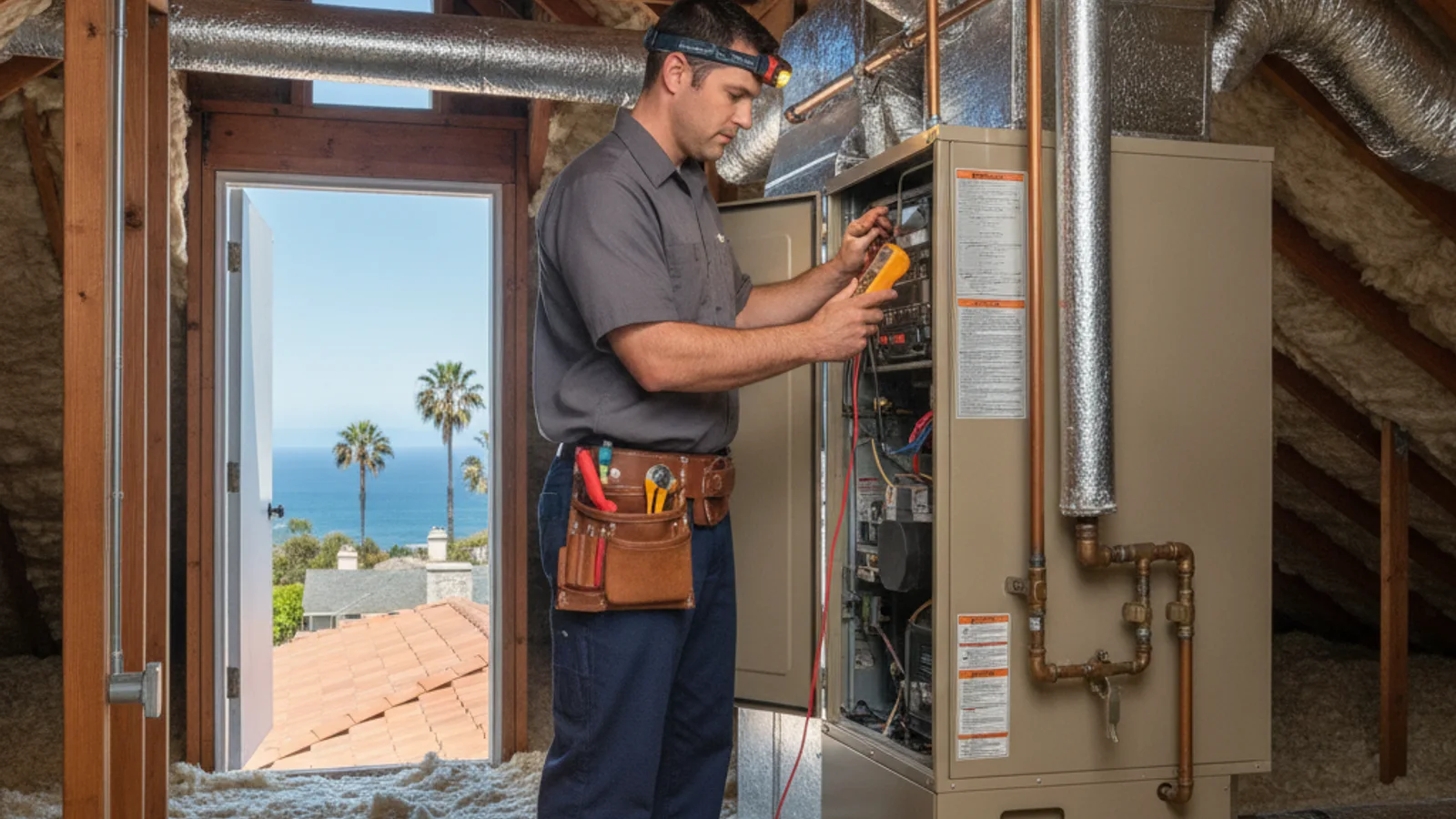
Del Mar furnace labor is often access, not the part
Write where the furnace sits: crawl, closet, or garage. A failed ignitor in a tight crawl is a different job than the same part in a garage. Coastal Del Mar homes often hide equipment in low crawl spaces with limited combustion air. The matched contractor prices access first.
Checklist
- Photograph the access hatch size.
- Note any HOA rules on exterior vents.
- If you smell gas, leave.
- See furnace repair in Encinitas for idle-coastal contrast.
- Use Del Mar HVAC.
Related: Furnace repair and heating repair in Carlsbad.
Where the furnace sits changes everything about the job
Walk through the housing here and you’ll find four common furnace locations, each with its own repair economics.
Attic-mounted horizontal furnaces are the most common in the hillside homes above Camino del Mar and up through Del Mar Heights. The unit lies on its side on a platform, reached by a pull-down ladder or a hatch in a closet ceiling. Every part comes up that ladder, and every panel has to be pulled with the tech lying flat. A blower motor swap that takes an hour in a garage takes considerably longer up there.
Closet units in the older beach-block cottages near 15th Street and Stratford Court are the tightest. Some were installed before the surrounding walls were finished, which means the cabinet cannot be removed without cutting drywall. When those units reach the end of their life, the replacement is frequently a different form factor entirely, because nothing that size is still manufactured.
Crawl space units under the terrace homes on the bluff side are the third group. They’re accessible, barely, and they sit in the dampest air in the house.
Garage units are the easy case, and they’re mostly in the newer construction on the Carmel Valley side of the city.
Ask any contractor to tell you, in the quote, how long they expect to spend on access alone. A vague quote on an attic unit is where surprise charges live.
The parts that fail first in an attic or a crawl space
Location doesn’t just change labor. It changes what breaks.
Attic furnaces run hotter in summer than anything in a garage. A Del Mar attic bakes through August even with the marine layer holding the outside air down, and control boards, relays, and capacitors age faster in that trapped heat. The furnace isn’t running, so nobody notices, and then it won’t start in December. Heat-aged electronics are a common attic-furnace failure commonly reported.
Condensate is the attic’s other problem. High-efficiency furnaces produce acidic condensate that has to drain, and an attic install needs a primary drain plus a secondary pan with a float switch. When the primary line clogs, the float switch cuts the furnace off. Homeowners get no heat and no obvious reason. It’s a genuinely good outcome, since the alternative is water through a bedroom ceiling.
Crawl space and closet units fail differently. Damp air rusts the burner assembly and the flue collar. Return ducts pull in crawl space air through leaky joints, which brings moisture and soil odor into the house and drops delivered temperature. If the air out of your registers feels lukewarm rather than hot, that’s worth reading about in our piece on a furnace blowing cold air.
What ocean air does to a flue
Del Mar sits directly on the water, and the whole city is inside the salt aerosol band. Nothing here is more than a short distance from the beach.
The vent system takes the worst of it. Type B vent pipe is galvanized steel with an aluminum inner liner, and where sections join above the roofline, the coating breaks down under years of salt-laden fog. Rust at a roof jack or a joint means combustion gas can leak into the attic instead of leaving the building. On a furnace call, the vent from the cabinet to the roof termination should be inspected end to end, not just at the appliance.
Induced-draft furnaces make this a little less forgiving than people assume. The inducer creates positive pressure in parts of the vent run, so a hole doesn’t simply let air in. It lets exhaust out.
Heat exchangers matter here too. Salt doesn’t usually cause the crack, but coastal humidity accelerates the corrosion that widens one. Any furnace in Del Mar past roughly fifteen years should get a proper exchanger inspection during a repair visit, with a camera or a mirror and a light, not a glance. Nearby furnace repair in Solana Beach runs into the same corrosion clock, a mile up the coast.
Furnaces in houses that sit empty half the year
A real share of Del Mar’s housing is second homes, seasonal rentals, and places occupied only part of the year. That changes the failure pattern in ways worth naming.
An unoccupied house has nobody to notice the early warnings. A furnace that has been short cycling, or a condensate pan that’s been filling slowly, gets discovered only when someone arrives for the holidays and turns the heat on. By then a small fault has had months to become a bigger one.
Long vacancies also dry out condensate traps and P-traps, which lets sewer or crawl space gas into the space, and they give rodents an undisturbed run of the attic. Thermostat batteries die. Smart thermostats drop off a WiFi network that got reset by the internet provider and revert to a schedule nobody wants.
The practical fix is simple. Have someone run the heating system for fifteen or twenty minutes once a month during the off season, even in July. It circulates lubricant, keeps the trap wet, and reveals a problem in September rather than the night you arrive with guests. Where a house is rented out seasonally, put that on the property manager’s checklist alongside an annual maintenance visit.
Combustion safety comes before comfort
One rule outranks everything above. If a carbon monoxide alarm sounds, get everyone outside and call 911 from outside the house. Don’t reset the alarm and don’t wait to see if it happens again.
Short of an alarm, the warning signs of a combustion problem are a persistent headache or nausea that improves when you leave the house, soot marks around the furnace cabinet, a yellow rather than blue flame, and heavy condensation on nearby windows when the system runs. Any one of them means the furnace goes off at the switch until a technician has looked at it.
Carbon monoxide alarms are required in California homes with a fuel-burning appliance, and the exact current requirement for your property is worth confirming with the City of Del Mar building department rather than taken from a blog. What isn’t in dispute is the practical standard: one alarm on every sleeping level, plus one near the furnace itself. Del Mar’s attic and closet installations put the appliance above or beside bedrooms more often than a garage install would, which is precisely the layout where an alarm earns its keep.
Alarms also expire. There’s a manufacture or replacement date printed on the back of the unit, and the sensor degrades on a fixed clock whether or not it has ever been triggered. An alarm past its date is decoration. Check the ones in a house you’ve just bought, because they’re rarely newer than the sale.
When you’re comparing contractors for furnace repair in Del Mar, run the license through the CSLB license check first. Every HVAC pro in the network is licensed and insured, and the lookup confirms status, bond, and workers’ comp for anyone you’re considering.
When to call us
Attic and crawl space furnaces, vent corrosion, and any suspected combustion problem are licensed-technician work, and in Del Mar that describes most of what goes wrong. Handle the filter and the thermostat batteries yourself, then stop. Call us at (442) 777-6440 and we will match you with a licensed local pro.