Three different heating systems are common in Carlsbad, and which one you own decides almost everything about the repair: a wall furnace in the older Village blocks, a central gas furnace, or a heat pump in the newer master-plan tracts. Naming the system first saves you a wasted service call.
That sounds obvious. In practice, plenty of homeowners call for a furnace problem and turn out to own a heat pump running in heating mode, which fails for completely different reasons.
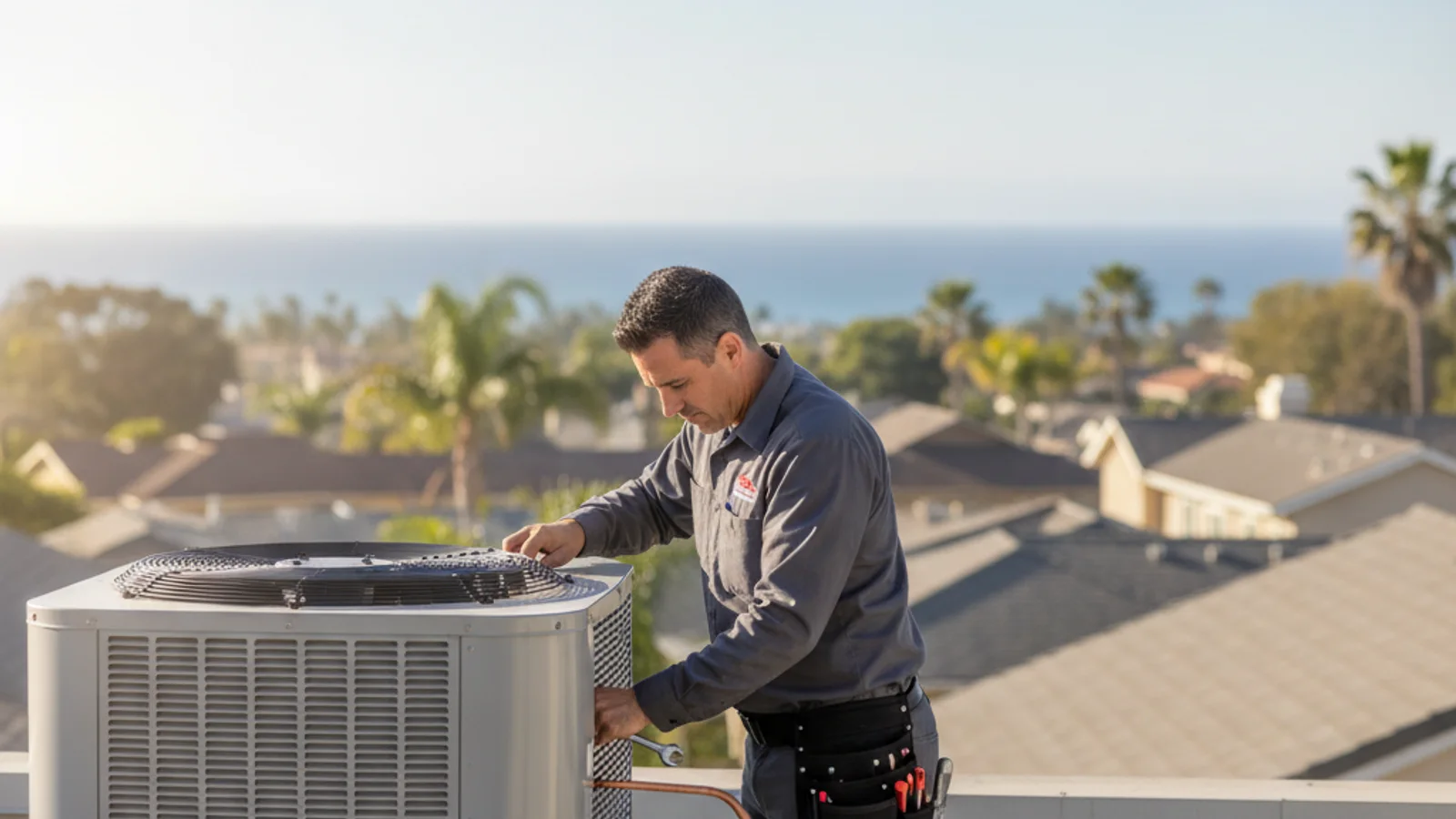
Carlsbad heating repair: name the system and the city permit
Say whether you have a furnace, heat pump, or wall heater. Carlsbad is its own permitting city. City of San Diego mechanical rules do not apply. Coastal heating runtime is short. Salt still corrodes vent terminations and outdoor heat-pump coils.
Checklist
- Photograph the appliance type.
- Ask the contractor to confirm City of Carlsbad permit needs before replacement.
- See furnace maintenance Encinitas.
- Use Carlsbad HVAC.
- Verify C-20 on CSLB.
Related: Furnace repair and heat pump service.
Start by naming the system you have
Walk to the thermostat. If it has a setting labeled emergency heat or auxiliary heat, you almost certainly have a heat pump. If the only options are heat, cool, and off, you probably have separate heating and cooling equipment.
Next, find the heater itself. A metal grille set into a hallway or living room wall, with no ductwork behind it, is a wall furnace. That is common in the smaller pre-1970 homes around the Village core near Grand Avenue and State Street, and in the older Terramar and Tamarack blocks. A cabinet in a closet, the garage, or the attic, connected to ducts, is a central furnace or an air handler.
If there is an outdoor unit and it runs when you call for heat, that unit is a heat pump. An air conditioner never runs in heating mode. This one check settles the question faster than anything else.
Write down the brand and the model number off the data plate before you call anyone. It takes thirty seconds and it changes the conversation, because the pro can look up the parts and the common failure modes for that exact unit before showing up. Also note the age if you know it, since Carlsbad has a lot of equipment installed in the 1990s master-plan build-out that is now long in place.
Wall furnaces in the older Village and beach blocks
Wall furnaces are a different animal from central heat. They have no ductwork, no blower in many cases, and they heat by convection out of one opening. When one stops working, the usual suspects are the pilot assembly, the thermocouple, and the gas valve.
A pilot that lights and then dies within a minute usually points at a failing thermocouple. That is a small part and a routine repair on a serviceable unit. A pilot that will not light at all can be a blocked orifice, a gas supply problem, or a safety device that has already tripped for a real reason.
The part that matters most in these homes is age. Many Carlsbad wall furnaces are decades old, and parts availability gets thin. A licensed pro should tell you plainly whether the exact replacement part still exists for your model. If it does not, the honest answer is replacement, not a patch.
Do not run a wall furnace that smells of gas, produces soot around the grille, or has a yellow lazy flame instead of a steady blue one. Those are combustion symptoms. Shut it off, leave the gas alone, and if you smell gas strongly or feel unwell, get out and call 911 or SDG&E from outside. Carbon monoxide is the one heating risk that does not give you time to research it.
Central gas furnaces after eight quiet months
Carlsbad’s heating season is short. A central furnace here can sit untouched from March to November, and most of the calls that come in on the first cold night are the direct result of that idle stretch.
The classic pattern is a furnace that starts, runs for a few minutes, and shuts down before the house warms up. That is often a flame sensor coated in residue after months of disuse, or a pressure switch that cannot prove draft because something has settled in the vent path. Both are ordinary repairs. Neither is a reason to replace a working furnace.
A furnace that hums but never ignites is a different branch: the igniter, the gas valve, or a control board fault. A furnace that blows air that never gets warm points at the ignition side too, or at a thermostat wired or set incorrectly. Our guide to why a furnace won’t ignite walks the sequence in more detail.
Long idle periods also mean nobody has noticed the filter in eight months. A restricted filter makes a furnace overheat and trip its high-limit switch, which reads to the homeowner as short cycling. Pull the filter and look at it before you assume the worst. If daylight will not pass through it, that is your first suspect.
Rodents and nesting debris turn up in garage and attic furnaces along the eastern Carlsbad hills more often than people expect. A pro should inspect the burner compartment, not just swap a part.
Heat pumps in Bressi Ranch, La Costa and Robertson Ranch
Newer Carlsbad construction leans heavily on heat pumps, and a heat pump in heating mode has failure modes a furnace simply does not have. The reversing valve, the defrost control, and the outdoor coil all matter on the heating side.
The most common complaint is lukewarm air. Heat pumps deliver a lower supply temperature than a gas furnace by design, so air that feels cool against your hand can still be correct. The real test is whether the house reaches and holds the set temperature. If it does not, something is wrong.
If the system is running on auxiliary heat constantly, your electric bill will tell on it before the thermostat does. That usually means the heat pump itself is not producing, so the backup strip heat is carrying the whole load. It is one of the more expensive faults to ignore, because the equipment keeps working while the meter spins.
A heat pump that heats sometimes and blows cold other times often has a reversing valve or a control problem. A heat pump that runs constantly with ice on the outdoor coil has a defrost issue. Neither is a homeowner repair, because both involve the refrigerant circuit, and refrigerant work requires EPA certification. See heat pump not heating for the full symptom list.
Salt air reaches the heating side too
West of I-5, salt exposure is a real factor in heating repairs, not only cooling ones. On a heat pump, the same outdoor coil and cabinet that cool the house in August carry the heating load in January, and corroded fins, rusted fasteners, and pitted contactor points all show up as heating faults.
Even on a gas furnace, the vent termination, the condensate path on a high-efficiency unit, and any exterior metal are exposed to the same marine air. Coastal furnace behavior is worth reading on its own if you live near the water, and we cover it in furnace repair in coastal Carlsbad.
When a pro comes out for a heating problem on a coastal property, ask them to photograph the outdoor unit’s cabinet base and the electrical connections. Corrosion is progressive, and a dated photo gives you a baseline for next season.
Carlsbad is its own permitting jurisdiction, so the City of San Diego’s mechanical permit rules do not apply here. Ask the contractor to confirm what the City of Carlsbad requires before any replacement work begins. For the license side, California requires a C-20 contractor for warm-air heating work above the Business and Professions Code section 7048 threshold of $1,000 or where a permit is required, and you can check any license free at the CSLB license lookup. Every HVAC pro in the network is licensed and insured.
What to check yourself, and where to stop
Four checks are safe and worth doing. Confirm the thermostat is set to heat and the set point is above room temperature. Replace the batteries if it has them. Check that the breaker for the furnace or air handler has not tripped, and that the service switch near the equipment is on. Look at the filter.
Stop there. Do not open a sealed burner compartment, do not bypass a safety switch, and do not attempt anything involving gas piping or refrigerant. Those are the boundaries that keep a small repair from becoming a hazard.
If you want a second reference point on maintenance rather than repair, the heat pump service page and the furnace repair page explain the scope of each. For neighborhood context on equipment ages and housing stock, the Carlsbad HVAC service page covers the city block by block.
When to call us
Any heating fault involving gas, combustion smells, refrigerant, or a system that trips its own safeties needs a licensed pro, not a parts swap. Call us at (442) 777-6440 and we will match you with a licensed local pro.