If you smell gas, leave the house and call 911 or SDG&E from outside. For everything else, switch the system off at the thermostat first, then work down a short checklist before you call anyone.
Vista sits inland of the marine layer, and a July afternoon in 92083 does not forgive a dead compressor the way an afternoon in Carlsbad does. That pressure pushes people into two mistakes: resetting a tripped breaker over and over, or waiting three days on a problem that was going to get worse.
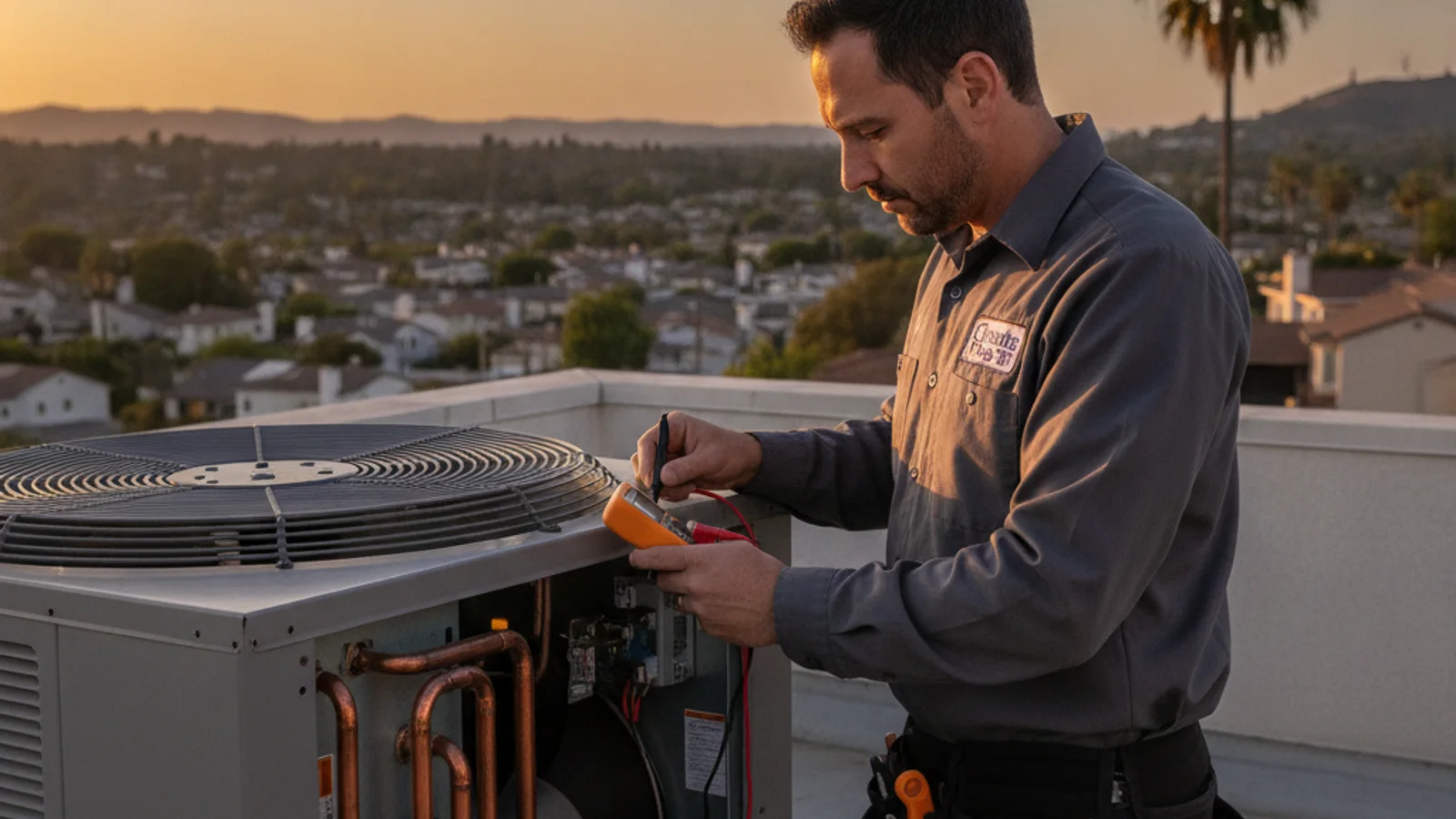
Vista emergency call: gas first, then power off
If you smell gas, leave. For every other failure, set the thermostat to Off before you inspect. Then check breaker, filter, and outdoor disconnect. Vista HOA and gated streets slow access. Have codes ready so the matched contractor is not waiting at the gate while the house overheats.
Checklist
- Write the gate and alarm instructions.
- Confirm no burning smell at the disconnect.
- Note indoor temperature for vulnerable occupants.
- See emergency HVAC service in Carlsbad for coastal contrast.
- Use Vista HVAC.
Related: Emergency HVAC and how to reset AC.
Stop the system before you troubleshoot it
The first move is off, not on. Set the thermostat to Off, not just to a higher temperature. That stops the indoor blower and the outdoor unit from calling for each other while you’re looking at them.
There are three shutoffs in most Vista homes, and it’s worth knowing where all three are before you need them.
The thermostat is the soft one. It stops the call for heating or cooling but leaves everything energized.
The breakers are the real ones. A central system usually has separate breakers for the condenser and the furnace or air handler. Label them once and you’ll never hunt again.
The outdoor disconnect is the small grey box on the wall within sight of the condenser. It pulls out by hand and kills power to that unit alone. If the outdoor unit is smoking, buzzing loudly, or sitting in standing water, pull that disconnect before you do anything else.
On a gas furnace there’s a fourth: the gas shutoff valve on the pipe feeding the unit, usually a quarter-turn lever. Turning it perpendicular to the pipe closes it. Do not relight anything after you close it. Relighting a pilot on a furnace that shut itself down for a reason is how a small problem becomes a dangerous one.
A breaker that trips once can be a fluke. A breaker that trips twice is telling you something is drawing current it shouldn’t. Leave it off after the second trip.
What actually counts as an emergency
Not everything that feels urgent at 4pm is urgent. These are the situations where the system stays off and the call happens now.
Any gas odor. Rotten egg or sulfur near the furnace, water heater, or anywhere in the house. Leave, then call 911 or SDG&E from outside. Don’t flip switches, don’t use the garage door opener, don’t look for the leak yourself.
Burning or electrical smell. Hot plastic, ozone, or scorched insulation coming from the vents or the air handler closet. Kill the breaker.
Repeated breaker trips. Especially on the condenser circuit. A shorted compressor winding or a failing contactor can pull enough current to cook wiring.
Water where water shouldn’t be. A stained ceiling under an attic air handler, or water running down the furnace closet wall, means the condensate drain has backed up. In Vista’s older tract homes with attic air handlers, this one quietly destroys drywall.
No cooling with a heat-vulnerable person in the house. Infants, older adults, anyone on medication that affects heat tolerance, or anyone recovering from illness. That changes the calculation regardless of what the thermostat reads.
Ice on the refrigerant lines or the indoor coil. Shut the system off and let it thaw. Running a frozen system can slug liquid refrigerant back into the compressor.
Everything on that list is a stop-and-call, and it’s what emergency HVAC service exists for. The rest can usually be triaged.
The five-minute check before you pick up the phone
Run these in order. Two of them are free fixes, and the rest give the pro something useful.
- Filter. Pull it. If light doesn’t pass through it, that alone can freeze a coil or trip a limit switch on a furnace. Vista’s inland dust and the summer run hours load filters faster than coastal homes.
- Thermostat batteries and settings. A blank or dim screen is often batteries. Confirm the mode is right and the fan is on Auto, not On.
- Both breakers. Look for one sitting between On and Off. Reset it once and once only.
- The outdoor unit. Check for cottonwood fluff, grass clippings, or a bougainvillea grown into the coil. Airflow starved outside looks exactly like a refrigerant problem from inside.
- The condensate float switch. Many attic air handlers have a small switch in the drain pan that cuts the system when water backs up. A full pan and a dead system is a clogged drain, not a dead compressor.
If the outdoor fan spins but the house stays warm, or the indoor blower runs while the outdoor unit sits silent, note that. It narrows the diagnosis before anyone opens a panel. Our AC not cooling checklist walks the same symptoms in more detail.
What to say when you call
The more specific you are, the shorter the diagnostic. Have this ready.
The age and type of the system. Gas furnace with a separate AC, a heat pump, or a package unit. The nameplate on the outdoor unit has a model and serial number, and a photo of it is worth five minutes of description.
What changed and when. Did it stop mid-cycle, or fail to start this morning? Was there a sound first? A grinding bearing, a hard electrical hum, or a single loud click all point different directions.
Breaker behavior. Held, tripped once, or tripping every time.
What you already checked. Filter, drain pan, outdoor coil. This keeps you from paying for someone to check the filter.
Ask two questions of your own before you agree to anything: what the diagnostic fee is, and whether it applies toward the repair if you go ahead. Every company sets its own policy on that, and there’s no single answer across San Diego County. Also ask whether after-hours work carries a different rate, as a dollar figure, not a description.
Before the visit, you can confirm any contractor’s license status and classification through the CSLB license check. HVAC work in California falls under the C-20 classification.
Keeping a Vista house livable in the meantime
Inland North County holds heat into the evening in a way the coast doesn’t, so the goal is to stop gain during the day and dump it after sundown.
Close blinds on the west and south glass by late morning. In the Shadowridge and South Vista tracts, the two-story homes with west-facing bedrooms are the ones that stay uncomfortable longest, because the second floor keeps the heat the ground floor sheds.
Shut doors to rooms nobody is using and move everyone to one lower-floor room. A single portable unit or a couple of box fans cooling one room beats trying to hold the whole house.
Run the bathroom and kitchen exhaust fans in the evening once the outside air drops below the inside air. Open windows on opposite sides of the house to get real cross-flow instead of one cracked window.
Skip the oven. Keep the ceiling fans pointed at people, since a fan cools skin and does nothing to the room. And if the system is off because of a tripped breaker, leave it off. The compressor is the expensive part, and repeated restart attempts are what turns a repairable fault into a replacement decision. If you’re already weighing that, our AC replacement vs repair guide lays out the math, and the Vista service area page covers what’s available locally.
When to call us
Anything involving gas, repeated breaker trips, refrigerant, or a burning smell needs a licensed pro and needs the system left off until one looks at it. The same goes for a no-cool call in an inland summer when someone in the house doesn’t handle heat well. Call us at (442) 777-6440 and we will match you with a licensed local pro.