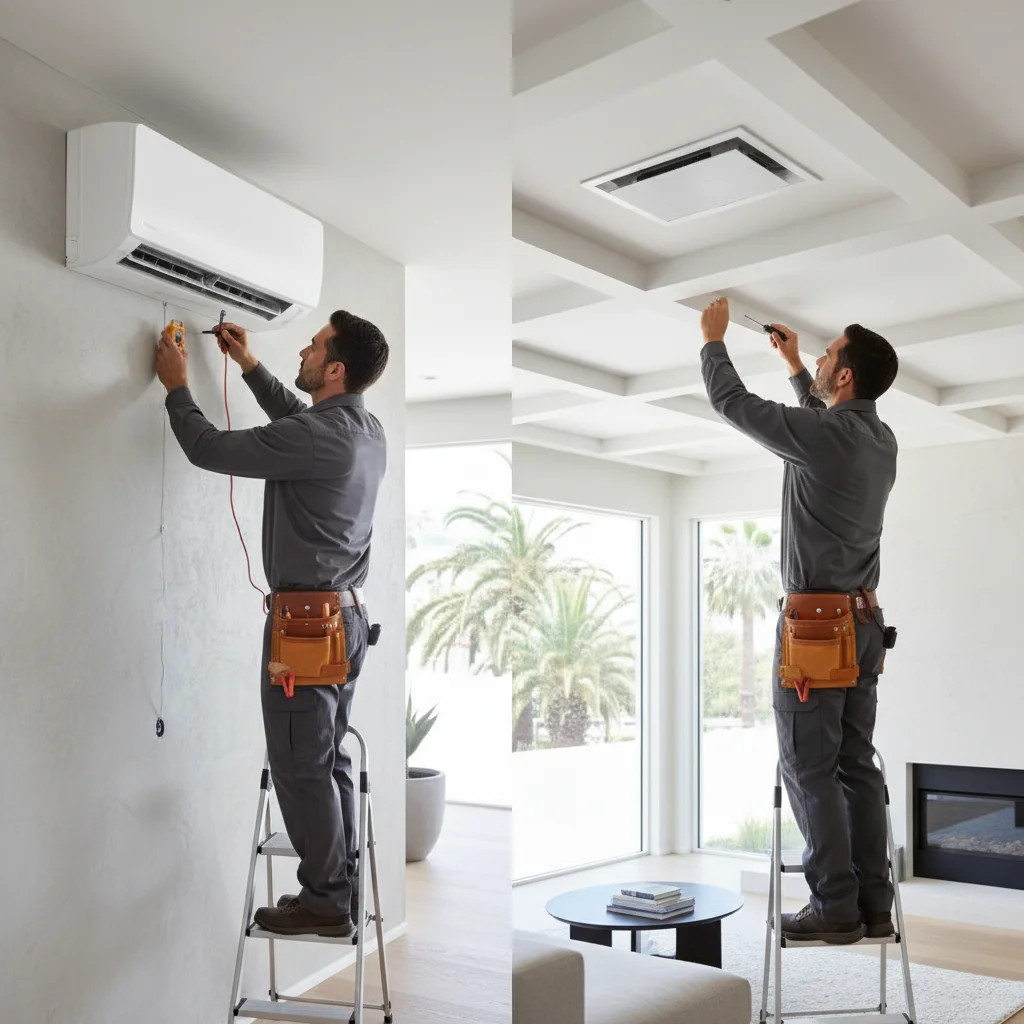
A junior ADU, or JADU, is carved out of the house you already own. That one fact shapes every heating and cooling choice. The real question is whether the JADU borrows the main house’s system or gets its own mini-split head. Climate Pros SD matches you with licensed, independent HVAC professionals who size, permit, and install the system. We don’t publish installed prices.
This guide covers the JADU-specific decision. For the general ADU picture, read our mini-split guide for ADUs.
What counts as a JADU, and why does it matter for HVAC?
California’s housing department defines a JADU as a unit of no more than 500 square feet of interior livable space. It must sit entirely within a single-family residence. It can have its own bathroom or share one with the main house. An attached garage counts as part of the residence for JADU purposes.
The City of San Diego sets its own range of 150 to 500 square feet. It also requires a separate exterior entry.
Here’s why that matters. A JADU has no new building around it. The house’s ducts, panel, and walls are right there. That makes tying in look easy. The rules are less friendly than they look.
Can a JADU share the main house’s ducts?
Often it can’t, at least not the way people hope. The California Energy Commission took up a close cousin of this question. Someone asked whether existing furnace ducts with a central return could be extended to heat a 600-square-foot attached ADU conversion. The answer was no. The Commission said the California Mechanical Code does not allow return air from an existing forced-air system to serve that way. It concluded the existing ducted furnace may not serve both the existing home and the proposed ADU.
That answer was about an ADU, not a JADU. A JADU is still its own dwelling unit, so ask your pro and the plans examiner whether the same limit applies to your layout. Don’t assume the answer.
If part of the duct system is extended, the Energy Code adds work. For additions, any length of duct extended from an existing system means the old and new ducts must both meet the duct requirements in Section 150.2(b)1D. Leakage can be no more than 10 percent of air handler airflow, or 7 percent to outside.
When does a JADU’s own mini-split head make more sense?
Here’s the case for giving the JADU its own head.
- Control. The tenant sets their own temperature. Nobody negotiates over one thermostat.
- Load. The main system was sized for the main house. A second dwelling is a new load. A pro should run a Manual J load calculation on both.
- Heat and cooling in one. A heat pump head handles winter mornings and summer afternoons.
- Simple failures. If one system quits, only one dwelling goes cold.
The Energy Commission’s ADU FAQ says mini-splits and multi-splits can be used to comply with the Energy Code. They must still meet the mandatory equipment requirements in Section 110.2. The condenser needs a legal spot too, so see the condenser placement rules.
If the main house already has a ducted system in good shape, tying in may still be worth pricing. Get both options in writing from the pro, and let the load calculation and the plans examiner break the tie.
What changes for permits?
The City of San Diego says a Building Permit is required to create a JADU, with no exemptions. The minimum submittals include Title 24 energy calculations. Your HVAC choice goes into those plans, so settle it early.
Other City requirements affect the plan set:
- The owner signs a Junior Unit Agreement before the Building Permit is issued.
- If the main house has fire sprinklers, the JADU must get them. State law says sprinklers aren’t required in a JADU when the main house doesn’t need them.
- A JADU with its own kitchen and bathroom may need a fire-rated wall where it shares a wall with the house.
Whether a separate mechanical permit rides along is a call for the pro and the City. The mechanical permit page doesn’t name JADUs, so ask.
How does Title 24 treat a JADU?
The Energy Commission sorts the work by what you start with.
| JADU comes from | Energy Code category | What to ask the pro |
|---|---|---|
| Existing conditioned rooms | Alteration (Section 150.2(b)) | Which HVAC parts are covered by the alteration rules? |
| Attached garage or other unconditioned space | Addition (Section 150.2(a)) | Which equipment and duct requirements apply to the added space? |
The Commission also says JADUs may be subject to Energy Code requirements depending on the scope of work. Ventilation rules for a JADU may come through the California Mechanical Code. A newly installed mini-split is one of its examples of covered alteration work. Depending on the scope, mini-splits can require field verification and diagnostic testing by an Energy Code Compliance (ECC) rater.
Ask who files which paperwork. That’s a contractor question, not yours.
Who lives in a JADU, and how should that shape comfort?
State law says a JADU that shares a bathroom with the main house requires the owner to live on the property. JADUs can’t be short-term rentals. Any rental must run longer than 30 days.
So plan for a long-term occupant, not a weekend guest. That person needs winter heat as well as summer cooling. A head they can control is a plus. Quiet matters too, because the JADU shares walls with your living space. Ask about indoor head noise ratings and where the head will mount.
What should you ask the pro before you sign?
- Can the existing ducts legally serve the JADU, or is a separate system required?
- Did you run a load calculation for the JADU itself?
- Which Energy Code category applies, and will an ECC rater verify the work?
- Who handles the permit paperwork and inspections?
- Where will the condenser go, and where does the condensate drain?
- Does the existing panel have room for the new load?
For question six, our 100-amp panel guide explains how that check works.
FAQs
How big can a JADU be in San Diego?
State law caps a JADU at 500 square feet of interior livable space. The City’s range is 150 to 500 square feet.
Does a JADU need fire sprinklers?
Only if the main house is required to have them. City rules may still call for a fire-rated shared wall.
Do I have to live on the property?
If the JADU shares a bathroom with the main house, yes. Without shared sanitation, owner occupancy isn’t required by state law.
Will a mini-split need an Energy Code inspection?
Depending on scope, it may need verification and testing by an ECC rater. Your pro will know which applies.
Planning a JADU? Call (442) 777-6440. We’ll match you with a licensed local pro who can size and permit the system.
Related: mini-split installation, garage conversion HVAC.